An online business is a company that sells products, services or access over the internet and earns the difference between what customers pay and what it costs to deliver. If you are asking how does an online business work, the short version is five steps: people find you, see your offer, pay, get what they bought and, if it goes well, come back.
The same flow runs behind a Shopify store, a blog with affiliate links, a course, a freelance service and a software product. What changes is what you sell, how you charge and what it costs to run.
This guide walks through each part of the flow, follows one order from the first click to profit, compares six business models with costs and pros and cons, and covers customers, margins, legal basics and the warning signs of scams. Figures are rough and come mostly from vendor and advisor pages, so treat them as ranges.
How does an online business work? The short answer
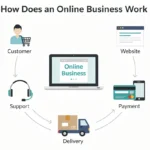
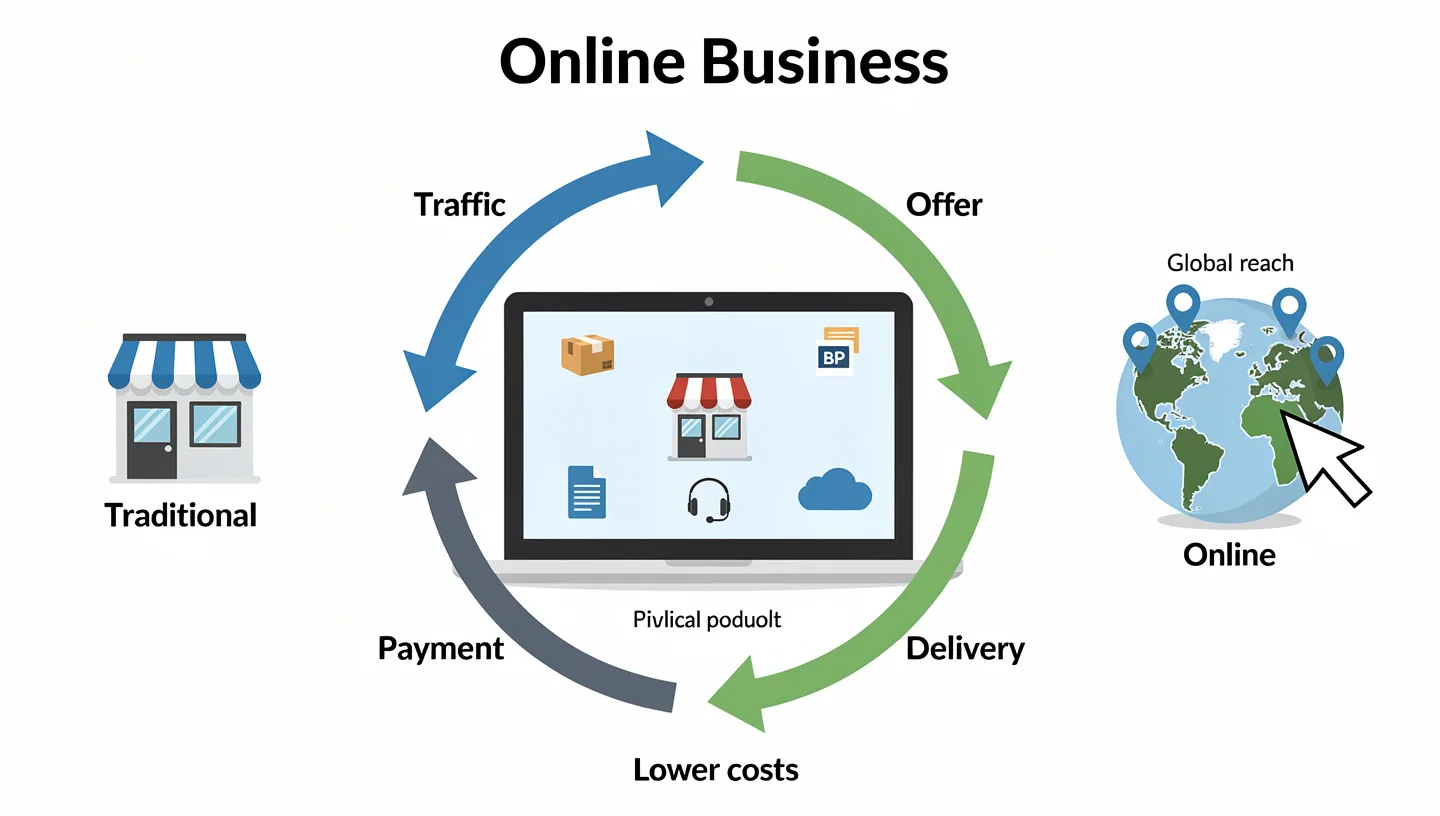
Every online business follows the same basic path. Here it is in five steps:
- Traffic: people find you through search, social media, ads, email or a recommendation.
- Offer: they land on a website, store or marketplace page that explains what you sell and what it costs.
- Payment: they pay online by card, bank transfer or digital wallet, and the money moves through a secure payment system.
- Delivery: you ship a product, send a file or give access, or you do the work if you sell a service.
- Support and repeat sales: you answer questions, handle returns and give people a reason to buy again.
That is how an online business works at its simplest, and the rest of this guide fills in each step. Online business owners earn money when what customers pay is higher than the cost of the product, the delivery, the payment fees, the ads and the tools that keep everything running.
Many steps in an online business can be automated, so one person or a small team can serve customers around the clock without opening a shop. That is the biggest difference from a traditional business.
What is an online business?
Online business definition
An online business is any business that earns most of its revenue through the internet. It can sell physical goods, digital files, services or access to software, and it can run from a website, a marketplace or a social media page. The key point is that the internet is the main channel for finding customers and getting paid, not a side channel. You may also see it called e-business, digital business or internet business. Beginners often ask how do online businesses work without a physical shop, and the answer is the same loop of traffic, offer, payment and delivery.
Online business vs ecommerce vs e-business
People use these terms as if they meant the same thing, but there is a difference. Ecommerce is the buying and selling of products or services over the internet. E-business is wider and also covers internal work such as hiring, production and record keeping done online. In this guide, ecommerce means the selling side and online business means the whole operation.
Online business vs traditional business
The table shows where the two differ most.
| Factor | Online business | Traditional business |
|---|---|---|
| Reach | Customers anywhere, open all hours | Local customers, fixed hours |
| Startup costs | Usually lower, no shop rent | Rent, utilities and stock |
| Delivery | Shipping or digital delivery | Customer takes the product home |
| Growth | Add products or ads without new space | Needs more space and staff |
| Main challenge | Standing out and earning trust | Foot traffic and location |
Can a traditional business go online?
A shop or a service firm can add online sales without closing the door. Four steps cover it:
- Pick the products or services that suit online buyers.
- Choose a platform, such as a store builder or a marketplace.
- Set up payments, shipping and returns.
- Tell existing customers and put the web address wherever they already look.
The shop stays a physical business, and the online part becomes one more sales channel.
Benefits and drawbacks of an online business
An online business has real advantages and real limits. Shopify cites a Forrester forecast that expects online sales to reach about 29% of retail by 2030, so the shift is not slowing, but growth does not mean easy money.
Benefits
- Low overhead: no shop rent, fewer staff, and many tools are free or cheap to start.
- Global reach: customers in any country and no closing time. Sellers in fast-growing markets, like those in our list of online business ideas in Kenya, can reach buyers abroad.
- Flexible work: you can run it from home or while traveling.
- Easy to scale: add products, ads or automation without moving to a bigger space.
- Data: every visit and sale is tracked, so you can see what works.
Drawbacks
- Competition: it is easy for others to start too, so standing out takes work.
- Trust: shoppers cannot touch the product or meet you, so reviews and clear policies matter.
- Ad costs: paid traffic gets more expensive as more sellers compete.
- Logistics: shipping, returns and delays are the owner’s problem.
- Platform dependence: if a marketplace or ad account changes its rules, income can drop overnight.
The five parts of an online business
Each step in the short answer needs something behind it. To see how an online business works in practice, look at the five parts it actually runs on.
The offer: what you sell
Everything starts with an offer that solves a problem for a specific group of people. You can sell a physical product, a digital file such as a template or an ebook, a service such as design or tutoring, or access to something like a membership or software. Beginners do better with a clear problem and a small offer than with a long product list. Price comes next: add the product cost, shipping, payment fees and support time, then leave room for profit.
The storefront: where customers buy
Customers need a place to buy. It can be your own website or online store, a marketplace such as Etsy or Amazon, or a social media page. A website gives you the most control. For that you need a domain name, which is your web address, and web hosting, the service that keeps your site online. A .com domain from Namecheap costs about $7 for the first year, and shared hosting from Hostinger starts near $3 a month on a long plan, but both prices rise at renewal. Store builders like Shopify bundle the website, checkout and hosting into one monthly fee.
Traffic: how customers find you
Nobody buys from a store they cannot find. Traffic is the flow of visitors, and it comes from search engines, social media, paid ads, email and referrals. Organic traffic from search is free but slow. Paid ads are fast but cost money on every click. Most new businesses use a mix, then keep the channels that bring buyers and not only visitors.
Payments: how you get paid
When a customer pays, several systems work together in a few seconds. The customer enters card details at checkout. A payment gateway encrypts them and passes them along. A payment processor asks the card issuer’s bank to approve the charge. If it is approved, the money goes to your merchant account, and you get a notification. Stripe explains the steps in its guide to how online payments work. Most store platforms handle all of this for you, but you pay a fee on each sale.
Customers can pay by card, bank transfer or a digital wallet such as Apple Pay or PayPal, and offering the method your buyers prefer lifts sales. Security matters too. Card data is encrypted, and payment providers run fraud checks before approving a charge. Even so, a customer can dispute a charge with their bank, which is called a chargeback, and you may lose the money and pay a fee. Clear product descriptions, fast replies and an easy returns process cut the number of disputes. Funds usually reach your account after a few days, depending on the provider.
Delivery and support: how you keep customers
After the order, the business delivers. A physical order is picked, packed and shipped, either from your own stock or by a partner. In dropshipping, the supplier ships to the customer for you. A digital product is sent by download or email, and a service is done and invoiced. Good support after the sale, including tracking, returns and quick answers, brings customers back and earns the reviews that attract new ones.
One order from click to profit
Numbers make this easier to follow. Here is one sale from a small online store, using round figures. The product sells for $50, and these are examples, not benchmarks.
| Detail | Estimate |
|---|---|
| Selling price | $50.00 |
| Product cost | $18.00 |
| Shipping | $6.00 |
| Payment fee (2.9% + $0.30) | $1.75 |
| Ad cost per sale | $12.00 |
| Left after variable costs | $12.25 |
Now scale it up. With 100 orders in a month, revenue is $5,000 and variable costs are $3,775. Add about $69 in fixed costs, for example a $39 store plan and $30 in tools, and the store keeps about $1,156 before tax, a net margin of about 23%.
Two things follow. First, small changes matter: if the ad cost per sale rises from $12 to $20, profit per order drops from $12.25 to $4.25. Second, profit comes from the gap between the price and all costs, not from sales alone, which is why every cost needs to be tracked.
How do online businesses make money?
So how do online businesses make money? The answer has four parts, and competitors often mix them into one list. Splitting them makes the picture clearer.
Who you sell to
- B2C: a business sells to individual shoppers.
- B2B: a business sells to other businesses, often in bulk and with longer decisions.
- C2C: individuals sell to each other through marketplaces.
- C2B: individuals sell skills or content to companies, as freelancers do.
- D2C: a brand sells straight to customers without a retailer in between.
What you sell
You can sell physical products, digital products, services or access. Physical goods need stock and shipping. Digital products need none of that. Services trade your time for money, and access, such as a membership or a software plan, charges for continued use.
How you earn
A revenue model is the way money comes in. Most online businesses use one of five, and many combine two or more.
- Direct sales: customers pay once for a product or service. It is the most common model.
- Subscriptions: customers pay a recurring fee, which makes income steadier.
- Advertising: a site or channel with an audience earns from ads.
- Affiliate commissions: you earn a share when someone buys through your link.
- Transaction fees: a marketplace or platform takes a cut of each sale.
How orders are fulfilled
- Own stock: you buy or make products and ship them yourself.
- Dropshipping: a supplier ships each order to your customer, so you hold no stock.
- Print on demand: a partner prints your design on an item after the order and ships it.
- Wholesale: you buy in bulk and resell at a higher price.
- White label: you sell a ready-made product under your own brand.
Real examples of online businesses
Well-known companies show how these models work in practice.
| Example | Model | How it earns |
|---|---|---|
| Etsy | Marketplace | Fees on listings and sales |
| Amazon | Online store and marketplace | Direct sales, seller fees and advertising |
| Netflix | Subscription | Monthly membership fees |
| Spotify | Subscription and ads | Premium plans and advertising |
| Udemy | Course marketplace | A share of course sales |
| Canva | Software | Free plan with paid subscriptions |
| Shopify | Platform | Monthly plans and payment fees |
Online business models at a glance
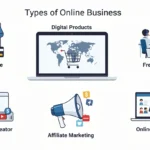
Here are the six models reviewed below, with the ones that use affiliate-friendly tools first.
- Online store on Shopify – physical or digital products sold through your own store
- Blog or affiliate site – content that earns from commissions and ads
- Digital products and courses – made once, sold many times
- Freelancing and services – skills sold to clients
- Subscription or membership – recurring fees for access
- Software or app – a tool sold by subscription
How each online business model works
Each review of an online business model follows the same order: a short description, a table with cost and risk, then pros and cons. Costs come from vendor and advisor pages and are only a guide.
1. Online store on Shopify
An online store sells physical or digital products through your own website. Shopify is a common way to build an ecommerce store, since it covers the storefront, checkout and orders in one account. You can make your own products, buy wholesale or use dropshipping or print on demand, where a partner makes and ships the item.
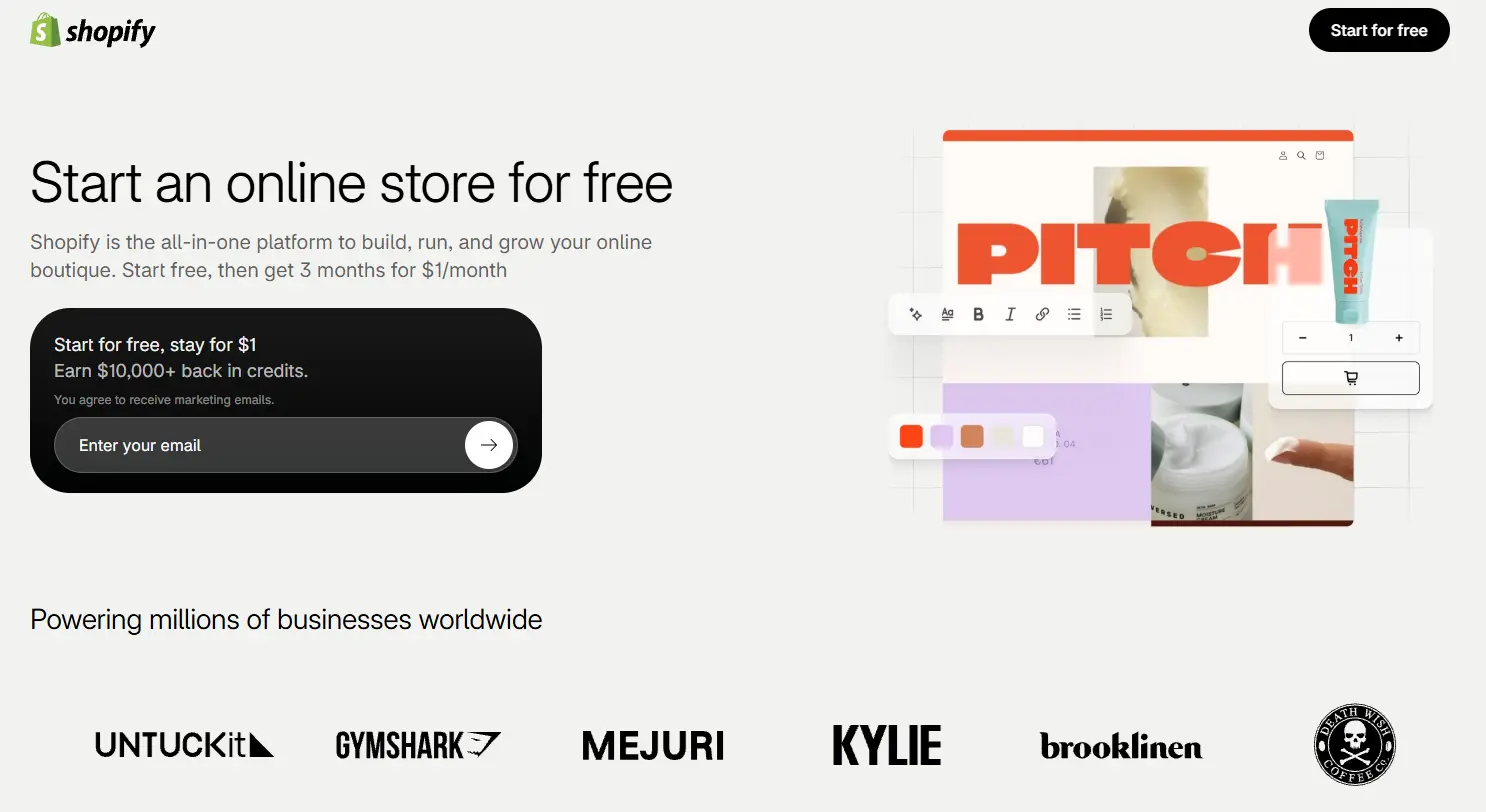
The Basic plan is listed at about $39 a month, with a card fee of about 2.9% plus 30 cents per online sale. The hard part is not building the store. It is getting steady traffic at a cost lower than your profit per order.
| Detail | Estimate |
|---|---|
| Cost to start | Dropshipping about $100 to $500, own stock $2,000 to $10,000+ |
| How you earn | Direct sales |
| Best for | People who want to sell products |
| Main risk | Ad costs eat the margin |
Pros
- Full control of brand and prices
- Many payment and shipping options
- Works with dropshipping or your own stock
- Reports show orders and traffic
Cons
- Ads are needed for steady sales
- Thin margins when suppliers and ads cost a lot
- App fees add up
2. Blog or affiliate site
A blog or niche site earns from affiliate commissions, ads or sponsored posts. You register a domain, for example with Namecheap, host the site on Hostinger or a similar provider, and publish useful content that ranks in search. When a reader buys through your affiliate link, you earn a commission.
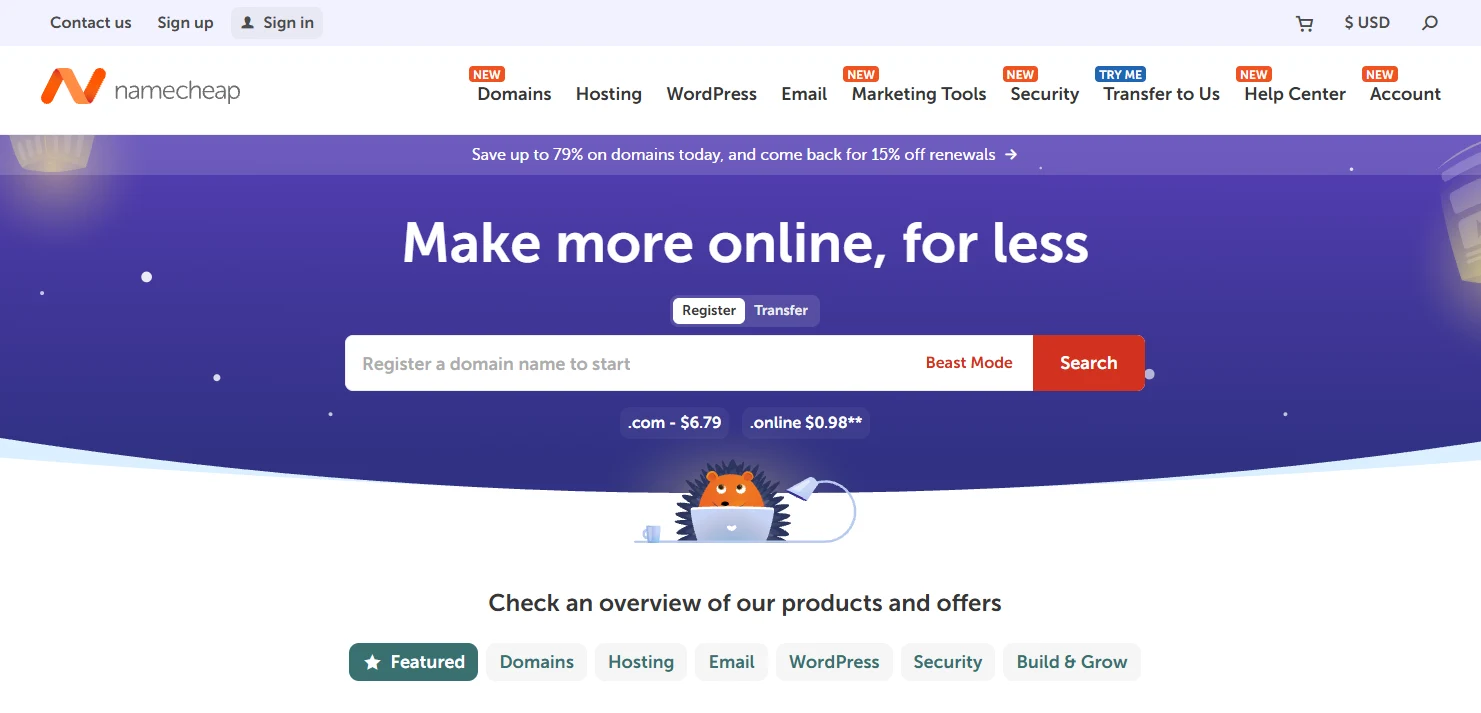
It costs little to start, but it is slow, because search traffic takes months to build. Renewal prices on domain and hosting rise after the first period.
| Detail | Estimate |
|---|---|
| Cost to start | Domain and hosting about $50 to $150 a year |
| How you earn | Affiliate commissions and ads |
| Best for | Writers and people with niche knowledge |
| Main risk | Slow traffic growth |
Pros
- Low start-up cost
- Free search traffic once content ranks
- Works from home
- No stock or shipping
Cons
- Slow to earn
- Needs steady publishing
- Income depends on search rankings
3. Digital products and courses
Ebooks, templates, printables, courses and software add-ons are made once and sold many times. A seller can design them in Canva, then build a landing page, email list and checkout in Systeme.io, which has a free plan with up to 2,000 contacts. Because delivery is a download, there is no shipping and no stock.
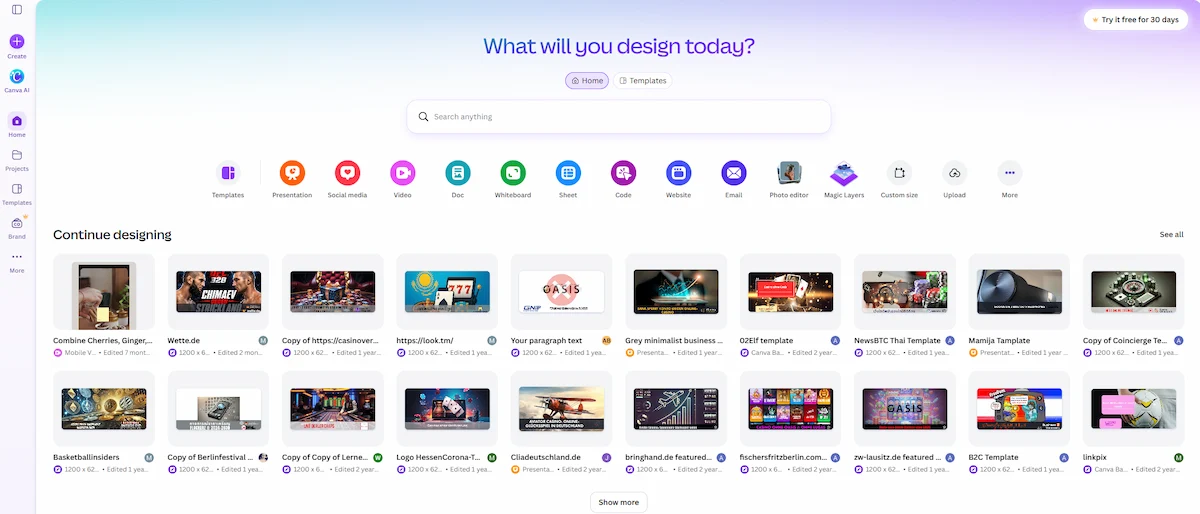
The work is in the first build and in finding buyers. Our guide on how to start an AI business with no money also covers cheap ways to create and sell digital products.
| Detail | Estimate |
|---|---|
| Cost to start | Free plans possible, paid tools from about $17 a month, more for production-heavy courses |
| How you earn | Direct sales |
| Best for | Experts and creators |
| Main risk | Slow start before the first sale |
Pros
- Make once, sell many times
- No shipping or stock
- Free tools to start
- High margins
Cons
- Needs an audience
- Many sellers in popular niches
- Support questions still arrive
4. Freelancing and services
Freelancers and consultants sell their skills: writing, design, coding, bookkeeping, coaching or tutoring.

Clients find them through a website, a marketplace or referrals, pay by invoice or online checkout and get the work by email or video call. It has the lowest start-up cost of any model, but income is tied to your hours until you add packages, retainers or a team.
| Detail | Estimate |
|---|---|
| Cost to start | About $50 to $300, often under $50 a month after |
| How you earn | Fees by hour, project or retainer |
| Best for | People with a skill clients pay for |
| Main risk | Income capped by hours |
Pros
- Fast to start
- Low costs
- Quick feedback from clients
Cons
- Trading time for money
- Client work can be uneven
5. Subscription or membership
Subscription businesses charge a recurring fee for access: a membership site, a newsletter, a box of products, a fitness community or a software tool.
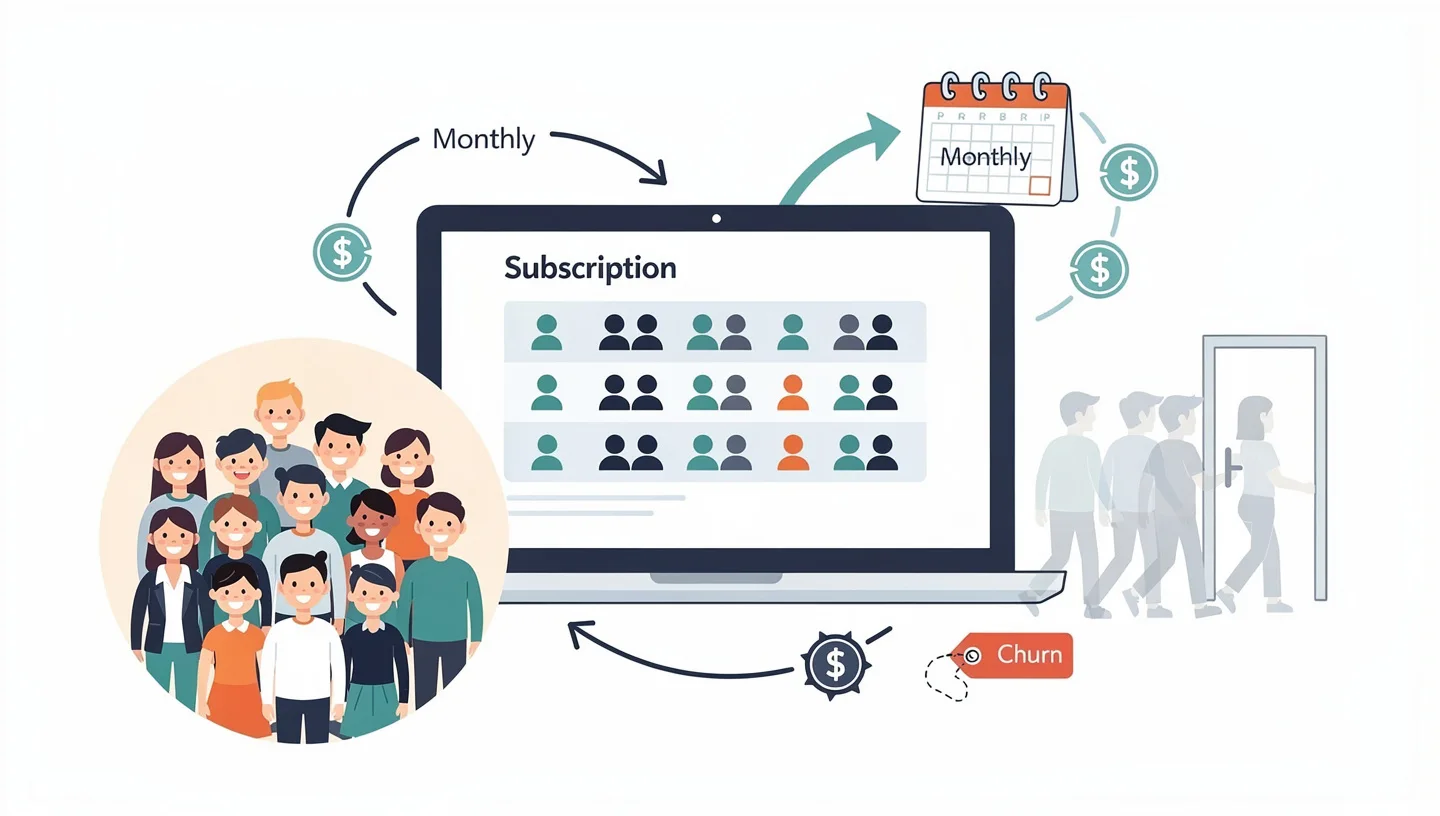
The income repeats every month, which makes it easier to plan, but the business has to give people a reason to stay. Cancellations, called churn, are the number to watch.
| Detail | Estimate |
|---|---|
| Cost to start | Varies: boxes need stock, memberships mostly need content and a platform |
| How you earn | Monthly or yearly fees |
| Best for | Those who can offer ongoing value |
| Main risk | Customers cancel |
Pros
- Predictable income
- Customers stay and spend more over time
- Easier to forecast
Cons
- Needs steady new content or products
- Churn eats growth
6. Software or app
A software or app business sells access to a tool that solves a problem, usually by subscription. It needs the most work and money at the start, since someone has to build and maintain the product, but it can grow without shipping anything.
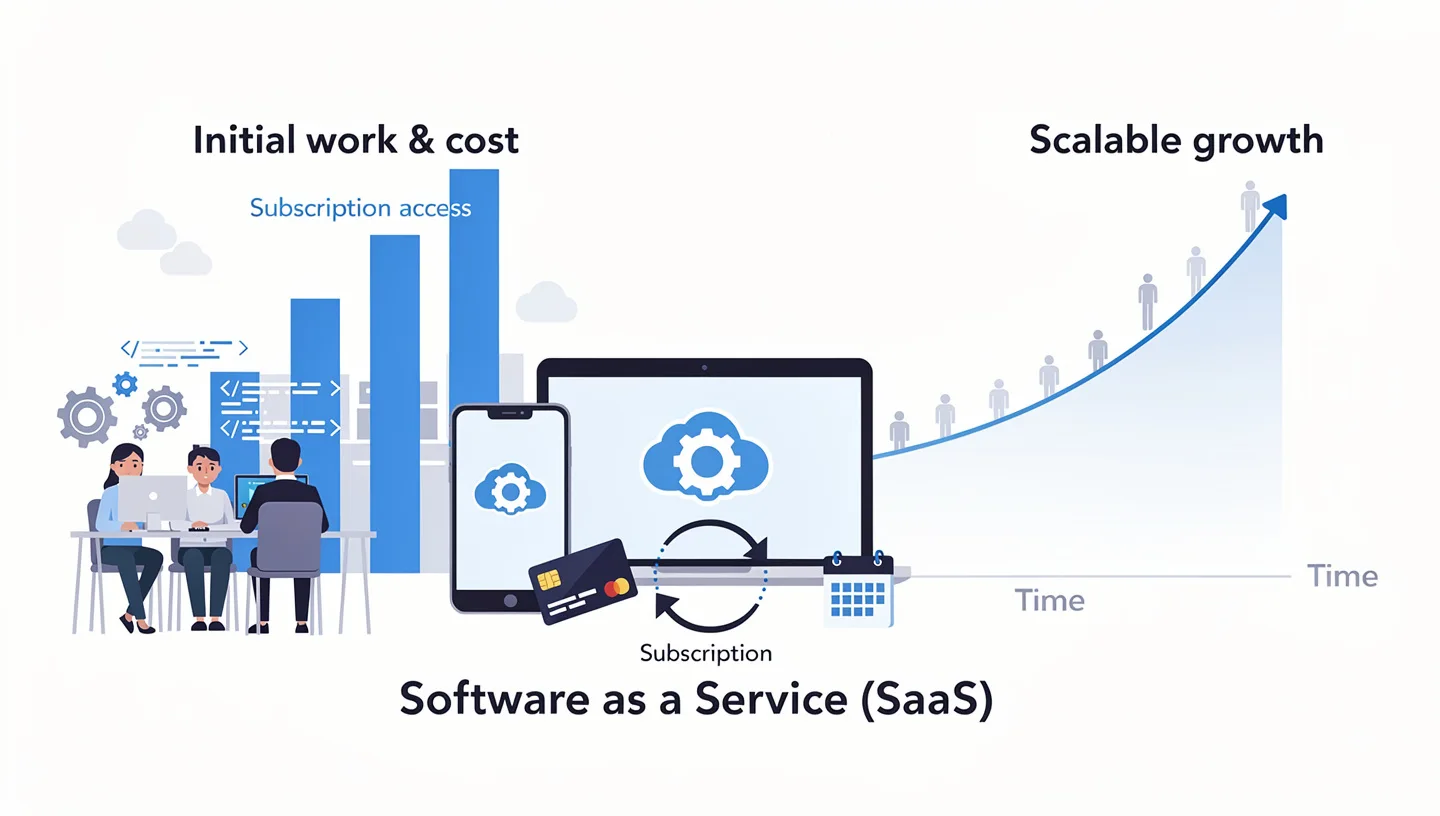
Founders weighing this path can read our guide on how to start a SaaS business in Dubai to see what the early stage looks like.
| Detail | Estimate |
|---|---|
| Cost to start | Highest, from a few thousand dollars up, depending on who builds it |
| How you earn | Subscriptions or usage fees |
| Best for | Technical founders or teams |
| Main risk | Long build time before revenue |
Pros
- Recurring revenue
- Scales without shipping
- Strong long-term value
Cons
- High up-front effort
- Support and maintenance never stop
How much does it cost to start an online business?
Startup cost ranges by model
The cost of an online business depends more on the model than on any single expense. These ranges come from vendor and advisor guides, so use them for a rough comparison.
| Model | Typical startup cost |
|---|---|
| Service-based business | $50 to $300 |
| Dropshipping store | $100 to $500 |
| Blog or affiliate site | $50 to $150 a year for domain and hosting |
| Digital products and courses | Free with free tools, $1,000 to $10,000 if production-heavy |
| Ecommerce with stock | $2,000 to $10,000+ |
| Amazon FBA | $2,500 to $10,000+ |
Sources disagree widely. Some give a range of $50 to $10,000 for the whole category, others $1,000 to $60,000 or more, and a Xero guide puts online businesses at $5,000 to $50,000. If your budget is tight, browse these business ideas under $5k before you pick a model.
Ongoing and hidden costs
Starting an online business is only part of the bill. In the first year, running costs often add up to more than start-up costs. The usual items are:
- Payment fees: on $5,000 of monthly sales, about $145 to $175. This is the cost most beginners forget.
- Ads: paid traffic, often the largest expense after the product.
- Platform and apps: store plans, email tools, design tools and plugins.
- Shipping and returns: postage, packaging and refunds.
- Your time: learning the tools and handling orders and support.
The cheapest way to start
The lowest-cost start is a service or a digital product built on free plans. Pick a skill people already pay for, set a clear price and sell it through a free landing page and a free email tool, for example the free plans on Systeme.io and Canva. Our guide on online business without investment lists more options. Once the first sales come in, put part of the money into a domain, hosting or a paid plan, and keep the rest as a cushion.
How do online businesses get customers?
Traffic sources
- Search (SEO): free but slow, and it grows over time as content ranks.
- Paid ads: fast, but you pay for every click.
- Social media: good for reach and trust, hard to turn into steady sales without a plan.
- Email: cheap and direct, and it works best for repeat buyers.
- Content marketing: a blog, videos or guides that answer questions buyers already search for.
- Influencers and partners: creators and affiliates who recommend your product to their audience.
- Referrals and marketplaces: word of mouth and platforms like Etsy bring ready buyers.
Conversion rate
Conversion rate is the share of visitors who buy. The formula is orders divided by visits, times 100. An average ecommerce store converts about 2% to 3% of visits. With 1,000 visits and a 2.5% rate, you get 25 orders. Sending more visitors helps little if your pages confuse them, so improve product pages, checkout and trust signals such as reviews and clear shipping and return terms.
Customer acquisition cost and lifetime value
Customer acquisition cost (CAC) is what you spend to win one customer: total marketing and sales spend divided by new customers. Spend $1,000 on ads and flyers and win 20 customers, and CAC is $50. A common target is for lifetime value (LTV), measured in profit, to be at least three times CAC.
In the order example, ads cost $12 per sale, so a customer should bring about $36 in profit over time. With $12.25 profit per order, that means roughly three orders per customer, which is why repeat buyers matter so much.
Other numbers to watch
Beyond conversion rate and CAC, four more numbers show how healthy the business is:
- Average order value (AOV): revenue divided by orders. $5,000 / 100 orders = $50.
- Cart abandonment rate: (carts created – purchases) / carts created x 100. If 400 carts lead to 100 purchases, 75% were abandoned.
- Return rate: returned orders divided by all orders, times 100. Eight returns out of 100 orders is 8%.
- Repeat purchase rate: customers with two or more orders divided by all customers, times 100. Twenty of 100 customers is 20%.
Check them weekly. A high abandonment rate points to checkout problems or surprise shipping costs, and a high return rate points to a gap between what the page promises and what arrives.
How much can an online business make?
Profit margins
How does an online business make money after costs? Through its margin. Gross margin is what is left after the direct cost of the product and delivery. Net margin is what is left after every cost. Guides put gross margin for ecommerce at 40% to 80%, with strong stores at 50% to 70%, and net margin at about 10% to 25%. Dropshipping margins are usually listed at 10% to 30% net. One analysis of more than 5,000 Shopify stores found dropshipping gross margins near 68% and net margins near 19%. The example store’s 23% net margin sits inside this range.
The first year in practice
Most beginners earn little at first. An analysis of more than 1,200 dropshipping stores, quoted by Printful, found beginners bringing in $0 to $2,000 a month, and industry estimates suggest only 10% to 20% of new stores reach steady profit in year one. Another source claims $6,000 to $25,000 in net profit for part-time sellers in the first year. The gap between these numbers shows how wide the range is, and most of them come from vendors.
What grows revenue
- Repeat purchases: existing customers cost less than new ones.
- Higher order value: bundles and add-ons raise the average order.
- Better conversion: clearer pages and checkout turn more visits into orders.
- Lower ad cost per sale: better targeting and stronger offers.
How to check demand and plan your first 30 days
Before you spend money, test whether anyone wants what you plan to sell. Traffic alone does not prove a business, and one month of focused work can tell you a lot.
How to check demand
Talk to ten people who fit your target customer and ask what problem they would pay to solve. Search for competitors, since competition usually means demand exists. Then try to pre-sell: a simple page, a small ad budget and a way to take payment or a waitlist signup will show whether strangers respond. If nobody does, change the offer before you build anything bigger.
A simple 30-day plan
| Week | Focus | Goal |
|---|---|---|
| Week 1 | Choose the problem and the offer, check competitors | One clear offer and price |
| Week 2 | Build a one-page site or store and set up payments | A working checkout |
| Week 3 | Find first customers through direct outreach, a small ad test or a marketplace | First sales or signups |
| Week 4 | Review traffic, conversion, costs and feedback | Decide to improve, change or stop |
What you need to set up legally
Rules differ by country and by what you sell, and most examples below come from the US. Treat this as a checklist of topics to confirm with your local authority.
Registration and licenses
In the US there is no separate online business license. You normally register the business locally, and cities or counties often require a general business license. A trade name different from your own name may need registration, and regulated products such as food, alcohol, cosmetics or supplements need special permits. For a look at how the steps work in another country, see our guide to online business in Ireland.
Business structure and bank account
A sole proprietorship is the simplest way to start: you and the business are one legal person, and you report the income on your own tax return. A limited liability company or similar entity separates your personal assets from business debts, but it costs fees and paperwork. Many founders start as sole proprietors and form a company when income grows. Whichever you choose, open a separate bank account for the business and check that your business name and domain are free to use and do not copy someone else’s trademark.
Taxes
Income from online sales is taxable, including income from a hobby. Many countries charge sales tax or VAT on goods and some digital services, and in the US states can require remote sellers to collect sales tax once they pass a sales threshold. Marketplaces like Amazon and Etsy often collect the tax for you, but you may still need to register. Digital sellers should also check how local rules treat downloads, since some countries tax them differently from physical goods. Keep every receipt and every sale in a simple record, and ask a local accountant before you grow. For setup steps in another market, see how to start an online business in Nepal.
Policies and minors
A store should publish a privacy policy, terms of sale and a returns policy, and many countries also require cookie consent and clear pricing. If you plan to sell in several countries, check consumer rules where your buyers live, since they often decide what you must offer on refunds and data. A short note on shipping times and a clear contact address also build trust with first-time buyers, who have no way to check you in person. People under 18 usually need a parent or guardian to open payment and platform accounts or to sign contracts. Teen founders can read our guide on how to start an online business under 18 for the details.
Online business scams and red flags
Because starting online looks cheap and easy, it attracts scams too. The US Federal Trade Commission lists warning signs that apply anywhere:
- Guaranteed income. Nobody can promise earnings from a store, trading or a course.
- Pay to get started. Real employers never ask you to pay for a job, training or equipment first.
- Pressure and upsells. A coach who pushes you to buy higher tiers before you earn anything is a warning sign.
- Done-for-you store packages. Sellers of ready-made dropshipping stores often promise more than they deliver.
- Task and recruitment schemes. Unexpected messages on WhatsApp or Telegram offering money for simple tasks, or deals that pay you for recruiting others.
Before you pay for anything, search the company name with words like scam, review and complaint, and show the offer to someone with no link to it, such as a mentor from a small business program. Not every online course is a scam, but guarantees, pressure and a model that depends on selling you more upgrades are the red flags. If you meet a scam, report it, and the FTC explains how in its guide to job and business scams.
What running an online business looks like each week
Running an online business is a mix of repeat tasks and small improvements. Most owners of an online business spend the week on four things, and the work can be done from anywhere, which is why many of the remote business ideas we list fit this style.
- Orders and support: confirming payments, sending products or files, answering questions and handling returns.
- Content and ads: posting, emailing and running campaigns that bring visitors.
- Numbers: checking traffic, conversion rate, customer acquisition cost and margin once a week.
- Improvements: fixing product pages, the checkout flow and the offer based on what the numbers show.
Write simple checklists for onboarding, payment confirmation, delivery, refunds, bookkeeping and follow-up. Keep them in a shared document or a project tool, so nothing depends on one person remembering it. Once these are written down, they are easy to hand to a helper, and that is where a freelancer or an online business manager can take over the daily work while you focus on growth.
Common mistakes beginners make
- Skipping demand checks. Build the offer only after you know people want it.
- Counting traffic instead of buyers. Visitors are not sales.
- Forgetting costs. Payment fees, returns and ad spend quietly shrink the margin.
- Keeping no records. Without records, you cannot see profit or file taxes properly.
- Using too many tools at once. Start with one platform and learn it well.
- Believing fast-money promises. Real online businesses take months to grow.
Final thoughts on how an online business works
An online business runs on one repeating loop: traffic brings visitors, an offer turns them into buyers, a secure payment system collects the money, delivery and support keep them happy, and the numbers show what to fix next. Pick one model, start small, track every cost and expect the first year to be slow. That is how an online business works, and also how it grows.
Frequently asked questions about online businesses
How does an online business work?
An online business uses the internet to attract customers, show an offer, take payment and deliver a product, service or access. The owner earns the difference between sales and all costs.
How does an online business make money?
Through direct sales, subscriptions, advertising, affiliate commissions or transaction fees, and often a mix of these. Profit is what stays after product, delivery, payment, ad and tool costs.
What is an online business?
It is a business that earns most of its revenue over the internet, whether it sells products, services, digital files or access to software.
How do I start an online business for beginners?
Pick a clear problem, choose a model, build a simple site or store, set up payments and get your first customers through a channel you can afford. Start with a small offer.
How do I start an online business with no money?
Sell a service or a digital product on free plans, use a free landing page and email tool, and reinvest the first earnings into a domain or paid plan.
How much does it cost to start an online business?
Estimates run from about $50 for a service business to $10,000 or more for models with stock, and some guides list up to $60,000. The model matters more than any single expense.
Is an online business profitable?
It can be, but most beginners earn little in the first year. Net margins of 10% to 25% are common for stores, and only a minority of new dropshipping stores reach steady profit in year one.
Do I need a website to run an online business?
Not always. You can sell through a marketplace or a social media page, but your own website gives you more control over your brand, prices and customer data.
Do I need a business license to sell online?
Often yes, in some form. In the US there is no special online license, but a local business license and a sales tax permit may apply. Rules vary by country, so check locally.
Do online businesses pay taxes?
Yes. Income is taxable, including from a hobby, and many countries charge sales tax or VAT. Marketplaces may collect some of it, but you may still need to register.
What are the main online business models?
Online stores, blogs and affiliate sites, digital products and courses, freelancing and services, subscriptions and memberships, and software or apps.
What are the most important ecommerce tools?
A store or website platform, a payment provider, an email tool, analytics, a design tool and simple accounting software. Add shipping and support tools as orders grow.
How do I market my online store?
Start with search content, email and one social channel where your buyers spend time. Add small paid ad tests once you know your conversion rate and margin.
How long does it take to make money online?
It depends on the model. Services can earn within weeks, while blogs and stores often take months. Many beginners earn little in the first year, so plan for a slow start.
Can a traditional shop sell online?
Yes. Pick products suited to online buyers, add a store or marketplace listing, set up payments and shipping, and tell your existing customers.
How do I know if an online business opportunity is a scam?
Be careful with guaranteed income, requests to pay first, pressure to buy upgrades and unexpected messages offering easy money. Search the company name with scam or review and ask someone neutral.