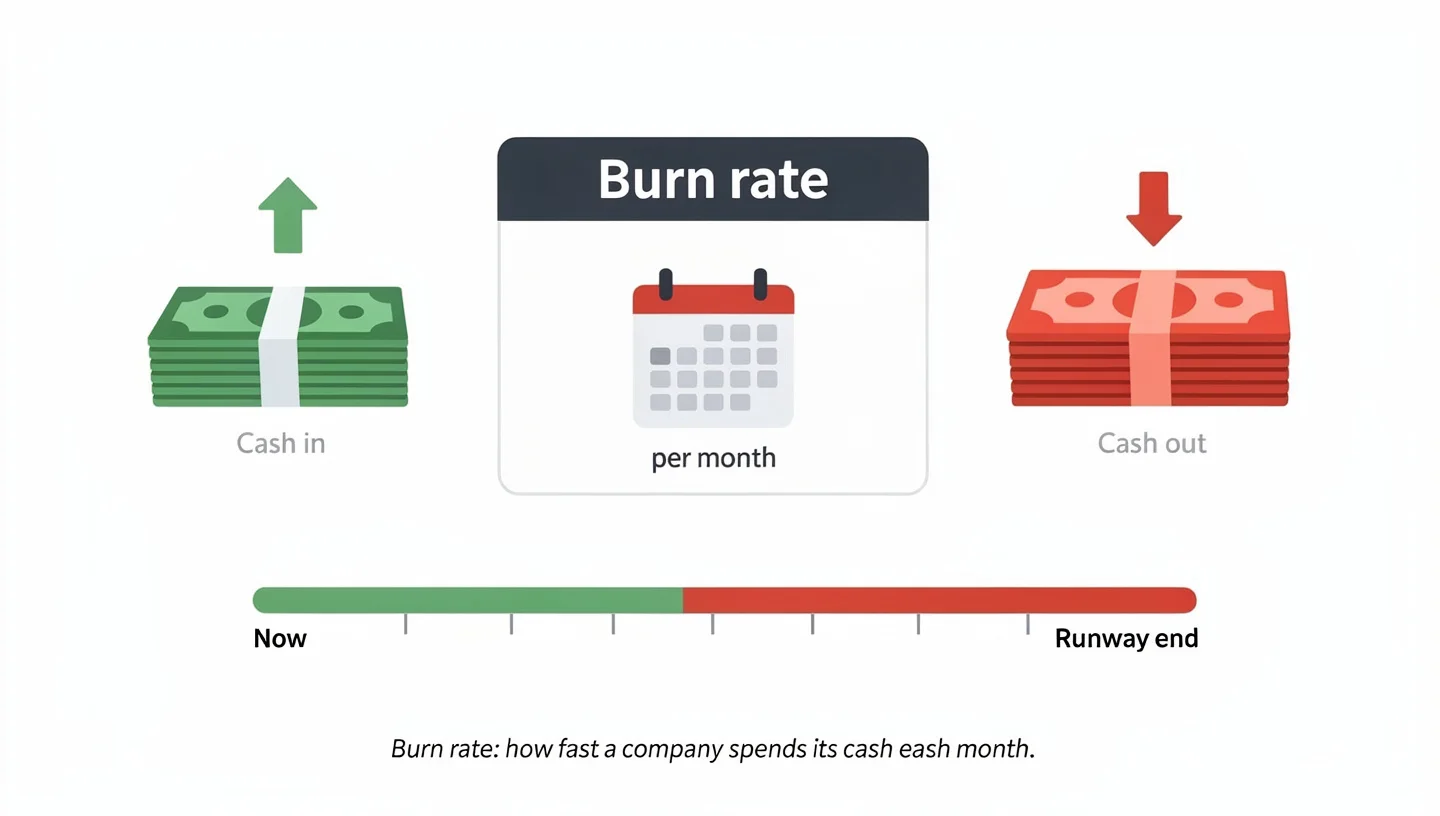
What is burn rate? Burn rate is the speed at which a company spends its cash reserves, usually measured per month. It shows how much money leaves the business before any profit arrives, which makes it one of the first numbers investors ask a startup to explain. A company with a burn rate of $40,000 a month and $240,000 in the bank has about six months before the cash is gone.
This guide explains what burn rate means, the difference between gross burn and net burn, every formula you need and a worked example with real numbers. It also shows how to read the result against cash runway, what counts as a good burn rate and how to bring a high burn rate down. It ends with common mistakes, tracking tips and a FAQ.
What is burn rate?
Burn rate is a cash metric. It measures how fast a business uses up the money it has in the bank, and it is most often applied to startups that spend more than they earn. The number is normally stated per month, so a burn rate of $30,000 means that $30,000 of cash leaves the business each month.
The metric matters because cash and profit are different things. A company can show a paper profit and still run out of cash if customers pay late, and a company with a loss can survive for a long time if it has enough money saved. Burn rate looks only at the cash that actually moves in and out of the account.
Founders use it to answer one practical question: how long can the business operate before it needs more funding? Investors use it for the same reason, and they usually want to see a clear plan for how the burn rate will change after the money is raised. Companies that are close to break-even watch it too, because a bad quarter can turn a small burn into a large one.
Burn rate in plain terms
Think of burn rate as the monthly fuel use of a company. If the tank holds $240,000 and the engine uses $40,000 a month, the trip ends after six months unless someone refuels or the engine gets more efficient. Refuelling means new funding or higher revenue, and a more efficient engine means lower costs.
The word burn is not negative in itself. Many healthy startups burn cash on purpose to build a product or win customers, and the real problem starts only when the burn is higher than the plan or the runway is too short to reach the next goal. A steady monthly burn that matches the plan is normal for a company at this stage.
Types of burn rate
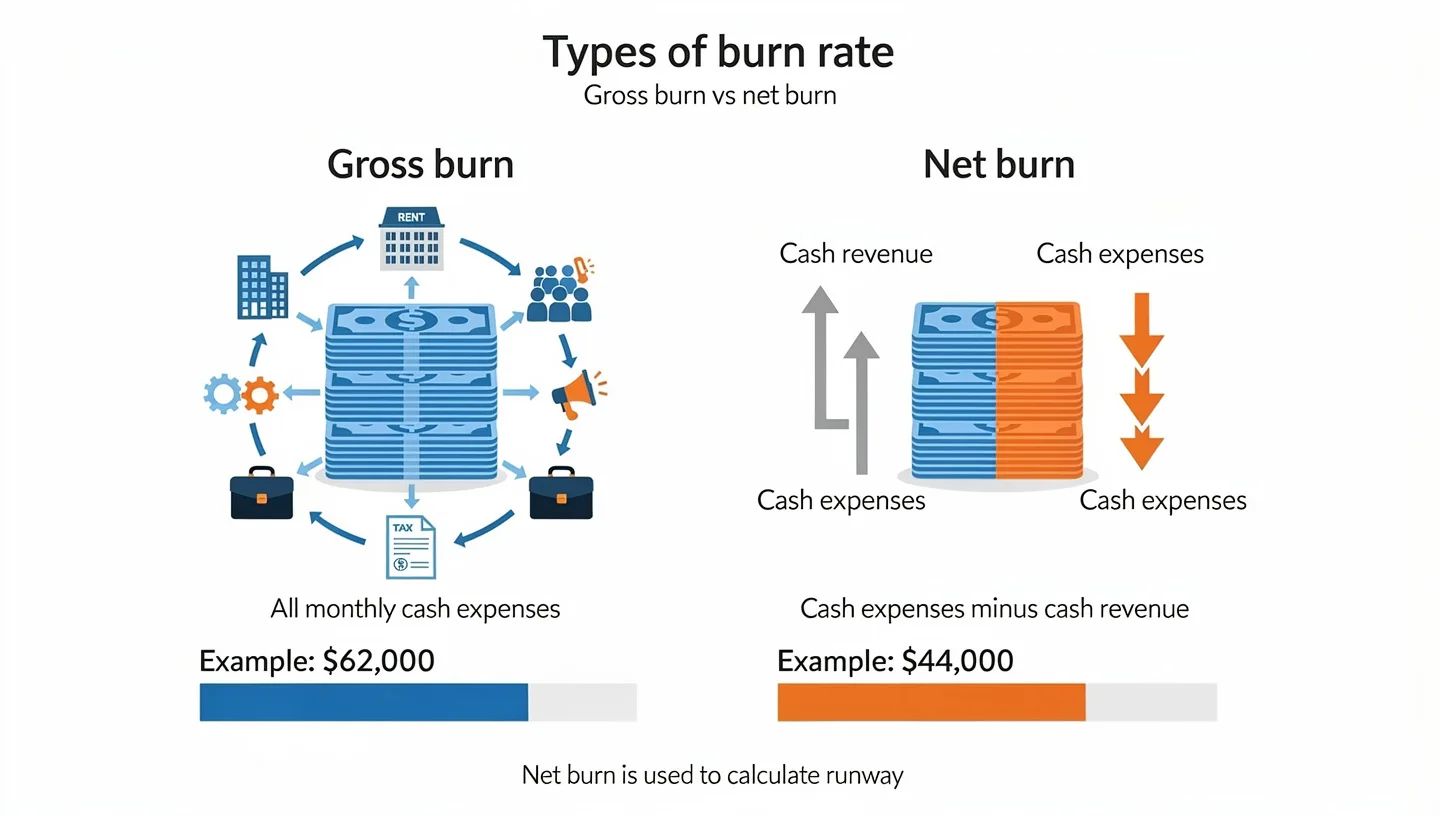
There are two main types, and they answer different questions. Gross burn shows how much a company spends. Net burn shows how much cash it loses after income is counted.
Gross burn rate
Gross burn rate is the total amount of cash the company spends in a month, without subtracting any income. It includes salaries, rent, software, marketing, contractor fees, taxes and every other cash expense. Gross burn is useful for seeing the full size of the cost base and for checking which expenses grow fastest.
If a company pays $62,000 in cash expenses in one month, its gross burn is $62,000, even when customers paid $18,000 in the same month. Gross burn is also the number to use in a worst-case view, where sales stop completely and the company has to live off its savings.
Net burn rate
Net burn rate is the amount of cash the company loses in a month after counting its cash income. You find it by taking monthly cash expenses and subtracting the revenue that actually arrived in the account. If expenses are $62,000 and cash revenue is $18,000, the net burn is $44,000.
Net burn is the figure most people mean when they say burn rate, because it shows the real drain on the bank balance. It is also the number used to calculate runway. A falling net burn means the company is either spending less or earning more, and a net burn of zero means the company has reached cash break-even.
Gross burn vs net burn
The table below puts the two side by side.
| Factor | Gross burn | Net burn |
|---|---|---|
| What it counts | All monthly cash expenses | Cash expenses minus cash revenue |
| Formula | Total monthly cash expenses | Monthly cash expenses minus monthly cash revenue |
| Question it answers | How much does the company spend? | How much cash does the company lose? |
| Best used for | Cost control and worst-case planning | Runway and investor reporting |
| Example | $62,000 | $44,000 |
Both numbers are worth tracking. Gross burn shows if costs are getting out of control, and net burn shows if the business is moving toward break-even.
Average burn rate
One month can mislead, so many teams also track an average burn rate over three, six or twelve months. A launch, an annual software payment or a late invoice can push a single month far above or below the normal level. The average smooths these swings and gives a better base for planning the runway.
Burn rate formulas at a glance
The formulas below cover the calculations used most often. Every example in this guide uses the same company, so the numbers can be followed from one section to the next.
| Metric | Formula | Example |
|---|---|---|
| Gross burn | Total monthly cash expenses | $62,000 |
| Net burn | Monthly cash expenses minus monthly cash revenue | $62,000 – $18,000 = $44,000 |
| Average burn rate | (Starting cash – ending cash) divided by number of months | ($400,000 – $268,000) / 3 = $44,000 |
| Cash runway | Cash balance divided by net burn | $264,000 / $44,000 = 6 months |
| Burn rate percentage | (Net burn divided by cash reserves) x 100 | ($44,000 / $264,000) x 100 = 16.7% |
| Run rate | Monthly revenue x 12 | $18,000 x 12 = $216,000 |
| Burn multiple | Net burn divided by net new monthly recurring revenue | $44,000 / $11,000 = 4 |
Use the same period for every figure in a calculation. Mixing a monthly expense number with a quarterly revenue number is one of the most common reasons a burn rate formula gives a wrong result.
How to calculate burn rate
There are three common ways to calculate burn rate, and the right one depends on which data you have. All three give the same result when the numbers are clean.
Calculate burn rate from cash flow
The most direct method uses the cash flow statement or the bank account. List every cash expense for the month, add them up for the gross burn, then add up the cash revenue that arrived and subtract it from the expenses to get the net burn. Use cash that moved, not invoices that were sent.
A simple version for the example company looks like this: salaries $38,000, rent $6,000, software $4,500, marketing $9,000 and other costs $4,500. The total is $62,000 of gross burn. With $18,000 of cash revenue, the net burn is $44,000.
Calculate burn rate from starting and ending cash
When the expense list is long, you can work backward from the bank balance. Take the cash at the start of the period, subtract the cash at the end and divide by the number of months. If the company started a three month period with $400,000 and ended with $268,000, it lost $132,000, which is $44,000 a month.
This method works well for an average burn rate. It also catches one-off items automatically, but it can hide them, so check the period for large payments such as annual insurance or equipment before treating the result as normal.
Calculate burn rate from financial statements
If you do not have a clean list of cash movements, you can build the burn rate from the financial statements. The cash flow statement is the easiest source, because its operating section already shows the cash that came in and went out. Subtract the cash that came in from the cash that went out, and divide by the number of months in the period.
When only the income statement and balance sheet are available, start with the net loss and add back non-cash items such as depreciation. Then adjust for changes in receivables, payables and inventory, because unpaid invoices and unpaid bills change the real cash result. The final figure is the cash loss for the period, and dividing it by the number of months gives the monthly burn rate.
Calculate burn rate percentage
The burn rate percentage shows how much of the cash reserves the company uses each month. Divide the net burn by the cash balance and multiply by 100. For $44,000 against $264,000, the result is 16.7%, which means about one sixth of the remaining cash disappears every month.
The percentage is useful for comparing periods. If it rises from 10% to 17% in a few months while the cash balance shrinks, the company is moving toward a cash problem faster than the dollar amount alone suggests.
A worked example
The table below shows the full calculation for one month of the example company.
| Item | Amount |
|---|---|
| Salaries | $38,000 |
| Rent | $6,000 |
| Software | $4,500 |
| Marketing | $9,000 |
| Other costs | $4,500 |
| Gross burn | $62,000 |
| Cash revenue | $18,000 |
| Net burn | $44,000 |
| Cash in the bank | $264,000 |
| Runway on net burn | 6 months |
On gross burn alone, the same $264,000 would last only a little over four months. That gap shows why net burn is the number to use for runway and gross burn is the number to use for a stress test.
More burn rate examples
The first example showed a company that already has some revenue. These two cases show how the burn rate story changes at other stages.
Early-stage startup with no revenue
A founding team raises $450,000 and spends $30,000 a month: $18,000 on salaries, $3,000 on tools, $2,000 on legal and accounting, $4,000 on marketing and $3,000 on other costs. With no revenue, gross burn and net burn are both $30,000, and the runway is 15 months. After the team hires a developer for $7,000 a month, the burn rate rises to $37,000 and the runway drops to about 12.2 months. One hire shortened the runway by almost three months, which is why hiring is the first place to look when the burn rate needs a check. Founders who want to avoid investors altogether can start with online business ideas that need no investment, where the first costs are small and the burn stays low.
Startup with growing revenue
A second company has $480,000 in the bank and a gross burn of $55,000. Its monthly revenue grows from $10,000 to $14,000, then $18,000 and $22,000 over four months, so the net burn falls from $45,000 to $41,000, $37,000 and $33,000. The runway at the start was 10.7 months. After four months the company has $324,000 left, and at the current net burn that is 9.8 months. Four months passed and the runway fell by less than one month, which shows that revenue growth is slowing the burn.
Burn rate and cash runway
Cash runway is the number of months a company can keep operating before it runs out of cash. It turns a burn rate into a deadline, and it is the figure that tells a founder when fundraising has to start.
Cash runway formula
Divide the cash balance by the net burn. With $264,000 in the bank and a net burn of $44,000, the runway is six months. If the net burn rises to $55,000 and nothing else changes, the runway shrinks to 4.8 months, so a small change in monthly burn can cost weeks of survival.
For a safer view, calculate runway twice: once with the current net burn and once with the gross burn. The gap between the two results shows how much the business depends on incoming revenue to stay alive.
How long should your runway be?
Advice differs by source. Some guides say a company should keep a minimum of six months, while others recommend 12 months or more, and venture-backed startups often aim for around 18 months after a raise. Fundraising usually takes several months, so a runway shorter than six months leaves a founder negotiating with investors from a weak position.
A practical rule is to start planning the next round when the runway falls to about 12 months. That leaves time to raise money, cut costs or grow revenue without panic. For companies that grow without investors, the same rule applies to the cash savings needed to survive a slow season. Founders who bootstrap their business usually need this reserve more than anyone, because no investor will cover a gap.
External factors that affect your runway
Runway is not only a result of internal choices. Higher interest rates can make loans and credit lines more expensive, inflation raises supplier and salary costs, and exchange rate swings change the price of anything paid in a foreign currency. A weak funding market also makes it harder to raise a new round on time. For this reason, a runway forecast should include a margin for costs that rise without warning.
Burn rate vs run rate
The two terms sound alike and measure opposite things. Burn rate measures the cash going out. Run rate projects current revenue forward to a full year, usually by multiplying the latest month by 12. A company with $18,000 of monthly revenue has a run rate of $216,000.
Run rate is a revenue forecast, and burn rate is a spending measure, so one does not replace the other. A company can have a growing run rate and a high burn rate at the same time, which is common in fast-growing software firms. Subscription businesses often express run rate as annual recurring revenue, which is another way to measure the same income stream over a year.
When investors compare the two, they look at how much cash the company burns to produce each dollar of run rate. That ratio is the idea behind the burn multiple covered later in this guide.
Burn rate vs cash flow and profit
Burn rate is closely related to cash flow, but they are not identical. Cash flow is the movement of money in and out of the account over a period and can be positive or negative. A negative cash flow is the same thing as a burn, and a positive cash flow means the company is adding to its bank balance.
Profit is different again. Profit comes from the income statement and includes items that do not move cash, such as depreciation, and sales that have not been paid yet. A business can report a profit and still have a burn rate if customers pay slowly or if it buys a large amount of inventory.
For this reason, burn rate should be calculated from cash, not from the profit and loss statement. Non-cash costs such as depreciation do not belong in the calculation, because they do not reduce the bank balance.
How to interpret burn rate
A burn rate on its own is neither good nor bad. The same $44,000 a month can be healthy for a company with 18 months of cash and growing sales, and dangerous for one with four months of cash and falling sales. To read the number, compare it with three things: the runway, the revenue trend and the next milestone the company needs to reach.
If the net burn is stable or falling while revenue rises, the company is moving in the right direction. If the burn is rising faster than revenue, or the runway is shrinking faster than the calendar, the company needs to change its plan. A single month is a snapshot, so look at the trend over several months before drawing a conclusion.
What is a good burn rate?
There is no single number that works for every company. A good burn rate is one that gives the business enough runway to reach its next milestone, such as a product launch, a funding round or break-even. The same $50,000 a month can be reasonable for a team of ten with strong sales and dangerous for a team of three with no customers.
Most guides give rules of thumb instead of fixed targets. Many suggest that a company should have at least 12 months of runway, that the burn should not grow faster than revenue and that net burn should trend down once the product has customers.
Good burn rate by company stage
- Pre-seed and seed: burn is small and mostly covers founders, a few early hires and basic tools. The goal is to reach a first product and early customers before the money runs out.
- Early stage: burn grows with hiring and marketing. Investors expect it to be linked to clear progress such as user growth or recurring revenue.
- Growth stage: gross burn can be large, but net burn should shrink as revenue scales. A company at this level is judged on how efficiently it turns cash into growth.
Some sources quote dollar ceilings per stage, for example about $50,000 a month for a small early-stage team. Treat these figures as rough guides, because the right level depends on the market, the cost of hiring and how much money was raised.
Burn rate by industry
Different industries have very different cost patterns, so a burn rate that is normal in one can be alarming in another.
- Technology and SaaS: payroll and cloud costs drive the burn, and revenue often takes months to catch up.
- Healthcare and biotech: research, trials and approvals mean a high burn for years before any revenue.
- Retail and e-commerce: inventory, shipping and advertising dominate, and seasonal sales make the burn uneven.
- Service businesses: payroll is the biggest cost, so burn follows headcount closely.
- Manufacturing and heavy industry: equipment, materials and facilities require large upfront cash.
- Media and entertainment: content production costs come first and income arrives later.
- Nonprofits: burn depends on the timing of grants and donations, so reserves matter more than monthly sales.
What is a dangerous burn rate?
A burn rate becomes dangerous when it threatens survival before the company can fix the cause. Warning signs include a runway under six months with no funding in sight, a net burn that rises for several months in a row while revenue stays flat, and a burn rate percentage that keeps climbing as the cash balance shrinks. When two or more of these appear together, the company should cut costs or start fundraising immediately.
How to set the right burn rate
You can also work backward from the runway you want. Decide how many months the cash has to last, then divide the cash balance by that number. A company with $360,000 that wants 18 months of runway can afford a maximum net burn of $20,000 a month. One guide suggests a rough check of about $10,000 of gross burn per employee, but treat this as a loose guide, because salaries differ a lot by country and role.
Burn rate in SaaS
Software companies have a special burn rate pattern. They spend heavily at the start on development, cloud hosting and sales, while revenue arrives slowly through monthly or annual subscriptions. This creates a long period of high net burn before recurring revenue catches up with costs.
For a SaaS company, the burn rate should be read together with monthly recurring revenue, churn and the burn multiple. A company that burns $44,000 to add $11,000 of new recurring revenue is in a better position than one that burns the same amount to add $4,000. Annual prepaid plans also help, because customers pay for twelve months upfront and the company receives cash long before it delivers the service.
Why burn rate matters
Burn rate matters because cash is the one resource a company cannot do without. Poor cash management is one of the most common reasons small businesses close, even when the product is good. Knowing the burn rate lets an owner see a problem months before the bank balance reaches zero.
It also shapes every major decision. A founder who knows the net burn can decide how many people to hire, how much to spend on marketing and when to start raising money. Investors use the same number to judge risk, and a company with a clear burn rate and a realistic plan usually gets a better hearing than one that cannot explain where the money goes.
A third reason is control. A business that tracks its burn rate every month can compare actual spending with the budget, spot expenses that grow without a return and act early. Companies that ignore the metric tend to find out about their runway only when it is too late to fix it. New founders can build this skill early, and the guide on how to learn online business basics is a good place to start reading numbers with confidence.
Burn rate also affects valuation. A company that reaches its goals with a lower burn shows efficiency, and investors tend to pay more for efficient growth than for growth that needs a large amount of cash. This is one reason many founders try to keep a lean cost base even after raising money.
What investors look for in burn rate
Investors do not look for the lowest burn rate. They look for a burn rate that matches the plan. They check how many months of runway the new money will buy, how the net burn compares with the growth it produces and if the founders understand their own numbers. A company asking for $1.2 million with a $60,000 net burn is promising 20 months of runway, while the same ask with a $100,000 burn gives only 12 months, and the investor will ask what changes in the plan to make up the difference.
Pros and cons of a high burn rate
A high burn rate is not always a mistake. It is a trade between speed and safety, and the right choice depends on the market.
- Pros: faster hiring, quicker product development, more marketing reach and a better chance to take market share before competitors.
- Cons: a shorter runway, heavy dependence on investors, more dilution for the founders, constant pressure to hit growth targets and less room for mistakes.
A high burn rate works best when the company has proof that each dollar spent brings back more than a dollar in future revenue. Without that proof, a high burn rate is a bet on hope.
How burn rate shapes business decisions
The burn rate is not only a report card. It affects almost every decision a founder makes, from hiring to the timing of a funding round.
Hiring and staffing decisions
Payroll is the biggest cost for most startups, so every new hire changes the burn rate. The cost of a hire is more than the salary, because tools, taxes, equipment and onboarding time add to it. The hiring trap is a common mistake: a company hires ahead of revenue because growth looks close, the fixed costs rise, and when sales arrive later than planned the runway is already shorter.
Marketing and product development
Marketing and product work are the two areas where spending can be adjusted most quickly. Test a channel with a small budget, measure what each new customer costs and increase the spend only where the return is clear. In product development, build the features customers ask for first and delay the rest, because every extra month of development adds to the burn without adding revenue.
Fundraising strategy
The burn rate decides how much money a company needs to raise and when to start. A simple approach is to multiply the expected net burn by the runway you want, then add a reserve for delays. Fundraising often takes several months, so the process should begin while the company still has 9 to 12 months of cash, not when the balance is nearly empty.
Fixed vs variable expenses
To change a burn rate, you first need to know which costs can change. Expenses fall into two groups, and the split shows where the room to cut is.
| Type | Definition | Examples |
|---|---|---|
| Fixed expenses | Costs that stay about the same each month, whatever the sales | Salaries, rent, insurance, software subscriptions |
| Variable expenses | Costs that rise and fall with activity | Advertising, inventory, contractors, payment fees, shipping |
A burn rate made mostly of fixed costs is harder to reduce quickly, because cutting salaries or leaving an office takes time. A burn rate with many variable costs can be adjusted within weeks, but it also tends to rise whenever the company grows.
Factors that influence burn rate
Several factors push burn rate up or down, and most of them are under the control of the founders.
- Headcount: payroll is the largest cost for most startups, so hiring speed has the biggest effect on burn.
- Office and equipment: rent, hardware and utilities add fixed costs that do not shrink when sales are slow.
- Marketing and sales spend: paid campaigns can raise burn quickly, so their return needs to be measured.
- Customer churn: every customer who leaves lowers revenue and raises net burn, which is why retention matters as much as new sales.
- Pricing and payment terms: low prices and slow-paying customers reduce the cash that arrives each month.
- Seasonality: businesses with strong and weak seasons see their burn jump and fall during the year.
- Funding stage: after a raise, many teams spend faster, so the burn often rises right after the money arrives.
How to reduce burn rate
Reducing burn rate means spending less, earning more or both. The goal is to extend the runway without damaging the parts of the business that produce growth.
- Slow down hiring: fill only the roles that bring in revenue or protect it, and use freelancers for short projects. Teams that start with remote business ideas and remote hiring also save on office costs.
- Review software and subscriptions: cancel tools that nobody uses, switch to annual plans where the discount is real and check for free versions of paid tools.
- Renegotiate with suppliers: ask for longer payment terms, volume discounts or lower fixed fees. Even a few extra days of payment time improves monthly cash.
- Cut or pause weak marketing channels: track the cost of winning a customer and stop spending where the return is poor.
- Raise prices or add paid plans: a small price increase can lift revenue without adding cost.
- Reduce churn: improve onboarding and support so customers stay longer, because keeping a customer costs less than finding a new one.
- Drop products that do not sell: a product that brings little revenue still uses time, tools and money.
- Collect cash faster: invoice quickly, ask for deposits and follow up on late payments.
- Review free trials and discounts: long free periods delay revenue, so check that the trial length matches the time customers need to see value.
- Look for low-cost ways to grow: many founders use the business ideas under $5k approach of testing small before spending big, and sell a service before building software.
Cutting too deep can backfire. A company that removes the sales team to lower the burn may find that revenue falls faster than costs, which leaves a shorter runway than before. Each cut should be checked against its effect on income.
Common burn rate mistakes
- Ignoring trends: looking at one month and missing a steady rise in spending over a quarter.
- Misjudging runway needs: assuming the next round will close on time, when fundraising often takes longer than planned.
- Overemphasizing growth: spending heavily to add customers who leave soon, which raises the burn without building lasting revenue.
- Mixing gross and net burn: using gross burn in a runway formula, or net burn when describing total costs, gives a result that does not match what investors expect.
- Counting non-cash items: depreciation and similar entries do not reduce the bank balance and should stay out of the calculation.
- Treating one-off payments as normal: a large equipment purchase or annual bill can distort one month, so label these items and look at the average.
- Using different periods: comparing a monthly cost with a quarterly revenue figure breaks the formula.
Key metrics to track alongside burn rate
Burn rate tells you how fast cash leaves. Other metrics tell you what the cash buys.
- Cash balance and runway: how much money is left and how many months it will last.
- Recurring revenue: monthly or annual recurring income, which shows how stable the revenue is.
- Churn rate: the share of customers who leave in a period, which directly reduces revenue.
- Customer acquisition cost: how much it costs to win a new customer, compared with how much that customer pays.
- Gross margin: the share of revenue left after the direct cost of delivering the product.
- Burn multiple: net burn divided by new recurring revenue, a measure of efficiency.
When to calculate burn rate
Calculate the burn rate at the close of every month as a routine. Also recalculate it before a major hire or purchase, before a fundraising round, after a sharp drop in sales and at the end of each quarter or year. A company in a cash squeeze should check it every week, because the situation can change faster than the monthly report shows.
How to track and forecast burn rate
Tracking burn rate is a monthly habit. After each month closes, record gross burn, net burn, cash balance and runway in one place, such as a spreadsheet. A simple burn rate calculator built in a spreadsheet with the formulas from this guide is enough for most small teams.
Forecasting adds a plan for the months ahead. Build three scenarios: a base case with current trends, a downside case where revenue falls and a growth case where hiring and marketing increase. Compare the runway in each. If the downside case gives less than six months, that is the signal to cut costs or start fundraising earlier.
Larger companies use finance software to pull the numbers from the bank and accounting system. Smaller teams can start with a spreadsheet and move to a tool when the volume grows. The U.S. Small Business Administration also offers guidance on how to manage your finances as a small business.
Tools for tracking burn rate
A spreadsheet is enough to start. It needs rows for cash expenses, cash revenue, gross burn, net burn, cash balance and runway, with one column for each month. As the business grows, accounting software can produce the cash reports automatically, and finance planning tools can run forecasts and scenarios. Some bank dashboards also show the monthly cash movement, which saves time on data entry.
Burn rate trends
A chart of net burn over six to twelve months shows more than any single figure. A rising line means costs are growing faster than income, a falling line means the company is getting more efficient and a flat line with a shrinking cash balance means the runway is getting shorter on a fixed schedule. Review the chart at every monthly check.
Burn rate adjusted for one-offs
One-time payments such as an equipment purchase, a legal fee or an annual insurance bill can distort a single month. To see the underlying burn, calculate it twice: once as reported, and once with one-time items removed. Show both numbers when you report to investors, and label the adjustments clearly so the figures can be trusted.
Burn multiple
The burn multiple compares net burn with the new recurring revenue added in the same period. If a company burns $44,000 and adds $11,000 of new monthly recurring revenue, its burn multiple is 4. The lower the number, the more efficiently the company turns cash into growth, and investors use it to compare startups that have very different sizes.
Default alive or default dead
Some founders ask a simple question: if the company keeps its current growth and costs, will it reach profit before the cash runs out? If yes, the company is default alive. If no, it is default dead and needs to cut costs, raise money or change the plan. The test is useful because it forces a clear look at the trend and not only at today figures.
Other meanings of burn rate
The term is also used outside company finance. In personal finance, it describes how quickly a person spends their income. In project management, it means the speed at which a project uses its budget or hours, which helps teams spot scope creep. The Wikipedia article on burn rate lists these uses along with those from chemistry and rocketry, where it refers to how fast a material burns. This guide covers the business meaning.
FAQ
What is burn rate in business?
Burn rate in business is the amount of cash a company spends each month. It is usually calculated as net burn, which is monthly cash expenses minus monthly cash revenue, and it shows how quickly the company is using up its cash reserves.
What is the difference between gross burn and net burn?
Gross burn is the total of all monthly cash expenses. Net burn is the same total minus the cash revenue that arrived in the month. Gross burn shows the size of the cost base, while net burn shows the real loss of cash.
How do I calculate runway from my burn rate?
Divide the cash in the bank by the net burn. A company with $264,000 and a net burn of $44,000 has six months of runway. Recalculate the figure every month, because both the cash balance and the burn rate change.
What is the difference between burn rate and run rate?
Burn rate measures how fast cash leaves the business. Run rate takes current revenue, usually the latest month, and multiplies it by 12 to estimate annual revenue. One shows spending and the other shows income potential.
What is a good burn rate for a startup?
A good burn rate gives the company enough runway to reach its next goal, and many guides suggest at least 12 months. The right amount depends on the stage, the industry and the size of the team, so compare the burn with the plan and not with a fixed number.
How often should I calculate my burn rate?
Calculate it every month, and more often during a fundraising round or a cash shortage. A monthly review catches rising costs early, and a three to six month average removes the noise from one-off payments.
Can a profitable business still have a high burn rate?
Yes. Profit and cash are different. A company can report a profit on paper while customers pay late or while it spends cash on inventory, equipment or a large annual bill, and in that case the bank balance falls even though the income statement looks good.
Does burn rate include non-cash expenses like depreciation?
No. Burn rate tracks cash that leaves the account, so non-cash items such as depreciation or stock-based pay are left out. Including them would make the burn look higher than the real drain on the bank balance.
Can burn rate be negative?
A negative net burn means the company earns more cash than it spends, which is the same as positive cash flow. Some sources write it as a negative number, so check how the result is presented before comparing figures from different places.
How does burn rate affect a startup valuation?
A lower burn with strong growth tells investors that the company uses money efficiently, and that can support a higher valuation. A high burn with weak growth increases risk, so investors may ask for better terms or a smaller round.
How can I reduce my burn rate without slowing growth?
Focus on costs that do not bring revenue, such as unused software, weak marketing channels and slow hiring plans. At the same time, protect the sales and customer support work that keeps revenue coming in, and reduce churn so existing customers stay longer. Founders who want a low-burn start can look at how to start an AI business with no money, where the first sales pay for the tools.
Is a lower burn rate always better?
Not always. A very low burn can mean the company is not investing enough to grow. The best burn rate is one that matches the plan, leaves enough runway and produces results such as new customers or higher revenue.
Is burn rate a KPI?
Yes. Burn rate is a key performance indicator for cash and survival, and many boards and investors review it every month. It works best when it is read with other KPIs such as runway, revenue growth and churn.
Why does burn rate matter even if the business is growing?
Growth can hide a cash problem. A fast-growing company often spends on hiring, stock and marketing before the revenue arrives, so the bank balance can fall quickly while sales rise. Tracking the burn rate shows if growth is paid for by earnings or by savings that will run out.
What burn rate do investors expect from early-stage startups?
Investors do not expect one fixed number. They expect a burn rate that fits the stage and the plan, with a runway long enough to reach the next milestone. Many look for at least 12 to 18 months of runway after a raise, and for a burn rate that rises only when it brings clear growth.
How do seasonal businesses manage burn rate?
They look at the average burn over a full year and not only at single months. Many keep a cash reserve from the strong season to cover the weak one, use flexible costs such as seasonal staff and plan the stock purchases so that large payments come after the busiest sales period.
How can startups predict future burn rates?
Build a forecast with a base case, a downside case and a growth case. Use past burn rates as the starting point, add planned hires and purchases and adjust revenue for the expected sales trend. Update the forecast every month so that the numbers stay close to reality.
How can I extend my runway without raising funding?
Cut costs that do not bring revenue, raise prices, speed up payments from customers, negotiate longer terms with suppliers and pause hiring. Bringing in cash from annual plans or deposits also helps, because it adds to the balance without taking on investors.