Yes, you can start an online business under 18. Most teens begin with a small service or a digital product, and the cost can stay close to zero. The catch is that most platforms, banks and payment apps want an adult on the account, so a parent or guardian has to be part of the setup from day one.
This guide walks through nine steps, from the first talk with your parent to your first paying customer. It also covers what the law says about minors, which online business ideas work for a teenager with no money, and which tools have a free plan.
The short version: pick one simple offer, check that people will pay for it, build the smallest working version, and let a parent hold the accounts that need an adult. Everything else can wait.
Can You Legally Start an Online Business Under 18?
In most places there is no minimum age for earning money from your own work. The limit that matters is 18, the age when you can sign contracts. A minor can usually cancel a contract later, so banks, platforms and customers ask an adult to sign. That is why a parent or guardian handles the paperwork while you do the work. Rules change by country and state, as a guide on how to start an online business in Nepal shows. Check your local rules, and for anything big talk to a lawyer or a tax professional. This article is general information, not legal advice.
Why Platforms Ask for an Adult Account
Most online platforms set the minimum age for an account holder at 18. That includes Shopify, Etsy and PayPal. The Shopify terms say the account must be opened by someone who is at least 18 or of legal age where they live. In practice, a parent creates the account, owns the store, connects their bank account and handles billing, and you run the daily work.
Keep one thing in mind. If the account is in your parent’s name, the business legally belongs to them, and the platform will follow their instructions. Agree on the rules in writing before the first sale, including who keeps the money and how often it moves to you.
Which Business Structure Works for a Minor
Most teens start as a sole proprietorship. In most states it needs no formal registration, and the income is reported under the parent’s name or your own, depending on the setup. An LLC gives more protection for personal assets, but a parent has to sign the formation papers, and some states only let an adult form one. It also costs more and takes more paperwork. For a first online business with small sales, a sole proprietorship is usually enough. Move to an LLC later if sales grow or you sell products that could cause harm.
Which Platforms Let You Open an Account Under 18?
This is the question most teens get stuck on. The table shows how the common platforms treat a minor, so you know in advance who has to sign up.
| Platform | Account holder | What a teen can do |
|---|---|---|
| Shopify | 18 or the legal age where you live | A parent owns the store and billing, and the teen builds the products, pages and marketing |
| Etsy | 18 | A parent opens the shop, and the teen makes and lists the items |
| PayPal | 18 | A parent holds the account, and payouts go to the parent or to a custodial account |
| Stripe | Adult owner | A parent opens the account in their own name and stays responsible for it |
| Social apps | Differs by app, and many start at 13 | Read the terms, and let a parent sign up and watch the account if you are under the minimum age |
Always read the terms of the exact service you plan to use, since rules change. A teen under 18 who signs up with a false birth date can lose the account and every dollar in it.
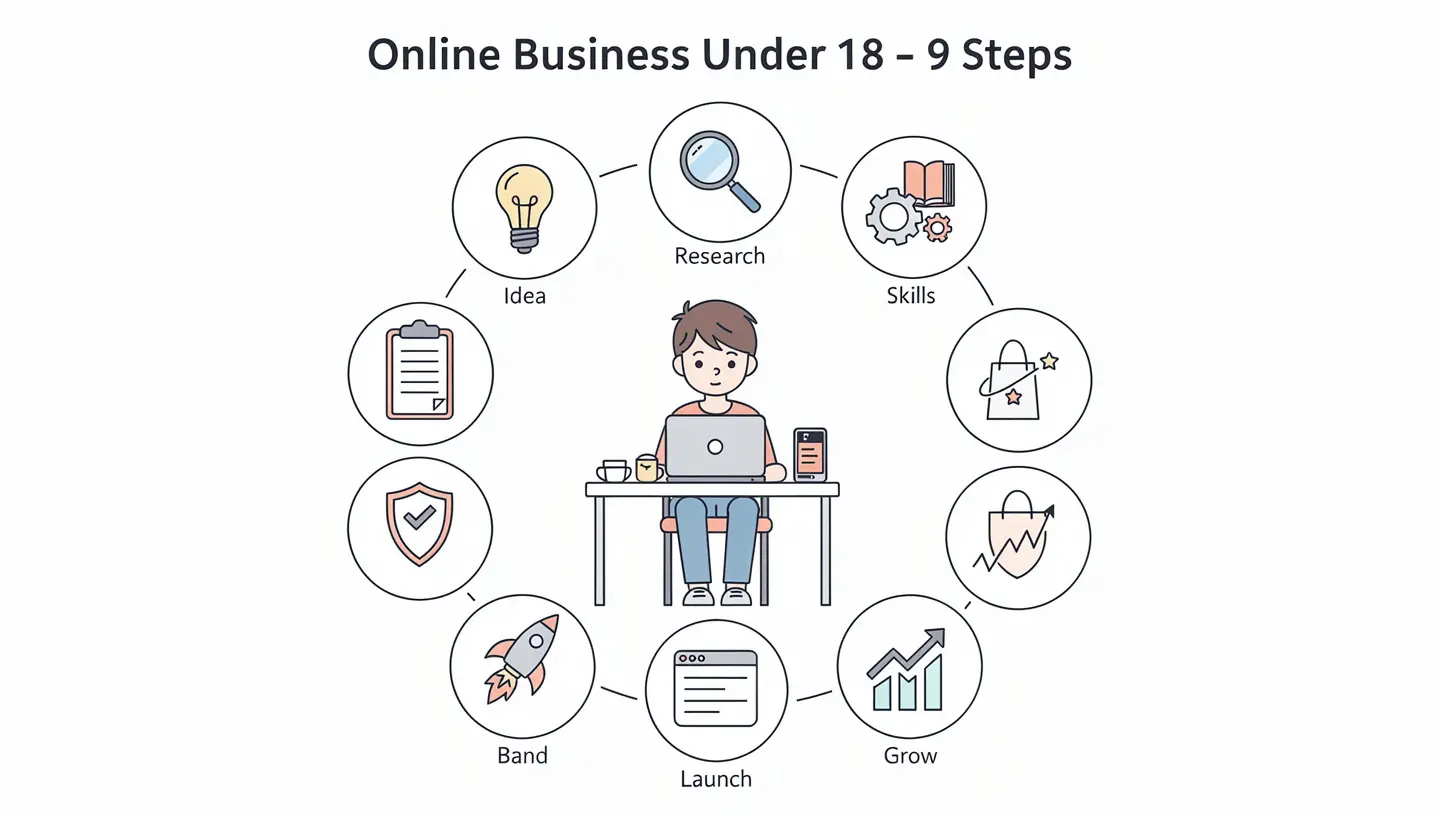
How to Start an Online Business Under 18 in 9 Steps
Follow the steps in order. Each one takes a weekend or less, and none of them needs a big budget.
Step 1: Talk to a Parent or Guardian First
Before you pick a logo or a name, sit down with a parent or guardian. Cover three points: your idea, which accounts need an adult, and how the money will be handled. Ask them to hold the accounts that have an 18+ rule, such as a payment app or a store. Agree on how often the money moves to your own account, who helps with taxes and how many hours a week you can spend on the business without hurting your grades.
Bring a short plan on one page with the idea, the price, the startup costs and the first goal. Parents say yes more often when they see that the idea is thought through.
Parents usually worry about money and time. Show them that the first version costs close to nothing, that you will set weekly hours and that they stay in charge of every account. A teen who arrives with answers gets a yes more often than one who only asks.
Step 2: Pick a Low-Cost Online Business Idea
Do not try to do everything. Choose one of three types:
- Digital products: planners, study guides, printables, templates and social media graphics
- Online services: tutoring, logo design, video editing or social media help for one local shop
- Content: a YouTube channel, a newsletter or a podcast around one topic
If you are not sure, start with digital products. They have the lowest cost and the fastest road to a first sale. Services pay faster than content, and content takes months before it earns anything. Pick something that matches what you are already good at, since you will do it after school for a long time.
Think about what friends already ask you for help with. A teen who edits videos for fun, makes slides for classmates or explains math to a younger cousin already has the skill for a service. Write down three ideas, then cross out two.
Step 3: Check That People Will Pay
Spend one weekend on this step. Ask ten people who fit your buyer, such as classmates, neighbors or members of an online group, whether they would pay a set price for your product. Count only clear yeses. If three people say they would buy at that price, go ahead. Polite interest does not count.
For a service, post your offer once in a few groups where your buyers hang out. One paying client tells you more than a hundred likes. If nobody answers, change the offer or the price before you change the whole idea.
Use free ways to ask. A poll in a class group chat, a post in a niche Discord server and a short message to ten people cost nothing. Write down every answer, including the no, because the no tells you what to change.
Step 4: Set a Price and Work Out Your Costs
List your startup costs first. Many online ideas need nothing more than a phone or laptop and a free design tool. Then split the rest into variable costs, which change with each sale (printing, shipping, fees), and fixed costs, which stay the same (a domain name or a monthly app).
Look at what similar products sell for on Etsy or in local listings, then set your price. For example, if a print on demand shirt costs 14 dollars to make and ship and you want 8 dollars in profit, the price is 22 dollars. Write the numbers down. This is the start of your business plan, and one page is enough.
Do not set the price too low. Very low prices make buyers doubt the quality and leave no profit to reinvest. Compare your price with other teen sellers and with adults who sell the same thing, and place yours in the middle.
Step 5: Build the Smallest Working Version
Do not spend a month on a perfect logo. Build the smallest version that someone can pay for. For a digital product, that is one file, one page and one clear picture of what the buyer gets. For a service, it is a five-line description and a way to book you, such as a message or a free landing page.
Free design tools are enough for the first version. Use the tools section below for options that cost nothing or very little, and skip paid bundles and courses until you have sales. A domain name from Namecheap and hosting from Hostinger can wait until the first sales come in.
Take a few clear pictures or mockups and write a short description that says who the product is for and what problem it fixes. One sentence about the buyer’s problem sells better than a list of features.
Step 6: Set Up Payments and a Bank Account With a Parent
Most banks require the account holder to be 18, so a teen usually needs a custodial account or a joint account with a parent. Keep business money in that account and away from your spending money. Payment apps such as PayPal and Stripe also need an adult, so the account goes in a parent’s name.
Ask the bank about custodial and joint accounts for minors, since offers differ and some charge a monthly fee. A teen under 18 cannot open one alone, so choose the account together with a parent.
Decide in advance how to split every payment. A simple rule works well: part goes back into the business, part goes to savings and part is yours to spend. Anyone under 18 who handles money should write the split down so there is no argument later.
Step 7: Get Your First Paying Customer
Aim for one paying customer in 14 days. Not a thousand followers, not a perfect website. One person who pays. Tell your family and friends, post in two or three online groups in your niche and message ten people who fit your buyer. Offer the first three customers a small discount in exchange for a short written review.
If fourteen days pass with no sale, look at the three usual causes: the offer is unclear, the price is off or the audience is wrong. Fix that one thing, not the whole business.
Reply fast to every message and deliver what you promised. A happy first customer is your best marketing, so ask for a review and for one referral.
Step 8: Keep Records and Plan for Taxes
Use a simple spreadsheet or a notebook. Write down every sale, expense and refund with the date and the amount. You need these records at tax time to work out profit.
In the United States, a minor can owe taxes on business income. The IRS says a return is needed when net profit from self-employment reaches $400 in a year. You report it on Form 1040 with Schedule C for profit or loss and Schedule SE for self-employment tax. The IRS Self-Employed Individuals Tax Center explains what counts as income and which expenses you can claim. Other countries have their own limits, so search for the official page in your country and let a parent help with the filing. Keep receipts and screenshots of payouts in one folder, so a parent can fill in the forms in an afternoon at the end of the year.
Step 9: Protect Your Schoolwork and Your Safety
Set fixed hours for the business, such as two evenings and one weekend slot, and block them in a calendar. When exams come, scale the business down, not your studying.
Keep your personal details private. Use a business email address, skip your home address and phone number, and let a parent review messages from strangers. If your site collects names or emails from children under 13, the US law called COPPA requires a privacy policy and permission from a parent. If your idea involves paid work such as lawn care, pet sitting or deliveries, a parent should also check the youth employment rules for your state before launch. If you feel tired or your grades slip, cut the hours. A business that runs small for years beats one that burns out a teenager in a month.
A Simple Plan for Your First 30 Days
If you want a clear schedule, use this one. It fits around school and keeps every step small, so a teen under 18 can follow it without a big budget.
- Week 1: talk to a parent, pick one idea and ask ten people if they would pay.
- Week 2: set the price, write the one-page plan and build the smallest working version.
- Week 3: open the accounts with a parent, post your offer in three places and message ten buyers.
- Week 4: deliver to your first paying customer, ask for a review and write down every sale and cost.
After the 30 days, look at what sold, what did not and how many hours it took. Keep the part that worked and drop the rest.
Best Online Business Ideas for Teens With No Money
A good online business idea for a teenager costs little, has flexible hours and can be run from home.
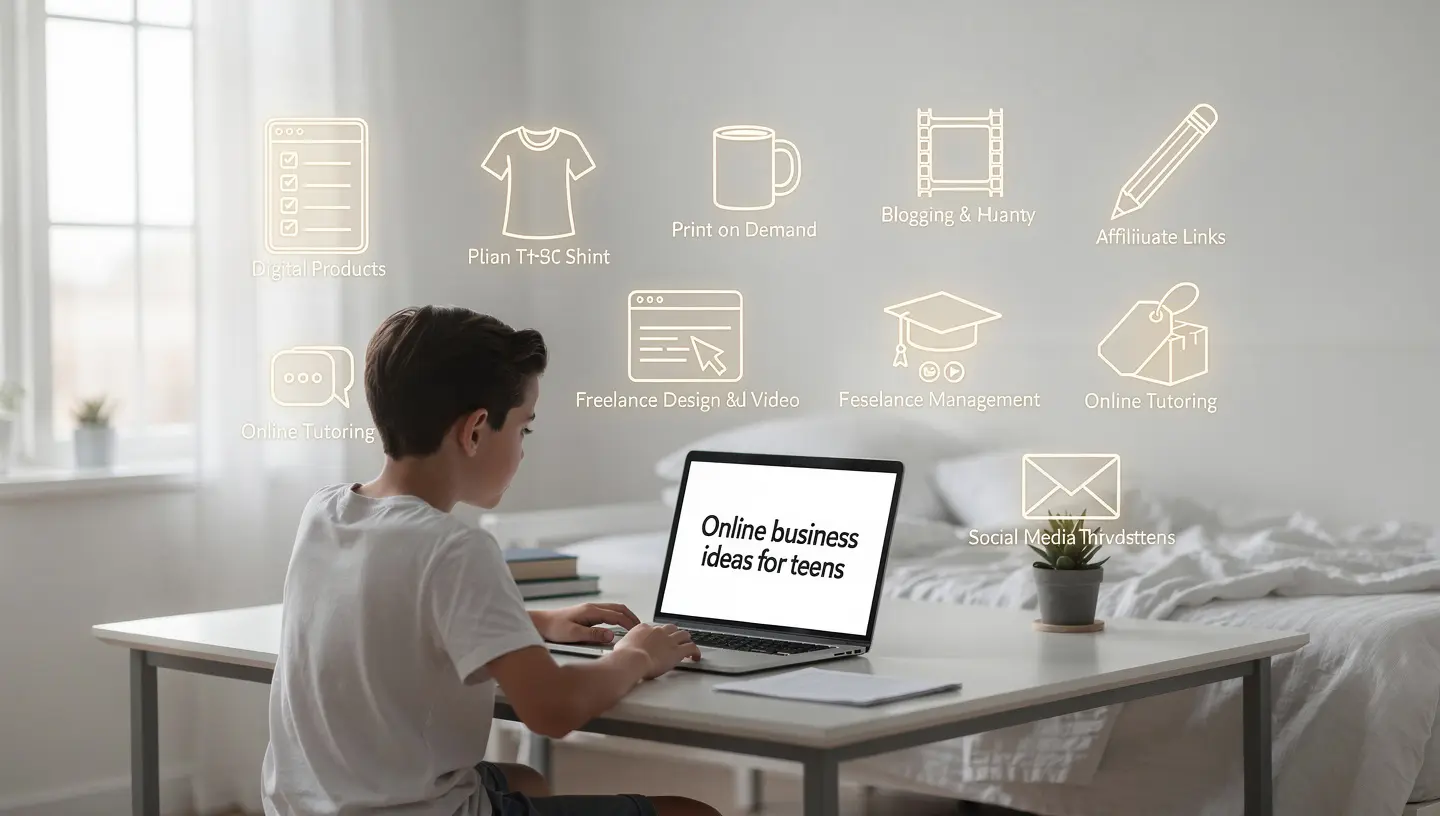
These online business ideas for teens work because they need no stock, no premises and no loan. The table shows eight business ideas for teens with no money, with the startup cost and a free tool for each.
| Idea | Startup cost | Free tool | Best for |
|---|---|---|---|
| Digital products (planners, study guides, templates) | Close to $0 | Canva free plan | Organized students and designers |
| Print on demand (shirts, mugs, posters) | $0 upfront, you pay when an order sells | Canva free plan | Artists with a clear style |
| Blog or niche website with affiliate links | Domain and hosting cost each year | Free blogging platforms to test | Writers who can wait months for income |
| Freelance design or video editing | $0 | Canva and free editing apps | Teens with a portfolio of school or hobby work |
| Online tutoring | $0 | Free video call app | Strong students who like teaching |
| Social media management for a local shop | $0 | Free scheduling tools | People who know TikTok and Instagram well |
| Reselling thrifted items online | The price of the stock | Free listings on marketplaces | Teens with an eye for deals |
| YouTube channel or newsletter | $0 | Phone camera, free email tool | Teens who enjoy making content every week |
Print on demand works like this: you upload a design, a supplier prints and ships each order, and you pay only after a customer buys. That makes it one of the lowest-risk ways to sell products online. Start with one row. Digital products and services give the fastest first sale, while the blog and the channel need patience. If you are younger than 13, take a look at these business ideas for kids and work on them with a parent.
Tools to Start for Free or Almost Free
You do not need paid software to launch. These tools cover design, pages, email and a store. Read the terms of each one before you sign up, since an adult usually has to hold the account and the payment card.
- Canva: the free plan covers logos, social posts, product mockups and simple graphics for digital products.
- Systeme.io: the free plan includes up to 2,000 contacts, three sales funnels and unlimited emails, so you can build a landing page and an email list without paying. Paid plans start at around 17 dollars per month.
- Namecheap: a place to register a domain name. A .com is a yearly cost, usually around 10 to 15 dollars, and it is optional for a first version.
- Hostinger: web hosting for a WordPress site if you decide to start a blog or a small store. Plans start at a few dollars per month.
- Shopify: best for physical products, and a parent has to own the account. The Starter plan is the cheapest way to sell through links and social media.
Free plans have limits, such as a cap on contacts or funnels, and you only need to upgrade when you hit one. To save time on homework so the business does not eat your study hours, check out these AI tools for class 9 students.
How Much Can a Teenager Earn Online?
It depends on the idea, the price and the hours you put in. Digital products and services often bring a first sale in a few weeks and small monthly income after that. A blog or a channel can take six months or more before the first dollar. Plan for the typical result, not the viral one, and reinvest the first earnings in the one thing that works. A teen who earns a small amount each month and keeps learning is ahead of one who waits for a big break.
Money also takes time to arrive. Payment apps hold funds for a few days, and a parent handles the transfer to your account. As orders grow past what you can manage between classes, look at what an online business manager does, since it shows which tasks can be handed off.
Mistakes to Avoid When You Start Young
Most teens who quit in the first month make the same few mistakes. Check the list before you spend anything on your online business under 18.
- Paying for a course that promises fast money. Many dropshipping and “get rich” programs sell a dream. Learn from free guides first.
- Lying about your age. Accounts that break the age rule get closed, and the money and the work go with them.
- Skipping the parent. Without an adult on the accounts, you cannot get paid or may lose access to the money.
- Buying tools before you have sales. A teen with a few hundred dollars a month does not need a monthly mastermind.
- Selling for a multi-level marketing company. You become the customer, not the owner of a business.
- Treating crypto or forex trading as a business. It is a bet, not a service or a product.
Final Verdict: Start Small This Week
If you are wondering how to start an online business under 18, the answer is a short list. Talk to a parent, choose one low-cost idea, test it with ten people, set up the accounts with an adult and get one paying customer. Keep records from the first sale and protect your grades. A small, simple offer that sells beats a big plan that never launches.
Frequently Asked Questions
Can you start an online business under 18?
Yes. There is no federal minimum age for running a small business in the US. The limit is that minors cannot sign binding contracts, so a parent or guardian has to open the bank account, hold payment apps and sign for anything official. A teenager can still build the product, find customers and run the daily work.
How can I start an online business as a teenager with no money?
Pick an idea that costs nothing to start, such as digital products, tutoring or design work, and use free tools like Canva and the Systeme.io free plan. Validate the idea with ten people, then get your first customer through friends, school groups and online communities. Spend money only after a sale. Keep the first version small, and ask a parent to hold any account with an age limit.
How old do you have to be to start an online business?
You can start at any age with an adult’s help. Platforms usually need an account holder who is 18 or older, so younger teens work through a parent’s account. Kids under 13 should also keep online privacy rules in mind.
Do I need my parents’ permission to start a business?
In practice, yes. A parent or guardian has to co-sign contracts, open a custodial or joint bank account and hold accounts on platforms with an 18+ rule. Their support also helps with taxes and safety.
Can a minor sell on Shopify, Etsy or PayPal?
Not as the account owner. These platforms require account holders to be at least 18, so a parent opens the account and you handle the products, the pictures and the customers. The payouts go to the parent’s bank account or to a custodial account.
What is the best online business for a 15-year-old?
Digital products, online tutoring and freelance design are the easiest to start at 15, since they need almost no money and fit around school. For more options, browse these online business ideas in Kenya and pick the models that work in your country.
Do teens have to pay taxes on online business income?
Often yes. In the US, a net profit of $400 or more in a year means a tax return, even for a minor. Keep records of every sale and expense, and ask a parent or a tax professional for help. Rules differ in other countries.
Can a 13-year-old run an online business?
Yes, with a parent running the accounts. A 13-year-old can make products, answer customer messages and run social posts under supervision. The parent handles payments, contracts and taxes, and checks the platform rules for minimum ages.