An online business halal question usually comes down to four things: what you sell, how you earn, how you pay and borrow, and how you treat customers. If those four follow Islamic trade rules, a halal online business is possible, because the internet by itself does not change the rules of a sale.
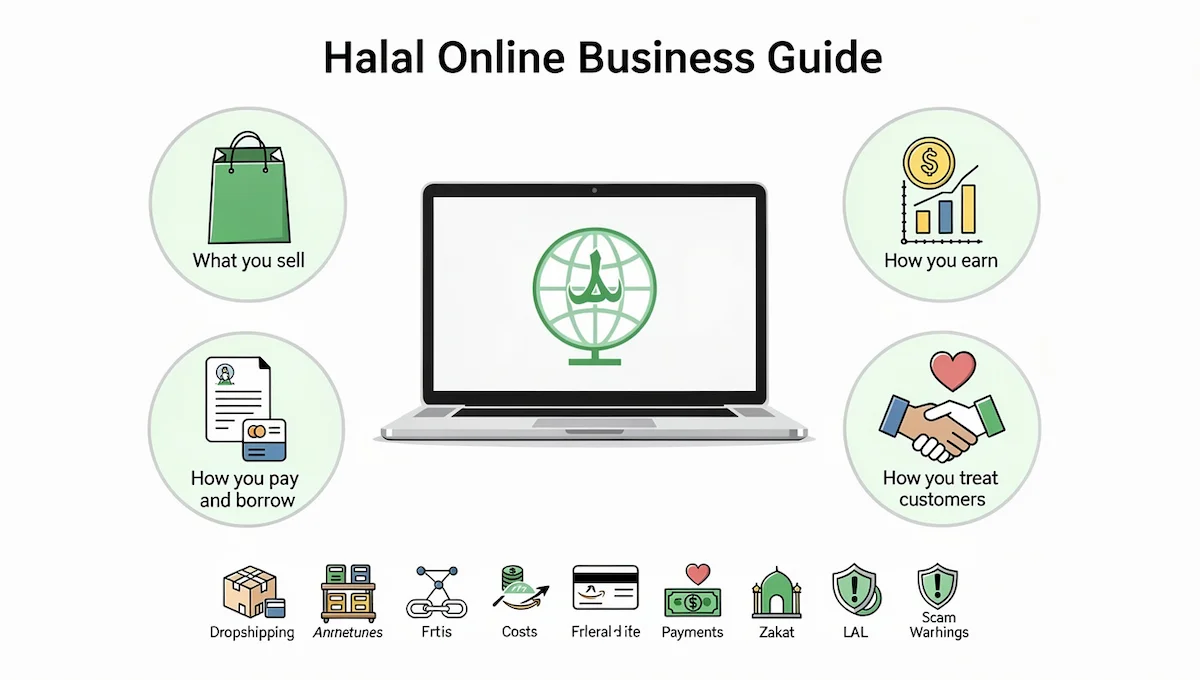
This guide collects what Islamic finance sites, scholars’ answers and halal business blogs say about starting a halal business online. It covers the basic tests, how sources treat models such as dropshipping, Amazon FBA, affiliate marketing and MLM, ten business ideas with costs, payments and loans, zakat, certification and scam warnings.
This is an informational guide, not a religious ruling. Scholars disagree on several points, and many sources are blogs or sellers of courses, so check anything you are unsure about with a qualified scholar.
Is an online business halal? The short answer
Yes, an online business can be halal when the product or service is permissible and the way you run the business follows Islamic trade rules. Sources that explain this agree that an online format does not make a deal haram by itself. If you want the general mechanics first, read our guide on how does an online business work.
Most halal checklists boil down to four questions:
- Is what you sell permissible, such as a halal product or a lawful service?
- Do you own the goods or have a clear way to deliver them before you sell them?
- Is there any interest (riba) in how you earn, pay fees or finance the business?
- Are your descriptions, prices and terms honest and clear?
If the answer to any of these is no or unclear, the business needs a closer look before you start. A halal business follows the same trade rules as any shop, and the only difference is where the sale happens.
What makes an online business halal?
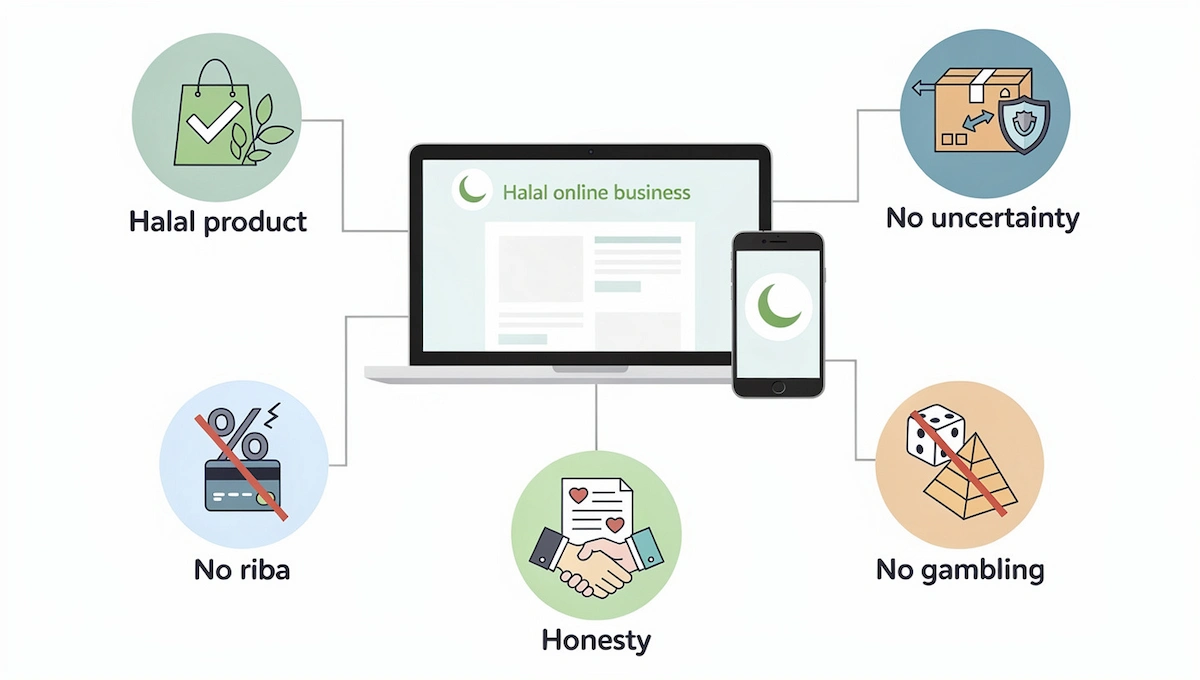
These five points come up in almost every guide on halal income and halal business ideas. They apply to a halal web store, a blog, a freelance service or an app.
The product or service must be permissible
The first test is the simplest one. A halal business does not sell alcohol, pork, gambling or adult content, and it does not provide services that help with them. The same applies to the ads you run and the brands you promote. A modest fashion store, a Quran tutoring service or a halal food shop passes this test. Anything haram, from alcohol to gambling, fails this test at once, and a shop that sells it does not pass, however honest the rest of the business is.
Ownership, delivery and gharar
Many guides quote a well-known hadith that tells traders not to sell what is not with them. Scholars read it in different ways, but the idea behind it is clear: do not sell something you cannot deliver or that you do not control. This is where gharar, meaning too much uncertainty in a sale, comes in. Sources use it to discuss dropshipping, pre-orders and any sale where the seller has no stock and no firm agreement with a supplier.
No riba in how you earn, pay and borrow
Riba means interest. It affects an online business in three places: loans and credit lines, credit cards and late-payment charges. A halal business can avoid interest in its own income and still meet it in financing, so the finance section of this guide matters as much as the product choice. Gharar and riba are the two terms that appear most often when sources explain why a deal is haram.
Honesty and clear terms
Islamic business ethics put weight on amanah, which means trustworthiness. For an online seller this means accurate product descriptions, photos that match what arrives, clear prices and delivery times, honest reviews and a fair returns policy. If you earn from affiliate links, say so. Hiding a defect or exaggerating a result is a breach of trust even when the product itself is halal.
Avoid gambling-like and deceptive models
Maysir, or gambling, covers more than casinos. Sources use it for schemes where the outcome depends on luck or on recruiting others. Pyramid schemes and models that pay mostly for bringing in new members are the usual examples. Promises of fast money fall in the same group, because they push people to buy something with an unclear return.
Online business models: what sources say
Not every model gets the same answer. The table below shows where sources agree and where they disagree. It reports what the sources say and is not a ruling. For models marked as disputed, where one answer calls a model halal and another calls it haram, ask a qualified scholar. If you want a plain overview of each model, see our guide on the types of online business.
| Model | Generally accepted when | Where opinions differ |
|---|---|---|
| Freelancing and services | The service is permissible and terms are clear | Which clients and projects to accept |
| Digital products and courses | The content is permissible and honestly described | What the content promotes |
| Store with your own stock | You own the goods before selling and they are permissible | Which products need certification |
| Amazon FBA | You own the inventory and Amazon acts as your agent | Some sources are stricter when goods ship before you receive them |
| Dropshipping | Sources that allow it want possession or a binding supplier agreement, or a clear agent model | Whether it is allowed at all |
| Affiliate marketing | The product is permissible, there are no lies and you disclose the link | Which programs and products to promote |
| Ads and AdSense | You control or filter the ads shown | When you have no control over ads |
| Network marketing (MLM) | Real product, no joining fee, commission on actual sales | Many scholars reject it because of its structure |
Dropshipping
Dropshipping is the most discussed model, and some sources call it halal under conditions while others call it haram. The strict view relies on the hadith about not selling what is not with you, and says a seller who lists a product before holding it has not yet taken possession. Some sources allow it under conditions. These include a binding agreement with the supplier before you sell, paying for a small amount of stock, or presenting yourself openly as an agent who earns a commission. Salam and Istisna contracts come up too, but one advisory firm explains that they also depend on who carries the risk of the goods.
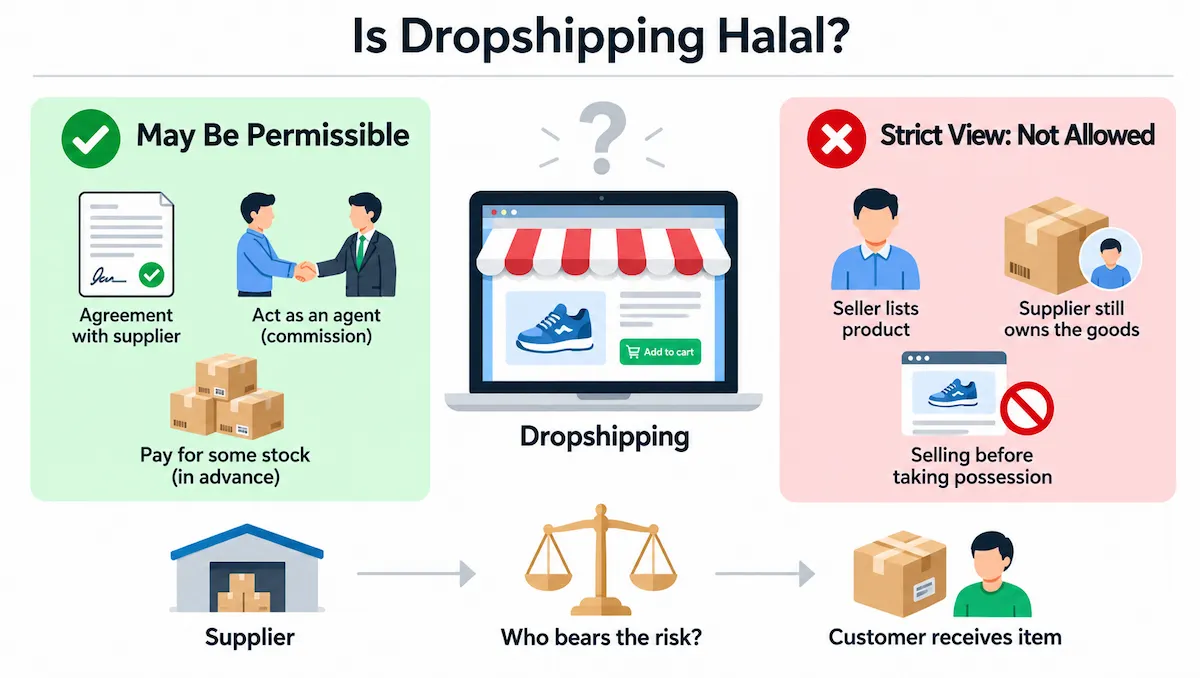
The test many sources use is simple: who bears the risk before the customer receives the item? Blogs written by dropshipping suppliers tend to say it is fine if you are transparent, which is a simplification. Several writers tell readers to ask a scholar and not to rely only on articles.
Amazon FBA and reselling
Sources are more relaxed about Amazon FBA, and most call it halal when you own the stock. A Hanafi answer says it is permissible because Amazon acts as your agent, takes possession and handles logistics for a fee, while you remain the owner of the stock.
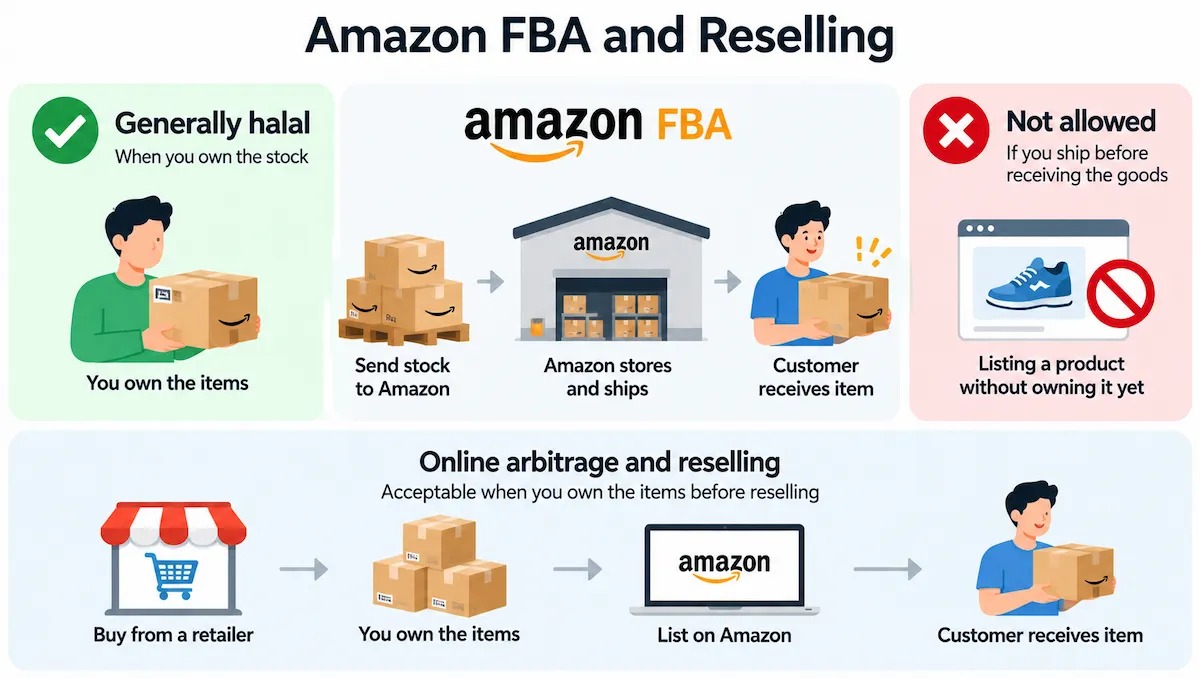
A forum fatwa makes a similar point. A Saudi source is stricter when a buyer’s order is shipped before the seller has received the goods. Online arbitrage is also described as acceptable when the trader really owns the items before reselling.
Affiliate marketing
Sources agree on the basic conditions. The product has to be halal, you should not lie about it, you should disclose that you earn a commission, and the way the customer buys should not break the rules. One fatwa applies this to commissions from large retailers and says it does not matter which item the buyer ends up purchasing, as long as the platform is lawful. Do not promote haram products, even if the program pays well.
Ads, YouTube and AdSense
A scholar’s answer on ad revenue says that selling ad space is not a problem in itself, much like renting out property. If you control the ads, as with YouTube AdSense settings, you should filter them so only permissible ads appear. If you have no control, the answer advises avoiding that income where possible. Halal ad networks, such as Halal.Ad and Muslim Ad Network, also exist for brands that target Muslim audiences.
Network marketing (MLM)
The answer depends on the structure, not on the name, according to one 2026 answer on online MLM. It treats a plan as problematic when it requires a joining payment, forces purchases or pays mainly for recruiting. A genuine referral arrangement, where the product is lawful and has real value and the commission is known, is viewed differently. Other answers from muftis are shorter and say plainly that MLM does not look correct.
Why the halal market matters for online sellers
Demand is the reason so many sellers search for halal online business ideas. The State of the Global Islamic Economy report by DinarStandard puts Muslim consumer spending across six sectors at about US$2.6 trillion in 2024. Muslim spending on food alone was about US$1.53 trillion, or 17.4% of global food spending, and the same report projects it to reach US$2.06 trillion by 2029.
Treat any market number with care. Other research firms publish very different figures for the same market, from a few billion to several trillion dollars, because they define the market in different ways. One report estimates that e-commerce makes up about 23% of halal retail purchases, but its method is not clear, so use it only as a rough sign.
Where the gaps are
Online selling helps most where local choice is thin. Muslims who live in countries with few halal shops often order food, cosmetics, modest clothing and books online. Halal Foundation advises sellers to look for a gap in the market, for example certified food, cosmetics and financial education. Check what buyers in your target country cannot find easily, and start there.
Halal online business ideas at a glance
Here are ten halal online business ideas, with the options built on common online tools first.
- Online store with Shopify – own stock or print on demand, with halal products
- Blog or niche site – content that earns from permitted affiliate links and ads
- Digital products and courses – made once, sold many times
- Freelance services – writing, design, virtual assistance and web work
- Online tutoring and Quran academy – low cost and quick to start
- Modest fashion store – hijabs, abayas and modest clothing
- Halal food products and snack boxes – needs certification and permits
- Islamic apps and software – prayer times, Quran, qibla and halal finders
- Content creation – videos and posts on permissible topics
- Translation and transcription – language work for clients worldwide
Best halal online business ideas
Each review follows the same order: a short description, a table with cost and what to check, then pros and cons. Costs are rough and come from vendor and advisor pages. Every halal business idea below still needs the checks from the earlier sections.
1. Online store with Shopify
A web store is the classic halal e-commerce idea. It lets you sell halal products such as modest fashion, Islamic books, prayer items or certified food and cosmetics. Shopify covers the storefront, checkout and orders in one account, and its Basic plan is listed at about $39 a month, with a card fee of about 2.9% plus 30 cents per online sale. The main halal question is how you hold stock. Own stock, print on demand and wholesale are straightforward, while dropshipping needs the checks described earlier. Keep product descriptions accurate and photos honest.
| Detail | Estimate |
|---|---|
| Cost to start | Own stock from about $2,000, print on demand from a few hundred dollars |
| How you earn | Direct sales |
| Best for | Sellers of halal products |
| What to check | Possession of stock and supplier certificates |
Pros
- Full control of brand and prices
- Works with own stock or print on demand
- Many payment and shipping options
- Sales data in one place
Cons
- Ads are needed for steady sales
- Dropshipping models need extra checks
2. Blog or niche site
A blog or niche site earns halal income from affiliate links, ads and sponsored posts. You register a domain with Namecheap and host the site on Hostinger or a similar provider, then publish helpful content about a halal topic such as modest fashion, family finance or Islamic education. Affiliate links should lead only to permissible products, and you should disclose them. Ads need filtering where the network allows it. It costs little but grows slowly.
| Detail | Estimate |
|---|---|
| Cost to start | Domain and hosting about $50 to $150 a year |
| How you earn | Affiliate links and ads |
| Best for | Writers and people with niche knowledge |
| What to check | Which products and ads appear on your site |
Pros
- Low start-up cost
- Free search traffic once content ranks
- Works from home
- No stock or shipping
Cons
- Slow to earn
- Ads and affiliate offers need checking
3. Digital products and courses
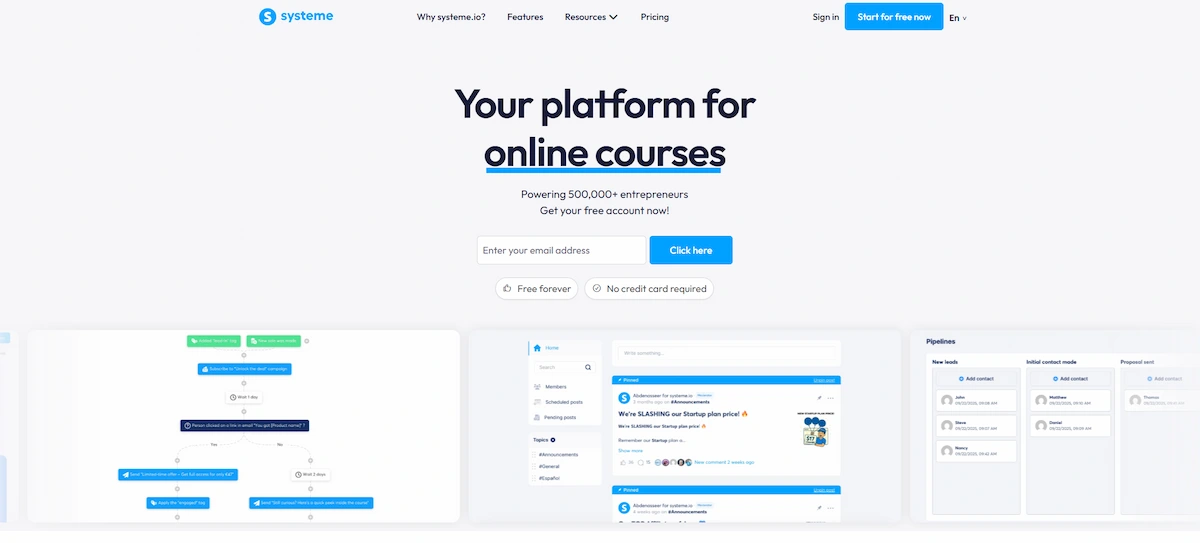
Ebooks, planners, printables, Islamic study guides and online courses are made once and sold many times. You can design them in Canva, then build a landing page, email list and checkout in Systeme.io, which has a free plan with up to 2,000 contacts. There is no stock and no shipping, so questions about possession rarely arise. The check here is the content itself and how honestly you describe the result. Our guide on how to start a digital business explains the setup.
| Detail | Estimate |
|---|---|
| Cost to start | Free plans possible, paid tools from about $17 a month |
| How you earn | Direct sales |
| Best for | Experts and creators |
| What to check | Content and honest claims about results |
Pros
- Make once, sell many times
- No shipping or stock
- Free tools to start
- High margins
Cons
- Needs an audience
- Many sellers in popular niches
4. Freelance services
Writing, graphic design, virtual assistance, social media management and web development are all common halal freelance options. You sell a skill, the client pays for the work, and nothing needs to be held in stock. A halal freelancer chooses clients and projects with care: designing or promoting something prohibited is not accepted by most guides. Payments are best taken with low fees and without interest or hidden charges.
| Detail | Estimate |
|---|---|
| Cost to start | About $50 to $300 |
| How you earn | Fees by hour, project or retainer |
| Best for | People with a skill clients pay for |
| What to check | The clients and the content you work on |
Pros
- Fast to start
- Low costs
- Quick feedback from clients
Cons
- Income tied to your hours
- Client work can be uneven
5. Online tutoring and Quran academy
Online tutoring covers school subjects, languages, Arabic and Quran reading. Start with a few students, a video call tool and a simple booking page. Parents trust tutors they know, so word of mouth and community groups bring the first learners. Quran academies need qualified teachers, and many sources list them among the lowest-cost ideas for Muslim entrepreneurs because they need almost no equipment.
| Detail | Estimate |
|---|---|
| Cost to start | Very low, often under $100 |
| How you earn | Hourly or monthly fees |
| Best for | Teachers and tutors |
| What to check | Teacher qualifications and student safety |
Pros
- Very low cost
- Quick first revenue
- Strong community demand
Cons
- Hours are limited
- Scheduling across time zones takes effort
6. Modest fashion store
Online hijab, abaya and modest clothing stores are among the most common halal e-commerce ideas. Choose between making items, buying wholesale or using print on demand. Own the stock or have a clear agreement with the supplier before you list anything, and describe sizes, fabrics and colors accurately, because returns are common in clothing. Pay attention to the image style you use on the store.
| Detail | Estimate |
|---|---|
| Cost to start | From a few hundred dollars for print on demand, more with stock |
| How you earn | Direct sales |
| Best for | Designers and resellers |
| What to check | Possession, sizing and returns |
Pros
- Strong demand worldwide
- Many suppliers and tools
- Works for niches like sports or kids wear
Cons
- Returns and sizing issues
- Stock is a cost for new sellers
7. Halal food products and snack boxes
Halal snack boxes, sauces, spices and ready meals sell well online, but food is also the most regulated category. You need to source halal-certified ingredients, follow food safety and labeling rules in your country, and ship in packaging that keeps products safe. Certification is usually expected, since buyers want proof, and there is no single global halal standard.
| Detail | Estimate |
|---|---|
| Cost to start | Higher: ingredients, packaging, permits and certification |
| How you earn | Direct sales or subscription boxes |
| Best for | Cooks and food businesses |
| What to check | Certificates, permits and shelf life |
Pros
- High demand for trusted halal food
- Repeat purchases through subscriptions
- Strong community marketing
Cons
- Permits and certification cost money
- Shipping and shelf life are hard
8. Islamic apps and software
Apps for prayer times, Quran reading, qibla direction and halal restaurant search are common examples in the guides. Software needs more work and money at the start, but it can earn from subscriptions without shipping anything. Review your ad partners and in-app purchases, and keep the content accurate. For early-stage ideas, see our list of business ideas for applications.
| Detail | Estimate |
|---|---|
| Cost to start | Highest, from a few thousand dollars up |
| How you earn | Subscriptions or in-app purchases |
| Best for | Technical founders or teams |
| What to check | Content accuracy and ad partners |
Pros
- Recurring revenue
- Scales without shipping
- Large global audience
Cons
- High up-front effort
- Support and updates never stop
9. Content creation
Videos, podcasts and social posts on permissible topics, such as cooking, education, fitness or family life, can earn from sponsors, affiliate links and ads. Ad income is the sensitive part, since you may not control what is shown. Take only sponsors with products you can honestly recommend, and be clear when a post is paid. A phone is enough to begin.
| Detail | Estimate |
|---|---|
| Cost to start | A phone and a free editing app |
| How you earn | Sponsors, affiliate links, ads |
| Best for | Creative people with a clear topic |
| What to check | Sponsors and ad filters |
Pros
- Low start-up cost
- Builds an audience you own
- Can lead to products of your own
Cons
- Slow to earn
- Ad control is limited
10. Translation and transcription
Translators and transcribers work for clients around the world, and the skills are in demand for Arabic, English, Bosnian, Turkish and many other languages. You need a language pair, a clean workspace and a simple portfolio. Choose projects with permissible content and agree on the price and deadline in writing.
| Detail | Estimate |
|---|---|
| Cost to start | Very low, mostly your time |
| How you earn | Per word, per page or per hour |
| Best for | Bilingual people |
| What to check | Content of the projects |
Pros
- Very low cost
- Work from home
- Steady demand
Cons
- Rates can be low at the start
- Client quality varies
More halal online business ideas worth a look
These ideas appear in several halal business lists. They did not get a full review here, but each can start small.
| Idea | What it is | Cost level | Watch out for |
|---|---|---|---|
| Halal skincare and cosmetics | Certified products or private label | Medium to high | Ingredient and certification checks |
| Event planning for Eid and aqeeqah | Plan and coordinate events online | Low | Local rules and vendor quality |
| Islamic art and calligraphy prints | Digital or printed designs | Low | Accuracy of text and sources |
| Online cooking classes | Live or recorded halal cooking | Low | Food safety and ingredient claims |
| Halal travel planning | Itineraries for Muslim-friendly trips | Low | Accurate facility information |
| Study and parenting courses | Online Islamic or family courses | Low to medium | Qualified teachers and sources |
| Tech help for older people | Setup help for phones and video calls | Very low | Privacy and safety at home visits |
| Book summaries | Short summaries of permissible books | Very low | Copyright |
How to choose the right halal business idea
Do not pick an idea only because a list ranks it first. Compare cost, time and risk for your own situation. The table gives a rough comparison of six common options.
| Idea | Startup cost | Time to first revenue | Scalability | Main check |
|---|---|---|---|---|
| Online store with Shopify | Medium | 1 to 3 months | High | Possession of stock |
| Blog or niche site | Very low | Several months | Medium | Ads and affiliate offers |
| Digital products and courses | Low | 1 to 3 months | High | Content and claims |
| Freelance services | Very low | Weeks | Medium | Clients and content |
| Online tutoring | Very low | Weeks | Low to medium | Teacher qualifications |
| Islamic app | High | Many months | High | Content accuracy and ad partners |
Then run a short test on the idea you like:
- Does it pass the permissible-product test?
- Can you try it in a week or two without spending much?
- Can you run it with the time you have?
- Does it avoid borrowed money with interest?
If an idea passes all four, start small. If two ideas pass, pick the one you can test fastest.
Halal payments, loans and financing for an online business
Finance is the part most guides skip, but it is where riba usually enters a halal business. These sections report what Islamic finance sites say. They are not personal advice.
Payment methods and processors
Accepting card payments is a normal part of an online store, and processors charge a fee on each sale. Sources discuss riba mostly from the consumer side, for example interest on credit cards, and say much less about the merchant who receives card payments. If you have doubts about a processor’s fees or terms, ask a scholar. A few halal-focused gateways, such as PayHalal in Malaysia, present themselves as Shariah-compliant, but they are regional and small. Whatever you use, keep fees and terms clear in your records.
Getting paid from abroad
Freelancers and online sellers often get paid across borders, and transfer fees and exchange rates can quietly eat income. Compare what each payout method charges, check the exchange rate you actually receive and avoid services with hidden fees or interest-based features. Keep a record of every payment, because you will need it for taxes and for your zakat calculation.
Business loans and credit cards
Sources that discuss whether a business loan is haram treat a conventional loan, a line of credit and a merchant cash advance as riba and therefore haram. A business credit card that is paid in full every month is described as conditional: many modern scholars tolerate it, while stricter ones avoid it, and one source notes there is no Shariah-certified business card in the US. A loan with no interest and no fee, called qard hasan, is accepted. Bootstrapping is also common. Our guide on online business without investment lists ideas that need little or no borrowed money.
Halal financing alternatives
Islamic finance offers three structures that replace interest. In murabaha, the financier buys the goods and sells them to you at a known profit. In musharakah, the financier and the business owner share profit and loss as partners. In ijara, the financier buys equipment and leases it to you. Providers are mostly regional, and a few operate in the US, such as Devon Bank and IjaraCDC. These products can be slower and costlier than a loan, so many founders start small with their own money. If funds are tight, read our notes on starting an online business with no money.
Buy now pay later at checkout
Buy now pay later (BNPL) often comes up for stores. Sources say a plan with no interest and no late fees is closer to a deferred sale and is generally treated as acceptable, while a plan with interest is riba. Klarna Pay in 4 is described as conditional, and one source notes that standard-setting bodies have doubts about BNPL in general. Offering BNPL at checkout means the provider charges you a fee, so check the terms and ask a scholar before you add it.
Zakat on an online business
Zakat is due on business wealth, and an online business is no exception. The common method values the business on one date each lunar year, subtracts short-term debts and pays 2.5% of what is left, provided the total is above the nisab. Calculators and finance sites explain this in similar words, but they differ on some details.
What counts
Most sources count cash and bank balances, stock that you hold for sale and money that customers owe you and are likely to pay. Equipment, computers, the website itself and a rented workspace are tools, not trade goods, so they are normally left out. Freelancers count their balances and unpaid invoices that are expected to be paid. If you have partners, each partner counts their own share.
Formula and worked example
The formula is simple: zakatable assets minus short-term liabilities, multiplied by 2.5%. Here is a worked example for a small online store.
| Detail | Estimate |
|---|---|
| Cash and bank balances | $30,000 |
| Stock at market value | $18,000 |
| Receivables expected to be paid | $6,000 |
| Short-term liabilities | – $9,000 |
| Net zakatable wealth | $45,000 |
| Zakat due (2.5%) | $1,125 |
The nisab is based on gold or silver, so check the current value before you compare. A business that is slow or at a loss can still owe zakat if its assets are above the nisab, according to some sources.
Where scholars and calculators differ
Three points vary. First, how to value stock: most sources use the current selling price, while one page says the lower of cost and market price. Second, whether self-employed people pay on assets or on net profit. Most guides use assets, but at least one self-employed guide uses profit. Third, how to treat money owed by weak customers. Because of these differences, pick a method, keep records and ask a scholar who knows your situation.
Halal certification and sourcing halal products online
If you sell food, cosmetics or supplements, buyers expect proof that the product is halal. A halal food business is the case where certification is nearly always expected. For clothing, books or digital goods, certification is usually not the issue, and the questions are about honesty and possession.
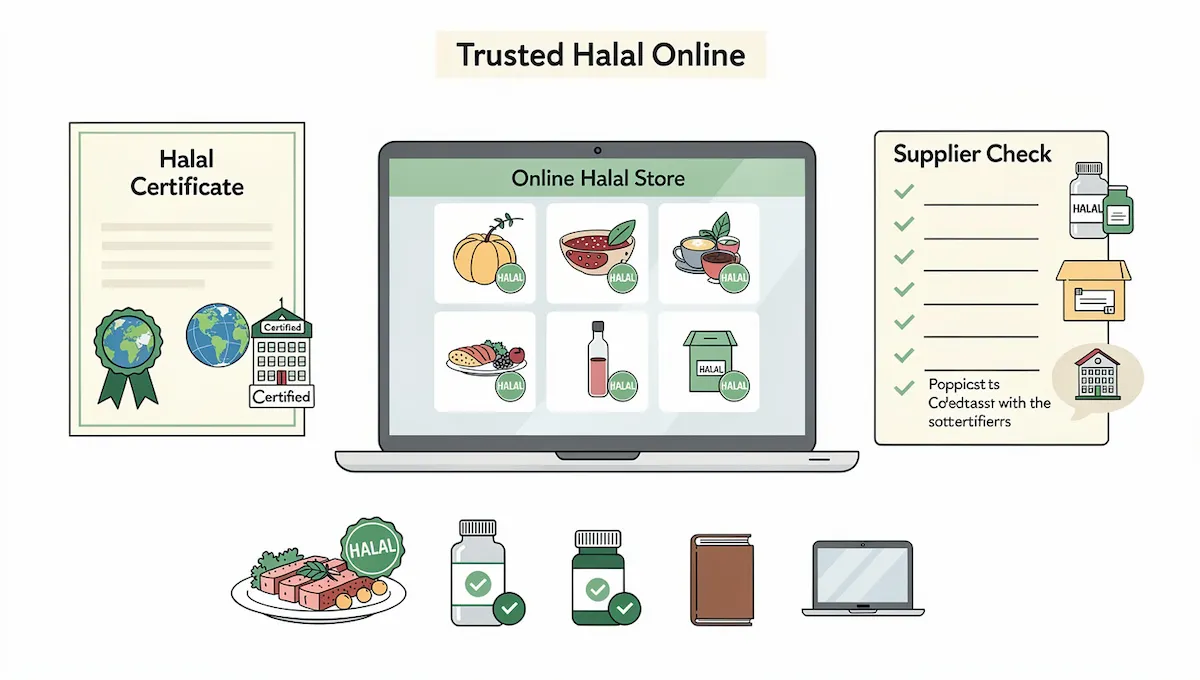
Certificates come from certification bodies, and the picture is not simple. There is no single global halal standard, so different bodies may read the rules differently. Many certifiers also sell their services, so treat their marketing with care. For a shop in a market with strong halal demand, look at our setup guide for starting an online business in Qatar.
When you choose a supplier, check these points:
- The certificate is current and lists the product or plant you are buying from.
- The issuing body is recognized in the market where you sell.
- The supplier can name the ingredients and the source of any animal-based items.
- You can contact the certifier to confirm the certificate.
- The labels and packaging match what the certificate covers.
Halal marketplaces and mainstream platforms
Halal-focused marketplaces, such as Zilzar, have existed for years, but several niche platforms have had mixed results. Mainstream options like Etsy, Amazon or your own Shopify store reach more buyers. On either route the same rules apply: permissible products, honest listings, and stock or agreements that you actually control.
How to start a halal online business step by step
These steps work for most models. Skip the ones that do not apply to your idea.
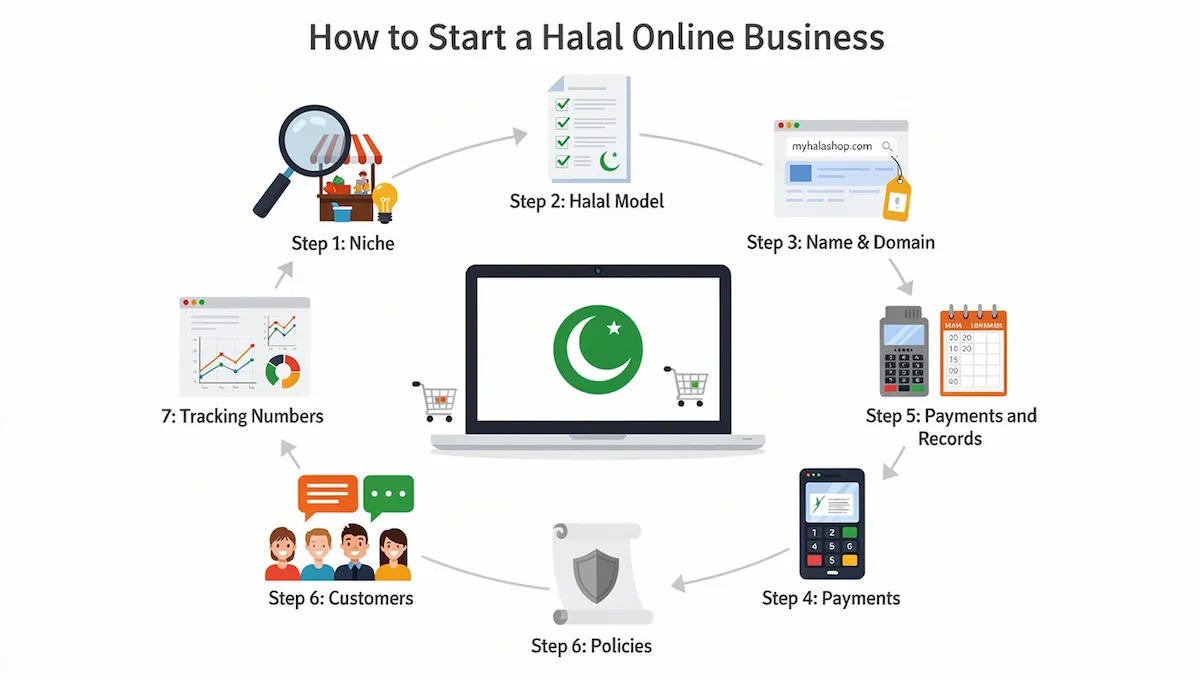
- Pick a niche and an idea for your halal business. Match your skills with a real need and check the permissible-product test.
- Check the model. Confirm that you own the goods or have a clear agreement, and that there is no interest in how you earn or finance.
- Choose a name, domain and platform. A domain from Namecheap costs about $7 for the first year, and hosting from Hostinger starts near $3 a month on a long plan.
- Set up payments and records. Use a clear payment provider, keep every receipt and note the date when zakat is due.
- Write your policies. Publish honest descriptions, prices, delivery times and a returns policy.
- Get your first customers. Start with people you know, community groups and one marketing channel.
- Track the numbers. Check traffic, sales, costs and profit every week, and adjust.
Starting costs depend on the model. A service business can begin with about $50 to $300, a dropshipping store with $100 to $500 by vendor estimates, and a store with stock from $2,000 and up. Sources disagree widely on totals. People under 18 usually need a parent or guardian to open payment and platform accounts, and our guide on how to start an online business under 18 explains what that involves.
Can you start part-time? Some halal business blogs say one to two hours a day is enough to begin. That comes from sellers of courses, so treat it as a rough guide. A service or a digital product can start in that time, while a store with stock needs more hours.
Halal marketing and customer honesty
Marketing is where honesty gets tested. Accurate product claims, real photos and clear prices matter more than clever copy. Avoid false urgency such as countdown timers that reset, invented stock levels or fake reviews, since each one misleads the buyer. Disclose affiliate links and sponsorships in plain words.
Choose your ad partners with care, and do not promote haram products, even in a banner. Some brands use halal-focused ad networks to reach Muslim audiences, while others run normal campaigns and filter categories. Whichever you pick, review what appears on your site and fix problems quickly.
Social proof and reviews
Buyers trust other buyers, so ask satisfied customers for honest reviews and show them on your site. Display certificates where they apply, and share real photos of products and packaging. Never buy or invent reviews, since that is deception however many sales it brings.
Community and networking
Many sources suggest starting with the community you already know: family, mosque groups, Muslim business chambers and online groups. Word of mouth builds trust faster than ads, especially for a new halal business. Join a few groups, help people before you sell and be patient, because trust takes months to build.
Halal online business for women and students
For women
A home-based online business suits many women, and halal job lists often include freelance writing, virtual assistance, social media management, self-publishing, tutoring and modest fashion. Pick a model that fits your hours and keep the setup simple. Many women combine two small income streams, such as a tutoring service and a digital product, so one slow month does not stop everything. Our list of remote business ideas shows more options that work from home.
For students
Students need low cost and flexible time. A student with exams has less time, so a service you can pause is better than one with fixed customer hours or stock to manage. Tutoring, freelance writing, virtual assistance, translation and print on demand all start with very little money. Choose one idea, test it for a month and keep the time for study. Also check whether your school or visa rules limit paid work, since some students are not allowed to earn income in the country where they study, and keep a simple record of what you earn. Our collection of business ideas for students has more ways to earn while studying.
Red flags: halal business scams and hype
Because halal income is a popular search, it attracts sellers of expensive courses. Watch for these signs:
- Guaranteed income. Nobody can promise earnings from a store, trading or a course.
- Halal as a sales slogan. Words like halal wealth or guaranteed halal income are marketing, not proof.
- Pay to join. Real jobs and real programs do not charge you to start.
- Income from recruiting. If you earn mostly by bringing in others, it is a red flag, and many answers call such a plan haram.
- Screenshots of earnings. They are easy to fake and prove nothing.
Before you pay, search the company name with words like scam, review and complaint, and show the offer to someone with no link to it, ideally also to a scholar. The US Federal Trade Commission explains how to report a problem in its guide to job and business scams.
Common mistakes
- Assuming online means no rules. The same trade rules apply.
- Selling what you do not have. Check possession before you list.
- Taking interest in financing. Look for halal alternatives or bootstrap.
- Skipping the zakat date. Put it in your calendar when you start.
- Copying a list without checking. Each model has its own conditions.
- Relying on one blog. Compare sources and ask a scholar for disputed points.
Final thoughts on online business halal
An online business halal setup, meaning a halal online business, is possible when the product is permissible, you own or control what you sell, there is no riba in how you earn or finance, and you deal honestly. Pick a clear model, check the points that sources disagree on, keep records and ask a qualified scholar when in doubt.
Frequently asked questions about halal online business
Is online business halal?
An online business can be halal when the product or service is permissible and you follow Islamic trade rules on ownership, interest and honesty. The online format does not change those rules.
What makes an online business halal?
The product is permissible, you own or control the goods, there is no riba in earning or financing, and you are honest in descriptions, prices and terms. Avoid gambling-like and deceptive schemes.
What is the safest way to earn halal income online?
Sources usually point to services and digital products, such as freelancing, tutoring and online courses, because they involve no stock and few ownership questions. Choose permissible clients and content.
Is dropshipping halal?
Sources disagree. Strict views say selling what you do not hold is not allowed, while others accept it with a binding supplier agreement or a clear agent model. Ask a scholar before you start.
Is affiliate marketing halal?
Sources say it can be, if the product is halal, you do not lie, you disclose the link and the platform is lawful. Do not promote prohibited products.
Is Amazon FBA halal?
Several sources say yes, because you own the inventory and Amazon acts as your agent. Some are stricter when goods ship before you receive them, so check the details.
Is freelancing halal?
Freelancing is generally accepted when the service is permissible and the terms are clear. Avoid projects that promote or help with prohibited content.
Can I start a halal online business with no money?
Yes, with services such as tutoring, freelance writing or translation, which need little beyond time. Use free tools and avoid borrowing with interest.
Which halal business ideas need no investment?
Tutoring, freelancing, virtual assistance, translation, and blogging on free plans need little or no money. Digital products can start on free plans too.
Do I pay zakat on an online business?
Yes. Most sources say zakat applies to cash, stock for sale and receivables above the nisab, minus short-term debts. Methods differ, so ask a scholar.
Is a business loan haram?
Sources treat conventional business loans and credit lines as riba and therefore haram. Interest-free loans and structures such as murabaha and musharakah are described as alternatives.
Do I need halal certification for an online business?
It is usually expected for food, cosmetics and supplements, and not for clothing, books or digital goods. There is no single global standard, so check the body that issues it.
Is MLM halal?
Answers depend on structure. Plans with joining fees, forced purchases or income from recruiting are widely rejected, and many muftis advise staying away.
Is Shopify halal?
Sources treat a platform like Shopify as a tool. What matters is what you sell, how you hold stock and how you earn and pay. The monthly plan is a service fee, but check the terms of any lending or financing product a platform offers.
Is selling on Etsy or eBay halal?
The same rules apply as for any online sale. Sell items you own, describe them honestly and avoid prohibited products. Platform fees are charges for a service, and any loan or credit offer needs a separate check.
Is YouTube income halal?
Answers on ad revenue say that selling ad space is not a problem in itself. If you can filter ads, do so, and if you have no control, one answer advises avoiding that income where possible. Sponsorships need permissible products.
Is AI-related online work halal?
Sources treat it like other services. What matters is what you produce and who you work for, so avoid projects tied to prohibited content and be honest about what the AI did and what you did.
How do I tell if an online business involves riba indirectly?
Look at where money comes from and where it goes: interest-bearing loans, credit card interest, late fees charged to you, or deals where your income is tied to interest. Review contracts and ask a scholar.
How can I market my halal online business?
Start with word of mouth, community groups, one search or social channel and honest reviews. Show certificates where they apply and avoid fake urgency and invented stock levels.
How is zakat calculated for a business with no stock?
Count cash, bank balances and receivables you expect to collect, subtract short-term debts and pay 2.5% if the total is above the nisab on your zakat date. Tools and equipment are normally left out.
What are the best halal online jobs for women?
Common options include freelance writing, virtual assistance, social media management, tutoring, self-publishing and modest fashion stores that can be run from home.