What is CAC? CAC stands for customer acquisition cost. It is the average amount a business spends to win one new paying customer in a given period. To find it, you add up your sales and marketing spend for that period and divide the total by the number of new customers you gained. If a shop spends $5,000 and gains 125 customers, its customer acquisition cost is $40.
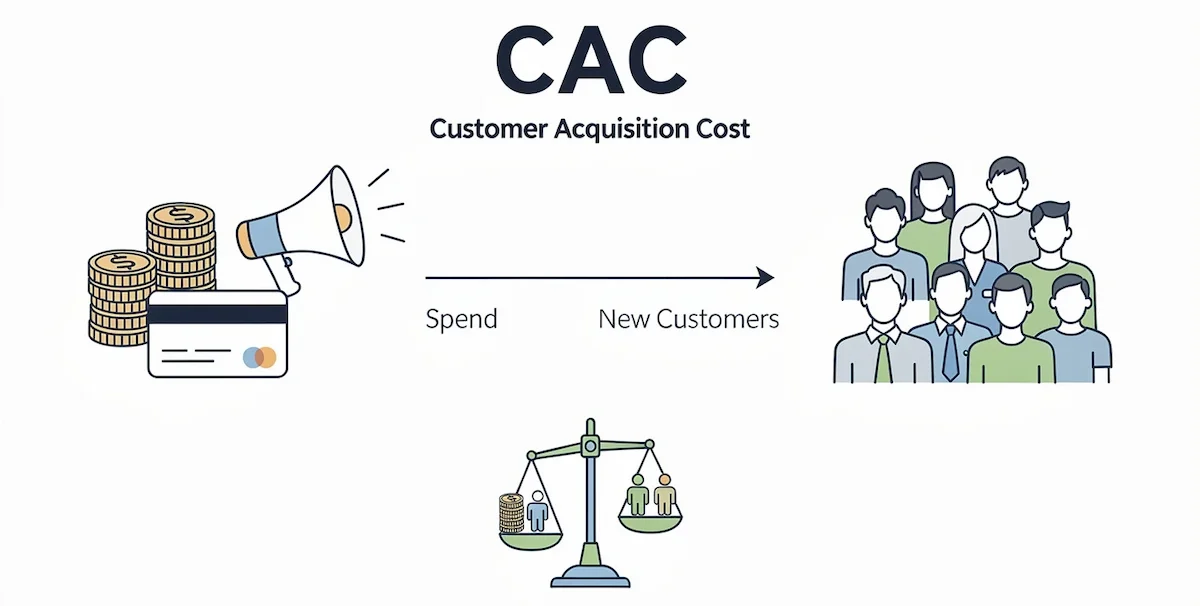
Customer acquisition cost shows whether growth pays for itself. A low customer acquisition cost next to a high customer value means a business can spend more and grow faster, while a high customer acquisition cost can quietly drain cash. This guide explains the formula, what to include, five worked examples, the different types of customer acquisition cost, how it compares with CPA and lifetime value, what a good customer acquisition cost looks like and how to lower it. The letters customer acquisition cost also mean other things in other fields, so the first section clears that up. All numbers in the examples are made up to show the math.
Key Takeaways
- CAC is total sales and marketing spend divided by the number of new customers in the same period
- Count only customers who pay, and include salaries, tools and agency fees, not just ads
- Leave out support, product development and spend that keeps existing customers
- Compare CAC with customer lifetime value, and aim for an LTV to CAC ratio of about 3 to 1 or better
- Check the payback period, which is how many months it takes a customer to repay the customer acquisition cost
- Track customer acquisition cost by channel as well as overall, because one average can hide a costly channel
What Does CAC Stand For?
In business and marketing, CAC stands for customer acquisition cost. Teams in SaaS, e-commerce, agencies and local services use it to judge whether their sales and marketing spend is worth it. It is one of the first numbers an investor, a founder or a marketing manager asks for.
CAC Meaning in Business and Marketing
So what is CAC in practice? The CAC meaning is simple: what did it cost to turn a stranger into a paying customer? The answer covers every cost that helped win that customer, from ads and content to sales salaries and software. CAC in marketing usually focuses on campaigns and channels, while CAC in sales adds the cost of the people who close the deal. A complete number includes both, because customers rarely come from one team alone.
Other Meanings of CAC
Search for the letters alone and you will also find unrelated terms. If you landed here by mistake, these are the most common ones:
- Call admission control – A method that limits how many calls a voice network accepts so it does not overload
- Corporate Affairs Commission – Nigeria’s company registry, where businesses register
- Certified Acceptance Corporation – A US company that reviews and certifies collectible coins
- Cyberspace Administration of China – The national regulator for the internet in China
- CAC 40 – The benchmark French stock market index of 40 large companies on Euronext Paris, where the letters stand for Cotation Assistée en Continu
The rest of this guide covers customer acquisition cost.
Why CAC Matters
Why is CAC important? Because customer acquisition cost connects marketing spend to real customers, and it shows early whether growth is healthy or only expensive. Teams that do not track it often find out too late that each new customer costs more than the customer is worth.
- Profitability – Shows whether a customer brings in more profit than it cost to win them
- Marketing return – Helps you compare channels and put the budget where customers cost less
- Cash planning – Tells you how much cash is tied up before customers pay back, which affects hiring and stock
- Forecasting – Lets you estimate how many customers a budget can bring and what growth will cost
- Investor confidence – Lenders and investors look at CAC, LTV and payback to judge whether a business can scale
- Growth decisions – Shows when it is safe to spend more and when to fix the offer first
How to Calculate CAC
The CAC formula takes one line, and most of the work is deciding what goes into it. Use the same period for the spend and for the customers, such as a month or a quarter.
The Simple CAC Formula
The standard formula is:
CAC = Total sales and marketing spend / Number of new customers
Say a shop spends $5,000 on ads, an influencer, an email tool and a freelancer in March, and 125 new customers place their first order. Divide $5,000 by 125 and you get a customer acquisition cost of $40. That means it cost $40 to win each new customer that month.
Pick the Right Time Period
A month works for fast, low-priced sales. A quarter or a year suits longer sales cycles, such as business software where a deal can take months. Money spent in one period often pays off in the next, so a single short window can mislead you. If your sales cycle is long, shift the spend back by the length of the cycle or use a longer period so the cost lines up with the customers it helped win.
Lagged CAC for Long Sales Cycles
When deals take weeks or months, the spend and the customers do not land in the same period. A lagged customer acquisition cost matches them by shifting the spend back by the length of the sales cycle. Say a business has a 60-day cycle. It spent $20,000 in January and $30,000 in March, and it gained 100 new customers in March. Dividing March spend by March customers gives $300, which is too high, since many of those customers came from January spend. Dividing January spend by March customers gives $200, which better reflects what those customers cost. Use a lagged view for long cycles and a plain monthly view for fast, low-priced sales.
What to Include in CAC and What to Leave Out
Most wrong CAC numbers come from a messy list of costs. A rough rule: include everything that exists to attract and close new customers, and leave out what serves people who are already customers.
Costs to Include
- Ad spend – Search, social, display and sponsorships
- Content and creative – Writers, designers, video, photos and landing pages
- Salaries and commissions – The marketing and sales team, or the share of time spent on winning new customers
- Software – CRM, email, analytics and other tools used for acquisition
- Agencies and contractors – Anyone paid to run campaigns or find leads
- Events and webinars – Booth fees, travel and hosting costs
- Overhead – A fair share of rent and general costs tied to sales and marketing
- Founder time – Hours the owner spends on sales, valued at a fair rate
Costs to Leave Out
- Customer support after the sale
- Product development and infrastructure
- Loyalty programs, win-back campaigns and emails sent to existing customers
- Fulfillment, shipping and payment processing fees
Some spend does both jobs, such as a brand campaign that attracts new buyers and keeps old ones. Split it using a reasonable share and use the same split every period so your numbers stay comparable.
Count Only Paying Customers
Only customers who actually paid belong in the denominator. Free trial sign-ups, leads and newsletter subscribers are not customers yet. If you count them, your customer acquisition cost looks lower than it really is. For a freemium product, decide the moment a user counts as acquired, such as the first paid plan, and stick to it.
CAC Examples by Business Type
The same formula gives very different results in different businesses. These examples use invented numbers, and each shows what goes into the total.
An Online Store
A small store sells accessories online. In one month it spends the amounts below and wins 125 new customers.
| Item | Cost |
|---|---|
| Ad spend | $4,000 |
| Influencer fees | $600 |
| Email tool | $100 |
| Freelance designer | $300 |
| Total | $5,000 |
| New customers | 125 |
| CAC | $40 |
This is only useful next to profit. If the average first order brings in $35 of profit, the store loses $5 on every new customer, and it needs repeat orders to come out ahead. A guide from Shopify makes a similar point: an ecommerce customer acquisition cost built on ad spend alone can look far lower than the full cost.
A Local Service Business
A physiotherapy clinic runs search ads, prints flyers and pays part of a marketing coordinator’s salary. It gains 35 new patients in a quarter.
| Item | Cost |
|---|---|
| Search ads | $2,000 |
| Flyers and signs | $300 |
| Share of coordinator salary | $1,200 |
| Total | $3,500 |
| New patients | 35 |
| CAC | $100 |
Local businesses often get many customers from referrals, reviews and word of mouth, which cost little. If you are starting with a small budget, these business ideas under 5k show how some owners find first customers through local channels. A free Google Business Profile also helps a clinic or shop show up when people search nearby, which adds customers at almost no extra cost.
A SaaS Company
A software company sells a monthly plan. In one quarter it spends on ads, sales salaries, tools and commissions, and signs 250 new paying customers.
| Item | Cost |
|---|---|
| Ad spend | $30,000 |
| Sales salaries | $60,000 |
| Tools | $5,000 |
| Commissions | $5,000 |
| Total | $100,000 |
| New paying customers | 250 |
| CAC | $400 |
Ads alone would give $30,000 divided by 250, or $120, which is a third of the real number. SaaS teams usually watch customer acquisition cost next to recurring revenue, which is explained in this guide on what is ARR. Software buyers often take weeks to decide, so spend in one quarter may win customers in the next, and that lag is why SaaS teams look at customer acquisition cost over longer periods.
A Solo Freelancer or Agency
A freelancer has no ad budget but still has a customer acquisition cost. Say a consultant spends 10 hours a month on outreach and calls, values that time at $50 an hour, pays $200 for tools and wins 2 clients. The total is $500 plus $200, which is $700, and divided by 2 clients the customer acquisition cost is $350. Many people forget their own time, which makes a service business look cheaper to run than it is. Sellers of AI services use the same math, and this guide on how to start an AI business with no money shows how a low-cost first client search works.
A Mobile App
An app spends $20,000 on ads and gets 10,000 installs, so each install costs $2. Only 800 users pay for a plan. The customer acquisition cost per paying customer is $20,000 divided by 800, or $25. The two numbers answer different questions: the cost of an install is a marketing metric, and the cost of a paying user is the real acquisition cost.
CAC for E-commerce, SaaS and Services Compared
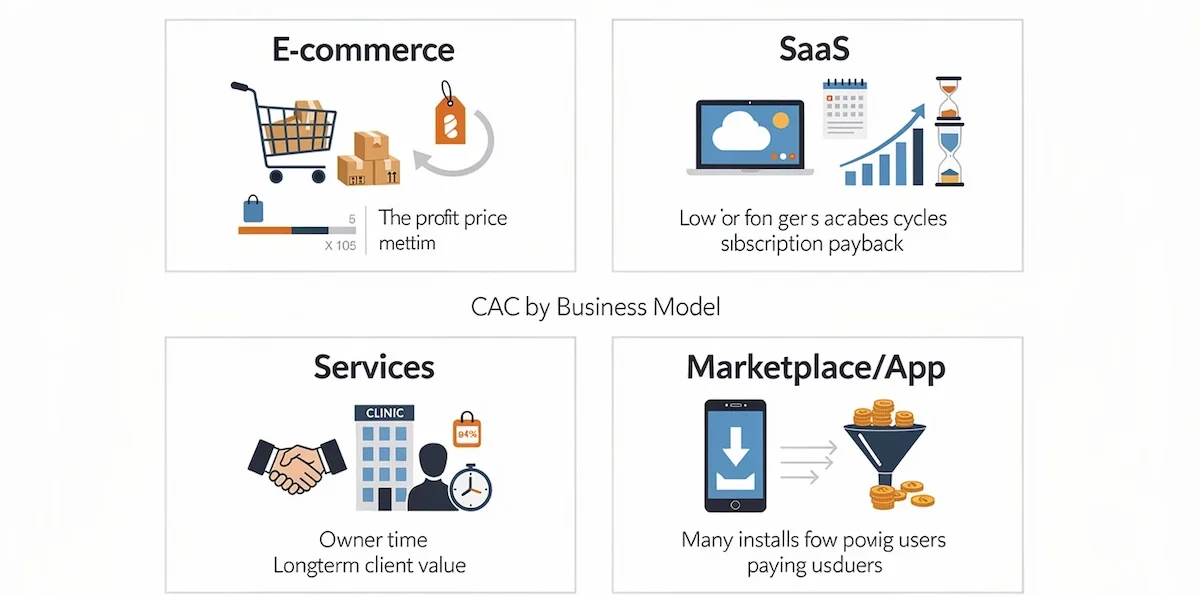 The same formula behaves differently in each type of business, because the sales cycle, the price and the chance of repeat purchases differ. Use this as a quick guide to what matters most.
- Ecommerce CAC – Short sales cycle and low price, so CAC is usually small, but margins are thin and the first order may not repay it. Repeat purchases decide whether the model works. Typical channels are paid social, search ads, email and influencers
- SaaS CAC – Longer cycles, subscription revenue and sales salaries in the mix, so CAC is higher and payback and churn matter most. Watch lagged customer acquisition cost, trial to paid conversion and LTV to CAC
- Service business CAC – Local clinics, agencies and consultants win customers through referrals, reviews, search and direct outreach. Owner time is a real cost, and one customer can be worth a lot over the years
- Marketplace or app CAC – Install costs are cheap but paying users are few, so measure CAC per paying user and not per install
Simple, Fully Loaded and Blended CAC
You will see CAC described in several ways. They are not different formulas, only different choices about what to count and how to group customers.
Simple CAC vs Fully Loaded CAC
A simple customer acquisition cost counts only direct spend such as ads. A fully loaded CAC adds salaries, software, agencies and overhead. In the SaaS example above, the simple number was $120 and the fully loaded number was $400. Use the fully loaded version for decisions and for any talk with investors, and use the simple version for quick channel checks.
Blended, Paid and Organic CAC
Blended CAC divides all acquisition spend by all new customers, whatever the source. Paid CAC counts only customers who came from paid channels, and organic CAC counts those from search, referrals and content. Take 100 new customers: 60 came from ads that cost $6,000, and 40 came from content and referral rewards that cost $2,000.
- Paid CAC – $6,000 divided by 60 customers, or $100
- Organic CAC – $2,000 divided by 40 customers, or $50
- Blended CAC – $8,000 divided by 100 customers, or $80
The blended $80 looks healthy, but it hides the fact that paid customers cost twice as much as organic ones. That is why a single average is a starting point and not an answer.
Initial, Renewal and Reactivation CAC
Subscription businesses sometimes split CAC by customer stage. Initial CAC is the cost of winning a customer for the first time. Renewal CAC is the cost of keeping a customer at renewal, and reactivation customer acquisition cost is the cost of winning back someone who left. Most guides and most business owners mean initial CAC when they say customer acquisition cost, so use the stage names only if you track more than one.
CAC by Channel: A Worked Example
An overall number hides which channels are worth the money. Take a store that spends $8,300 in a month and gains 126 customers. Split by source, the numbers look like this:
| Channel | Spend | New customers | CAC |
|---|---|---|---|
| Google search ads | $3,000 | 30 | $100 |
| Meta ads | $2,500 | 20 | $125 |
| Influencers | $1,800 | 12 | $150 |
| $400 | 40 | $10 | |
| Referrals | $600 | 24 | $25 |
| Total | $8,300 | 126 | About $66 |
The blended $66 looks fine. But influencers cost $150 per customer, 15 times as much as email, and Meta costs more than search. Email and referrals are cheap, but they are limited by the size of your list and your customer base, so doubling their spend will not double the customers. The smart move is to test cutting or fixing the weak channels and to grow the cheap ones carefully.
CAC vs CPA vs CPL
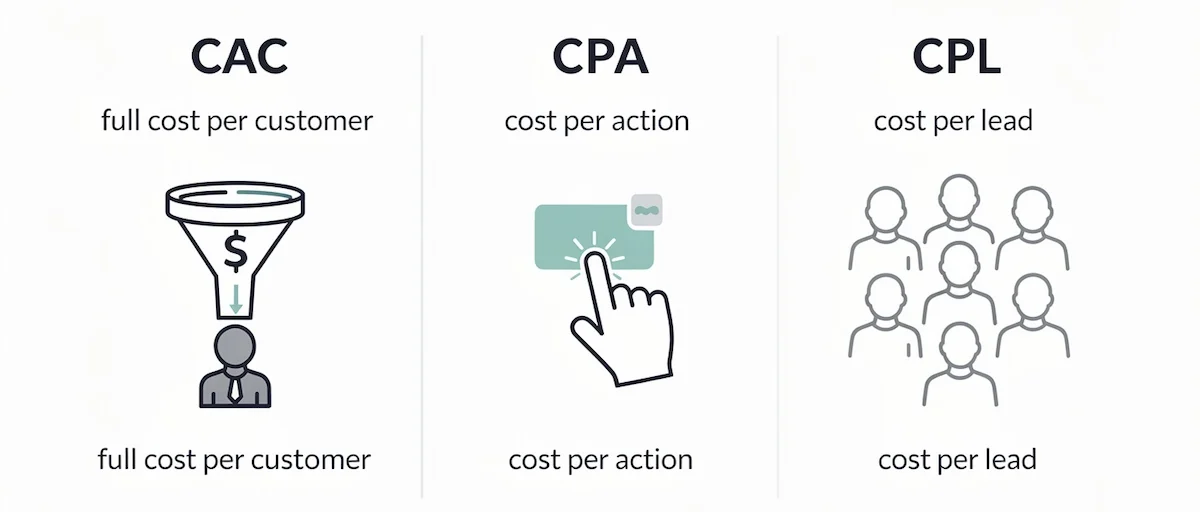
These three terms are often swapped, but they measure different things. Mixing them up is one of the most common reasons two people calculate customer acquisition cost differently.
- CAC – The full cost of winning a paying customer, across marketing and sales
- CPA, or cost per acquisition – The cost of one specific action, such as a sign-up, a trial, an install or a purchase from one campaign
- CPL, or cost per lead – The cost of one lead, before the person becomes a customer
Marketing teams use CPA and CPL to judge campaigns day to day, and CAC to judge the business. As Andrew Chen explains in his article on how to actually calculate customer acquisition cost, CPA is usually a leading indicator for CAC, because a cheap lead does not matter if few leads become customers. In the app example, $2 was the cost per install, which is a CPA, and $25 was the customer acquisition cost.
CAC and LTV: The Ratio That Matters
CAC on its own does not tell you whether you are doing well. A $400 CAC is a bargain for a customer worth $4,000 and a disaster for one worth $200. That is why CAC vs LTV is the most common comparison in business.
What Is Customer Lifetime Value?
Customer lifetime value, or LTV, is the total profit you expect from a customer over the whole relationship. A simple way to estimate it is average monthly revenue per customer, multiplied by gross margin, multiplied by the number of months the customer stays. The number of months is roughly one divided by the monthly churn rate, which is the share of customers who leave each month.
How to Read the LTV to CAC Ratio
Divide LTV by CAC to get the ratio. Guides from HubSpot, Stripe and Improvado describe a similar pattern:
- 1 to 1 – You earn back only what you spent, so the business loses money once other costs are counted
- 2 to 1 – The model works but has little room for growth spending
- 3 to 1 – The common target, where each dollar of CAC returns about three dollars of lifetime value
- 4 to 1 or more – Very efficient, and it may mean you can spend more on growth
A very high ratio is not always good news. It can mean you are being too careful and leaving customers on the table.
A Worked Ratio Example
A SaaS plan costs $80 a month, the gross margin is 80% and 4% of customers leave each month. Average customer life is 1 divided by 0.04, or 25 months. LTV is $80 times 0.80 times 25, which is $1,600. With the $400 customer acquisition cost from the SaaS example, the ratio is $1,600 divided by $400, or 4 to 1. If churn rises to 8%, customers stay about 12.5 months, LTV drops to $800 and the ratio falls to 2 to 1.
What Moves the LTV to CAC Ratio
You can improve the ratio from either side. Lower CAC by winning customers more cheaply, or raise LTV by earning more from each customer. These are the levers that move LTV:
- Price – A higher price or a better plan mix raises revenue per customer
- Churn – Fewer cancellations mean a longer customer life
- Expansion revenue – Upsells, add-ons and more seats raise what each customer pays
- Margin – Lower delivery and support costs raise profit per customer
- Customer mix – Some segments stay longer and pay more, so shift the focus toward them
- Onboarding – Customers who succeed early are less likely to leave
CAC Payback Period
The payback period answers a practical question: how long until a customer has repaid what it cost to win them? It matters because cash is tied up until that moment.
The Payback Formula
CAC payback period = CAC / (Monthly revenue per customer x Gross margin)
The bottom part is the monthly gross profit you earn from one customer. Divide the customer acquisition cost by it, and you get the number of months to break even on that customer.
Payback Example
Using the SaaS example, customer acquisition cost is $400 and monthly gross profit per customer is $80 times 0.80, or $64. Payback is $400 divided by $64, or 6.25 months. Stripe notes that many SaaS companies aim to recover CAC in less than 12 months, and its guide to the payback period says high-performing SaaS companies often reach 5 to 7 months. A shorter payback means you can reinvest the money sooner.
What Is a Good CAC?
There is no single good number. A good customer acquisition cost is one that sits comfortably below the profit a customer will bring, and that you can repay in a reasonable time. Cheap channels such as referrals, content and email help a lot, as in these examples of an online business without investment.
Good CAC Depends on LTV and Payback
Use three checks together. First, is the LTV to CAC ratio near 3 to 1 or better? Second, is the payback period short enough for your cash? Third, does customer acquisition cost stay stable as you spend more? If you can say yes to all three, your customer acquisition cost is good for your model, whatever the average in your industry.
CAC Benchmarks by Industry
Benchmarks give context, not targets. Here are some quoted ranges, with their sources:
- Small and mid-market B2B SaaS – About $300 to $5,000, according to a FirstPageSage report cited by Stripe
- Enterprise software – Much higher, since one customer can be worth $100,000 over time
- Consumer ecommerce SaaS – An average of about $64, cited by Stripe from the same source
- E-commerce and retail – Many guides quote roughly $10 to $100 depending on price and competition, but often without a source
Why Benchmarks Can Mislead
Industry averages mix very different businesses, years and ways of counting. A $300 CAC can be a bargain for a company with a $5,000 LTV and a problem for a store selling $50 products. Compare your customer acquisition cost with your own LTV, your own payback and your own history first, and use industry numbers only to check that you are in a sensible range.
What Makes CAC Go Up
If your customer acquisition cost is rising, look for the cause before you cut the budget. What affects CAC is usually a mix of these:
- Longer sales cycle – More meetings and follow-ups use more salary and time per customer
- Higher price or bigger deals – Expensive products take more effort to sell, so CAC is naturally higher
- Weak conversion rate – If fewer visitors buy, each customer costs more in traffic
- Rising ad prices – More competitors bidding on the same audience pushes the cost up
- Channel saturation – The first dollars in a channel work best, and each extra dollar tends to bring fewer customers
- Seasonality – Holiday periods raise ad costs and can distort a single month
- Weak brand awareness – Less trust means more touches before someone buys
- Poor lead quality – Cheap leads that do not buy raise the cost per paying customer
Look at CAC by channel and by month to see where the increase started, then fix that part first.
Common Mistakes When Calculating CAC
- Counting only ad spend – This ignores salaries, tools and agencies, so the number looks much lower than the real cost
- Adding retention spend – Loyalty offers and emails to existing customers belong to a different metric
- Mixing time periods – Costs from one quarter often win customers in the next, so match them to the sales cycle
- Counting leads or trials as customers – Only paying customers belong in the denominator
- Forgetting your own time – Founder hours are a real cost, especially in a service business
- Using only one average – A blended CAC hides channels that cost far more than others
- Comparing with the wrong benchmark – A B2B software customer acquisition cost says little about a store
- Trusting the ad platform alone – When a customer sees an ad, a search result and an email, several tools may claim the same sale, so check against your actual new customers
How to Reduce CAC
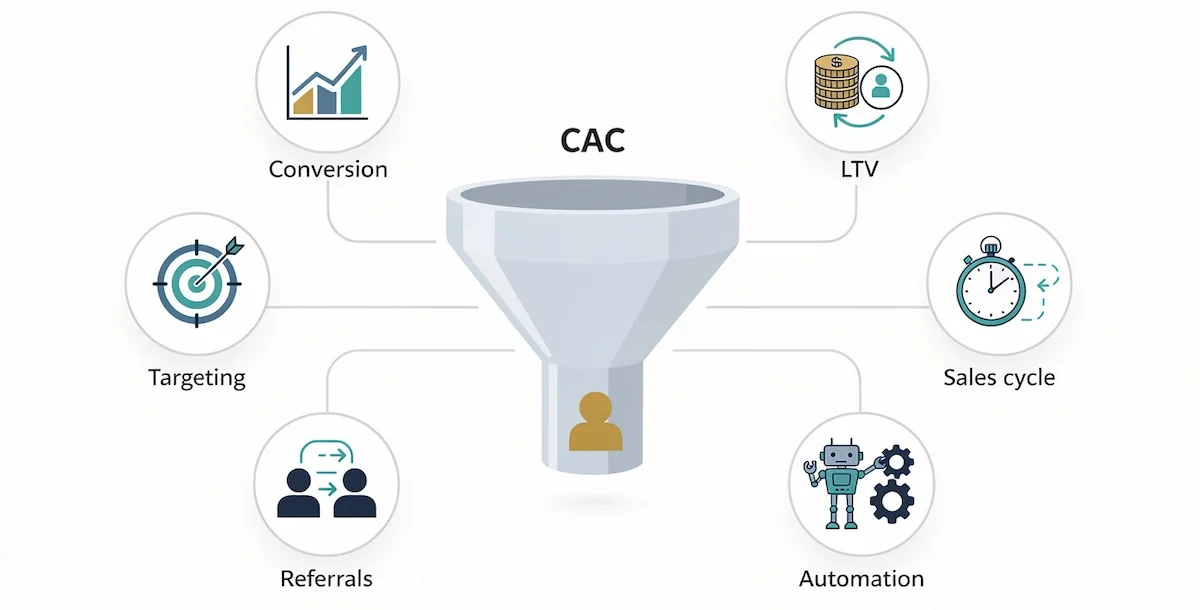
Lowering customer acquisition cost means winning more customers for the same spend, or the same customers for less. Founders who build with their own money, as explained in this guide on what is bootstrapping, often feel the cost of each customer first, since every dollar comes from the business. Work through the options below in order, and change one thing at a time so you can see what helped.
Improve Your Conversion Rate
Every extra visitor who buys lowers your cost per customer without extra ad spend. Fix the page before you buy more traffic: make the offer clearer, shorten the sign-up or checkout, add reviews and test your headlines and buttons. A small rise in conversion rate often beats a large rise in budget.
Fix Targeting and Cut Weak Channels
Look at customer acquisition cost by channel and compare it with the customers each channel brings. Cut the channels where the cost per customer is far above your target, and move the money to those that work. Know your ideal customer well enough that your ads and content speak to them, and not to everyone.
Use Referrals and Reviews
Happy customers are the cheapest acquisition channel. Ask for reviews, offer a small reward for a referral and make sharing easy. Referred customers usually trust you more, convert faster and stay longer, which helps both CAC and LTV.
Increase Retention and LTV
You do not always have to cut customer acquisition cost to improve the ratio. Better onboarding, good support and useful updates keep customers longer, and upsells raise what each one pays. If LTV rises, the same customer acquisition cost becomes easier to afford.
Shorten the Sales Cycle
The longer a deal takes, the more salary and time it consumes. Qualify leads early, remove steps that slow people down and look at lost deals to find where they stall. For self-serve products, a shorter path from visit to payment lowers cost per customer.
Automate Repeat Work
Email sequences, lead scoring, scheduling and reporting can take a lot of manual hours. Automating them lets the same team handle more leads. When the workload grows past what one person can do, you can hire help for daily tasks while you focus on sales.
Test One Change at a Time
Run small tests with a clear goal, such as a new headline, a different audience or a new channel, and let each run long enough to give a result. Track customer acquisition cost by cohort and by campaign. Steady small gains add up.
Metrics to Track Alongside CAC
Customer acquisition cost is more useful with a few other numbers next to it. These are the ones most guides recommend:
- ROAS (return on ad spend) – Revenue credited to ads divided by the cost of those ads, usually used for one campaign or channel
- MER (marketing efficiency ratio) – Total revenue divided by total marketing spend, which gives one blended view of the whole business
- CPA and CPL – The cost of a specific action or of a lead, useful for checking campaigns day to day
- Conversion rate – The share of visitors, leads or trials that become customers
- Churn – The share of customers who leave in a period
- ARPU – Average revenue per user, used in LTV and payback
- LTV and payback – How much a customer is worth and how long they take to repay CAC
Customer acquisition cost and ROAS answer different questions. ROAS depends on which sales an ad platform claims, and when several platforms claim the same order, the totals can add up to more than your real revenue. CAC and MER use your own revenue and customer counts, so they are harder to inflate. Use ROAS to compare campaigns and CAC to judge the business.
How to Track CAC Every Month
You do not need special software to start. A simple spreadsheet works, and you can move to a CRM or a reporting tool when the numbers grow. Keep one row per month with these columns:
- Ad spend by channel
- Content, creative and agency costs
- Salaries, commissions and tools tied to acquisition
- New paying customers, split by source
- CAC overall and by channel
- LTV, LTV to CAC ratio and payback period
Review the sheet at the same time each month. Compare it with the previous month and the same month last year, and note anything unusual, such as a new campaign or a price change. If your numbers sit in several tools, export them into one sheet so that spend and customers line up by date.
Build a CAC Calculator in a Spreadsheet
A simple customer acquisition cost calculator in Excel or Google Sheets takes about ten minutes to build. Put one month per row and use these columns, with formulas for row 2:
- A – Month
- B – Total sales and marketing spend
- C – New paying customers
- D – CAC, with the formula =B2/C2
- E – Average monthly revenue per customer
- F – Gross margin as a percentage, such as 80%
- G – Monthly gross profit per customer, with =E2*F2
- H – Payback in months, with =D2/G2
- I – Monthly churn rate, such as 4%
- J – LTV, with =G2/I2
- K – LTV to CAC ratio, with =J2/D2
Fill in a few months and the sheet will show how your customer acquisition cost, payback and ratio change over time. Add one more tab for CAC by channel with the same columns, so you can see where the cost comes from.
Your First Week With CAC
You do not need perfect data to start. This week, list every cost tied to winning customers in the last three months, count how many new customers paid in that time and divide. That is your first answer to what is CAC for your own business. Then split it by channel and compare it with what a customer is worth. If you are new to the whole field of online business, read this guide on how to learn online business first, then come back and refine the numbers.
Frequently Asked Questions
What Is CAC in Simple Terms?
Customer acquisition cost, or CAC, is the average cost of winning one new paying customer. You find it by dividing your sales and marketing spend in a period by the number of new customers in that period. If you spent $2,000 and gained 40 customers, your customer acquisition cost is $50.
What Does CAC Stand For in Marketing?
In marketing, CAC stands for customer acquisition cost. It measures how much a business spends on advertising, content, sales and tools to win each new customer, and it is used to judge whether those channels are worth the money.
How Do You Calculate CAC?
Add up all the sales and marketing costs for a period, including ads, salaries, tools and agencies, and divide the total by the number of new paying customers in the same period. Use the same period for both numbers so the result is comparable.
What Is Included in CAC?
Customer acquisition cost includes ad spend, content and creative costs, sales and marketing salaries and commissions, software, agency fees, events and a fair share of overhead. It leaves out customer support, product development and spend aimed at existing customers.
What Is a Good CAC?
A good customer acquisition cost is one well below the profit a customer brings and one you can repay in a reasonable time. Many businesses aim for an LTV to CAC ratio of about 3 to 1 and a payback of under 12 months, but the right number depends on your model.
What Is a Good LTV to CAC Ratio?
A ratio of about 3 to 1 is the common target, meaning each dollar of CAC brings back about three dollars of lifetime value. Below 2 to 1 you have little room for growth costs. Far above 4 to 1 you may be underinvesting in growth.
What Is CAC Payback?
CAC payback is the number of months it takes a customer to repay the cost of winning them. Divide CAC by the monthly gross profit per customer. A payback under 12 months is a common goal for subscription businesses.
What Is the Difference Between CAC and CPA?
CAC is the full cost of winning a paying customer across marketing and sales. CPA is the cost of one specific action, such as a sign-up or an install, usually from one campaign. CPA is a campaign metric, while customer acquisition cost is a business metric.
Is CAC the Same as Cost Per Lead?
No. Cost per lead measures the cost of getting a lead, before that person buys. CAC measures the cost of getting a paying customer. If only a few leads become customers, your customer acquisition cost will be much higher than your cost per lead.
How Do You Lower CAC?
Raise your conversion rate, cut weak channels, ask for referrals and reviews, shorten the sales cycle, automate repeat work and test one change at a time. You can also raise LTV with better onboarding and upsells so the same customer acquisition cost becomes easier to afford.
What Is Blended CAC?
Blended CAC divides all acquisition spend by all new customers, whether they came from paid or organic channels. It gives one overall number, but it can hide expensive channels, so check paid and organic CAC separately as well.
Does CAC Include Salaries?
Yes, a complete customer acquisition cost includes the salaries and commissions of people who work on winning new customers, or the share of their time spent on it. Leaving salaries out makes customer acquisition cost look much lower than the real cost, especially in software and service businesses.
Can CAC Be Zero?
Rarely. Even customers who find you through word of mouth or search took some time, content or tools to reach. Some channels cost very little, but a customer acquisition cost of exactly zero usually means some costs were left out of the calculation.
What Else Can CAC Mean?
Outside business, CAC can mean call admission control in telecom networks, the Corporate Affairs Commission in Nigeria, the Certified Acceptance Corporation for coins, the Cyberspace Administration of China or the customer acquisition cost 40 stock index in France. In marketing and finance, it almost always means customer acquisition cost.
What Is CAC in Advertising?
In advertising, customer acquisition cost is the cost of winning a paying customer through ads and the work around them. It usually counts ad spend, creative costs and the time of the people who run campaigns, divided by the new customers those campaigns brought.
What Is CAC in Ecommerce?
In ecommerce, customer acquisition cost is the cost of winning a new buyer, based on ad spend, influencers, email tools, designers and other sales and marketing costs for new customers. Compare it with profit on the first order and with repeat purchases to see if it pays off.
What Is CAC in SaaS?
In SaaS, customer acquisition cost is the sales and marketing spend divided by the number of new paying customers. Because sales cycles are longer and revenue arrives monthly, SaaS teams compare CAC with LTV and payback, and often use a lagged view.
Why Is CAC Important?
It shows whether growth is profitable, helps you compare channels, supports cash planning and forecasts, and gives investors a quick view of efficiency. Without it, a business can grow fast and still lose money on each customer.
How Often Should You Calculate CAC?
Every month is a good habit, with a quarterly review of trends and channel splits. For long sales cycles, also calculate a lagged customer acquisition cost so spend and customers line up. Recalculate after any big change in pricing, channels or budget.
What Is the Difference Between CAC and CLV?
CAC is what you spend to win a customer, and CLV, or customer lifetime value, is what that customer is worth over time. Compare them in a ratio, with about 3 to 1 as a common target, to see whether acquisition is worth the cost.
Is a Low CAC Always Good?
Not always. A low customer acquisition cost can come from cheap but low-quality customers who leave quickly, from ignoring costs such as salaries, or from underspending on growth. Judge it with LTV, payback and the quality of customers, not on its own.
What Is a Good CAC for a Startup?
There is no single number, since it depends on price, margins and how long customers stay. A good customer acquisition cost for a startup is one you can repay within a reasonable time, ideally under 12 months for subscriptions, with an LTV to CAC ratio near 3 to 1 or better.