What is bootstrapping? It is the practice of starting and growing a company with your own money and the revenue it earns, without taking outside investment or a large loan. Founders who choose this route rely on personal savings, early sales and tight cost control to keep the business alive. Bootstrapping is one of the most common ways to launch a startup, and it is the path behind well known names such as Mailchimp, GitHub and Spanx.
This guide explains the meaning of bootstrapping, how it works, the three stages, the main types, the pros and cons, real examples, a seven step plan and the mistakes that sink many bootstrapped businesses. It also compares bootstrapping with venture capital and shows when it makes sense to bring in external funding.
What is bootstrapping?
Bootstrapping means building a business from your own resources instead of raising money from investors or banks. The founder pays for the first costs with personal savings, and after that the business pays for itself through sales. Nobody outside the company owns a share, so the founder keeps full ownership and makes every decision.
A bootstrapped business usually starts small. The owner keeps overheads low, sells to the first customers early and puts the revenue back into the product, the stock or the marketing. Many founders also work with sweat equity, which means they put in unpaid hours instead of cash. Some keep a day job at the start, and others use a small credit card limit or a loan from family to cover the gap.
The term is often used as a synonym for self-funding, and the two overlap a lot. Bootstrapping puts more weight on lean spending and growth from early sales, while self-funding only says that the money comes from the owner. The difference is covered in the FAQ at the end.
Where does the word bootstrapping come from?
The word comes from the old saying about pulling yourself up by your own bootstraps, which describes doing something that looks impossible without any outside help. In the 20th century the phrase moved into computing, where a small starter program loads the rest of the system, and later into business, where it describes a company that lifts itself with its own earnings. Today the business meaning is the most common one in search results, although the word also has meanings in statistics and computing, which are explained near the end of this guide.
Why is bootstrapping important for a business?
Bootstrapping matters because it teaches a company to live on what it earns. A founder who has to pay costs from sales learns early which customers pay, which products sell and which expenses can be cut. That habit often stays after the company grows, and it is one reason many bootstrapped businesses reach profit sooner than companies that spend investor money from day one.
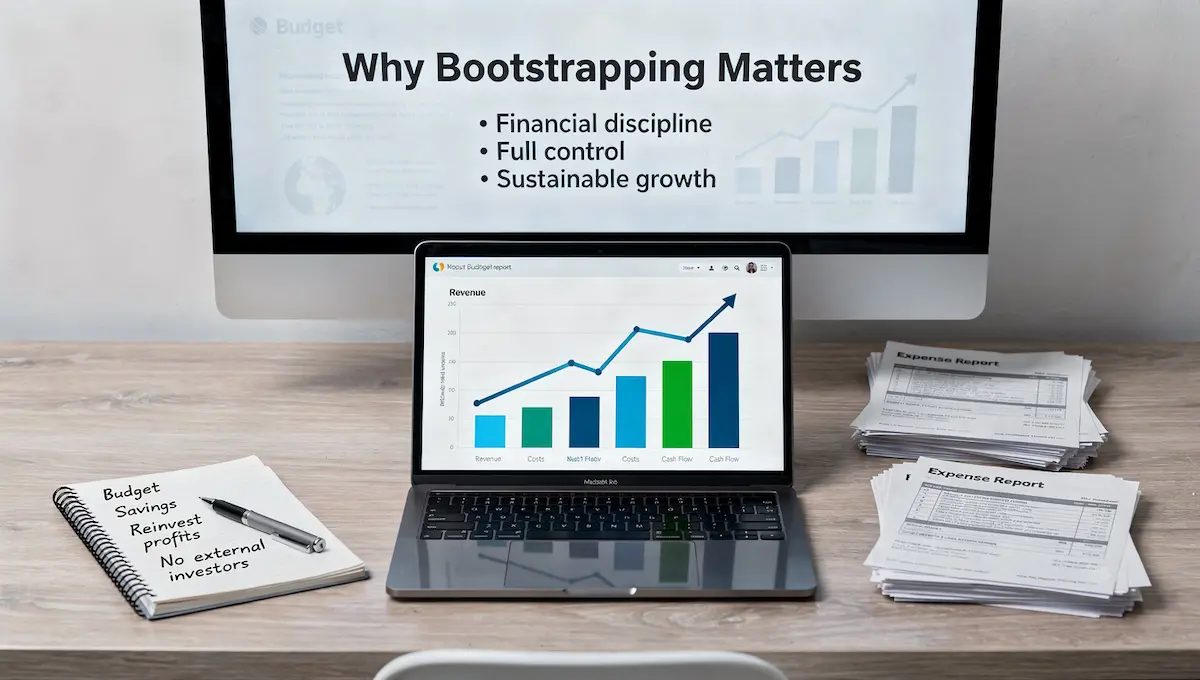
It also changes who the business answers to. With no outside investors, the founder answers to customers, and that keeps the product close to what people want. For small businesses that cannot attract venture capital at all, bootstrapping is often the only way to start, so it is a common route and not a last resort.
How does bootstrapping work?
Bootstrapping works because the money moves in a loop. The founder puts in a small amount of capital, builds something people will pay for and uses the first revenue to cover costs and fund the next step. Each round of sales pays for more stock, more tools or more advertising, so growth depends on how well the business turns income into more income.
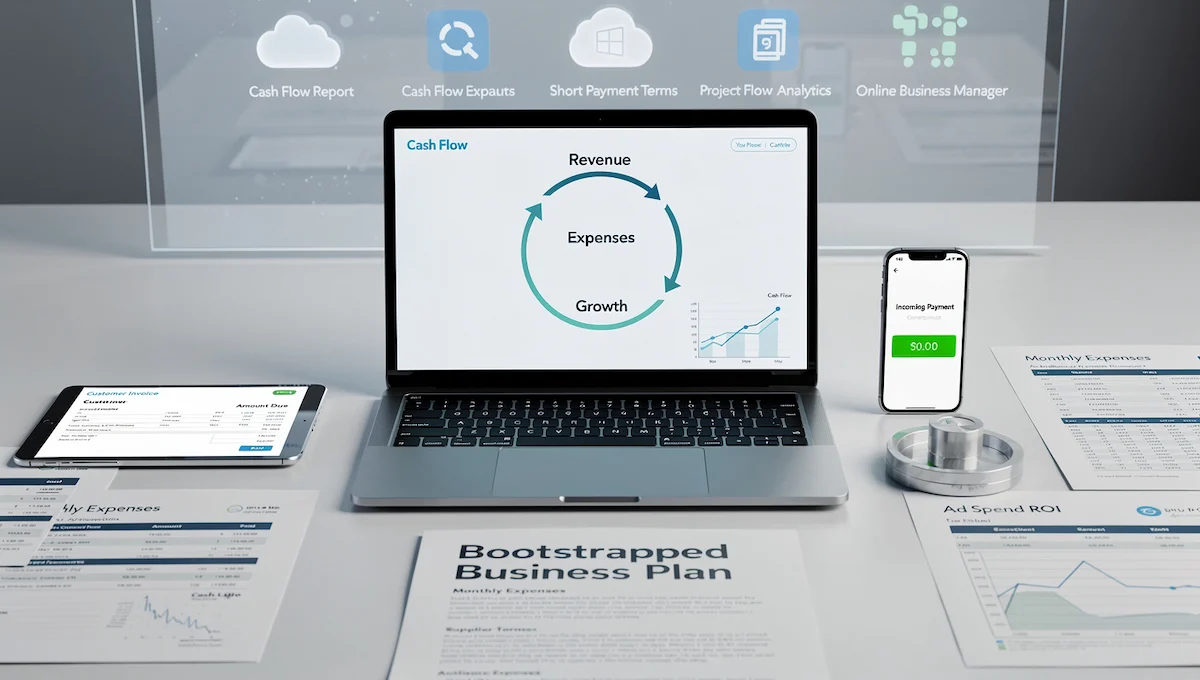
Cash flow is the center of the whole model. A bootstrapped company has no investor cushion, so a late payment from a customer or one bad month can stop work. For that reason founders track every expense, ask customers to pay upfront or on short terms, and negotiate longer payment terms with suppliers.
Most founders also follow one simple rule: spend only on things that bring in money or save money. A new office, a large team and expensive software usually wait until the business can afford them. When the owner is too busy selling to keep the numbers in order, an online business manager can take over the daily admin and reporting at a fraction of the cost of a full time hire.
The three stages of bootstrapping
Many guides split bootstrapping into three stages, and each stage has its own source of funding.
- Beginner stage: the founder pays for everything from personal savings, often while keeping a job. The goal is to build a first version and find the first buyers.
- Customer-funded stage: the business earns enough from sales to pay its own bills. Customers become the main source of funding through upfront payments, deposits or pre-orders.
- Credit stage: the company has a record of steady sales and uses a business credit card, a line of credit or a small loan to grow faster. Debt is used with care because the founder still carries the risk alone.
Not every business passes through all three stages. A freelancer who sells services can stay in the customer-funded stage for years, while a product business with high stock costs reaches the credit stage much sooner.
Customers as the main source of funding
In a bootstrapped company the customers act as the investors. Upfront payments, deposits, annual plans and pre-orders put cash in the account before the cost of delivery is paid, so the business grows on money that the market has already approved. This is also why selling matters so much: a founder who can win the first ten customers in person does not need a pitch deck.
Types of bootstrapping
Bootstrapping is not limited to money. Three types show up most often in guides and in practice.
- Financial bootstrapping: funding growth from savings, sales revenue and reinvested profit instead of investors.
- Technical bootstrapping: building a product in stages, where a simple early version is used to build the next one. Software founders often start with a basic tool and add features once users pay for it.
- Bootstrapped marketing: promoting the business with low-cost channels such as social media, email lists, content, referrals and partnerships instead of paid campaigns.
Most bootstrapped startups use all three at once. They fund the business from sales, release a minimum viable product and grow through free or cheap marketing.
The idea is not limited to startups. A nonprofit can bootstrap by proving its model with small grants, donations and earned income before it approaches major donors, and a side project can be bootstrapped from the evenings and weekends of its maker.
Examples of bootstrapped companies
Some of the best known companies in the world started with little outside money. These examples show how different bootstrapping can look from one business to the next.

Mailchimp
Ben Chestnut and Dan Kurzius started Mailchimp in 2001 as a side project of a web design agency, and they grew it for two decades without venture capital. The service charged small businesses for email marketing and later added a free plan that brought in millions of users. Intuit bought Mailchimp in 2021 for about $12 billion, and the founders had kept control of the company until the sale.
Basecamp
Basecamp began as an internal tool at a web design company called 37signals. The team sold the tool to other companies and used the income from clients and subscriptions to grow it, so the product paid for itself from the start. The company later stayed small and profitable on purpose.
Spanx
Sara Blakely started Spanx in 2000 with about $5,000 of her own savings and did not take outside investors in the early years. She kept her day job selling fax machines while she built the first product and pitched it to stores. Spanx grew into a brand valued at more than a billion dollars.
GitHub
GitHub launched in 2008 and ran for years without outside investors, funded by paid plans for private repositories. Its first outside round came in 2012, after the business was already earning well. Microsoft bought the company in 2018 for $7.5 billion.
GoPro
Nick Woodman started GoPro in 2004 with money from his own earlier sales and loans from his parents. He built the first wearable camera himself, sold it to surfers and sports fans, and reinvested the earnings into better models. The company went public in 2014.
Atlassian
Mike Cannon-Brookes and Scott Farquhar founded Atlassian in Australia in 2002 and paid for the first costs with credit card debt and early sales of their software. The company grew on revenue from customers for years before its first outside investment, and it listed on the stock market in 2015.
SparkFun
Nathan Seidle started SparkFun in 2003 from his college dorm room, selling electronic parts to hobbyists. He put early sales back into new stock and kept the company going on its own income. SparkFun grew into an electronics retailer with customers around the world.
Airbnb and ramen profitability
In 2008 the Airbnb founders sold limited edition cereal boxes to pay their debts and keep the site running. Airbnb is not a pure bootstrap case because it also took seed money, but the early period is a good example of ramen profitability, a term for earning just enough to cover the basic living costs of the founders. Reaching that point showed investors that the idea worked and made later funding easier.
Benefits of bootstrapping
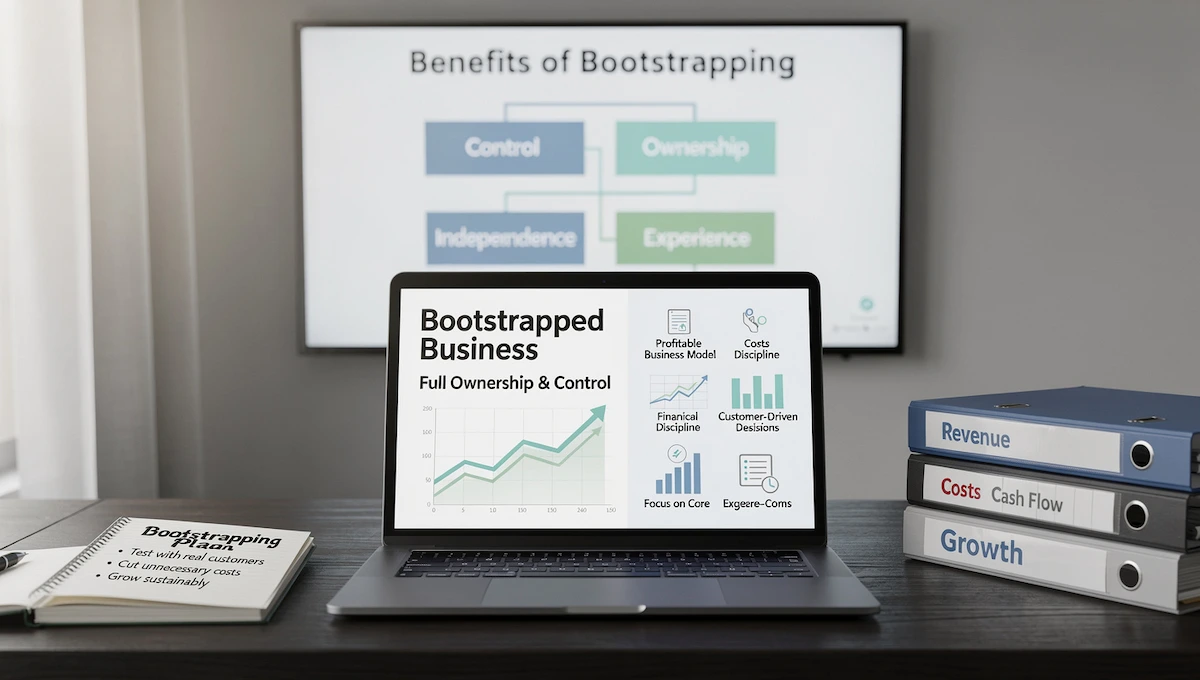
The main benefit of bootstrapping is control. The other benefits follow from the fact that every decision is made by the person who carries the risk.
Full ownership and control
A bootstrapped founder keeps all of the equity. There is no board to convince, no investor timeline and no pressure to chase fast growth, so the founder decides what to build, who to hire and when to sell.
A business model that has to work
Without investor money, the business has to earn from the start. This forces the founder to test the idea with real customers early and to drop products that do not sell, which usually makes the model stronger.
Lower costs and financial discipline
Every dollar comes from the founder or from sales, so spending stays careful. Teams learn to keep overheads low, negotiate with suppliers and measure what each expense brings back.
Independence from investors
Founders do not owe investors a return, so they can choose a slower and steadier pace with a longer view. Customers become the main voice that guides the product.
Focus on the core business
With little money to waste, the founder concentrates on the one product or service that brings in revenue. Side projects, extra features and distractions wait until the main business can pay for them.
Experience and a sense of accomplishment
Building a company with limited money teaches sales, accounting, marketing and negotiation. Students and first time founders often begin this way, and these business ideas for students show how little money some projects need at the start. Founders who bootstrap learn every part of the business, which helps if they hire a team or raise money later.
Disadvantages of bootstrapping
The pros and cons of bootstrapping are closely linked, because the same limits that protect the founder also slow the business.
Slower growth
With no outside cash, the business can only grow as fast as sales allow. A competitor with investor money can hire faster, spend more on ads and take the market first.
Personal financial risk
The founder usually risks personal savings and sometimes personal credit. If the business fails, the loss lands on the founder and not on investors. It helps to set a limit in advance on how much of your own money you are willing to lose.
Limited resources and fewer connections
Investors often bring introductions, advice and credibility with banks and partners. A bootstrapped founder has to build a network alone and often cannot afford the best tools, advisers or hires.
Less credibility with lenders and partners
A young company with no investors behind it can look risky to suppliers, banks and large customers. Some partners ask for upfront payment or a personal guarantee until the business has a track record.
Burnout and hard work
Founders do most of the work themselves in the early months, from product to customer support to bookkeeping. Long hours with no salary wear people down, which is why a realistic pace matters more than a heroic one.
Keeping the books organized
Without a finance team or an investor asking for reports, bookkeeping is easy to neglect. Records of income, costs and taxes should start with the first sale, because messy numbers hide the real cash position and make it harder to apply for a loan later.
Low survival rates
Many small businesses fail within the first years, and bootstrapped ones have less room for mistakes because there is no cash cushion. Careful planning and a small testing budget lower this risk, but they do not remove it.
Bootstrapping vs venture capital and other funding
The table below compares bootstrapping with the two other common ways to fund a company.
| Factor | Bootstrapping | Venture capital | Bank loan |
|---|---|---|---|
| Source of money | Savings and sales revenue | Investors who buy equity | A bank that lends and charges interest |
| Ownership | Founder keeps all of it | Founder gives up a share | Founder keeps all of it |
| Control | Full | Shared with investors and a board | Full, but the lender sets terms |
| Growth speed | Slower, tied to revenue | Faster, often aggressive | Depends on the loan size |
| Personal risk | High, savings are at stake | Lower, investors share the loss | High, often a personal guarantee |
| Best for | Service firms, small products, side projects | High growth tech with a large market | Businesses with steady income and assets |
The U.S. Small Business Administration lists loans, grants and investor funding as the main alternatives to funding your business on your own. Bootstrapping is also not permanent. Many founders start by bootstrapping, prove that customers pay, and then take a loan or an investor when they know exactly what the money will buy. Founders who want start-up financing without a loan can also look at grants, crowdfunding and pre-orders.
Is bootstrapping right for your business?
Not every business can bootstrap. Companies that need factories, licenses, heavy research or years of development before the first sale usually need outside funding. Businesses that can sell early and cheaply, such as services, software, online shops and consulting, are a better fit.
Bootstrapping tends to work when:
- you can reach the first paying customer within a few months;
- startup costs are low, as with the business ideas under $5k that many founders choose;
- you have savings or other income that covers your living costs;
- you are comfortable with slower growth in return for control.
Outside funding tends to work better when:
- the market rewards the first company to reach scale;
- the product needs large upfront spending before it can earn;
- competitors are already well funded and moving fast.
When to move from bootstrapping to venture capital
Bootstrapping works until the business needs more money than its sales can produce. Scale often requires money, especially when growth depends on network effects, where each new user makes the product more valuable to every other user. In that case a slower competitor with investor cash can still win the market.
Signs that outside funding may help:
- customer demand is higher than you can serve with current cash;
- the cost of hiring and stock grows faster than revenue;
- a well funded competitor is entering your market;
- each customer already brings in more than the cost of winning them.
Raising money from a position of strength, with revenue and data to show, usually brings better terms than raising in a crisis.
How much money do you need to bootstrap a business?
There is no single number. A freelance service can start for a few hundred dollars, an online store needs money for stock and ads, and a software product costs mostly time. The cost depends on the model, so it helps to look at online business ideas that need no investment before deciding how much to set aside.
A simple way to set the amount is to add up the costs of the first three to six months, including your own living costs, and then add a reserve for slow weeks. If the total is more than your savings can cover, either start smaller or plan a second income during the first months.
How to bootstrap a business in 7 steps
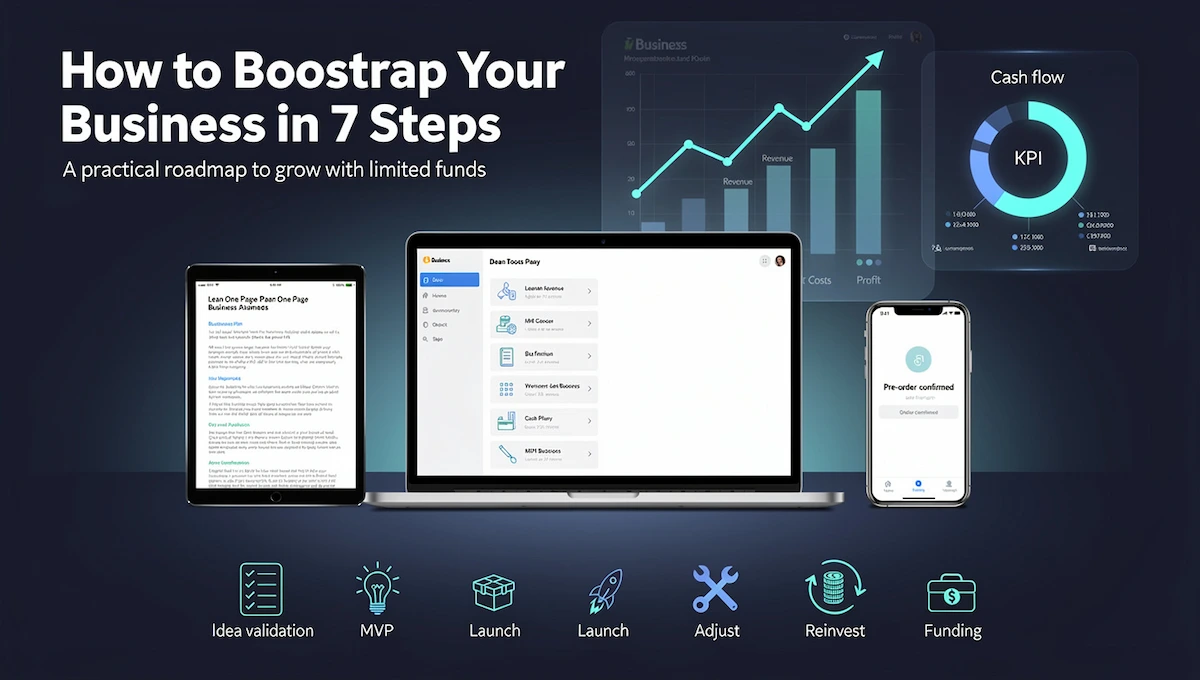
The steps below follow the order most successful bootstrapped founders use to start a business with little money.
1. Validate your business idea
Talk to potential buyers before you spend money. Ask what they pay for today, what annoys them and what price they would accept. The best proof is a pre-order or a deposit from a real customer.
2. Write a lean plan
Keep it to one page: who the customer is, what you sell, the price, the costs and the number of sales needed to break even. A long document is not needed at this stage.
3. Build a minimum viable product
Make the smallest version of the product or service that solves one problem. A minimum viable product (MVP) lets you start selling quickly and shows what customers actually use. Many a startup finds that buyers ignore half of the planned features, so the MVP saves both time and cash.
4. Launch and collect data
Sell to the first customers, then record who buys, who does not and why. Early sales numbers and feedback are worth more than any forecast.
5. Adjust the product or service
Fix what customers complain about and drop what does not sell. Small changes made quickly cost less than a big rebuild later.
6. Reinvest revenue
Put profit into the activities that bring in more sales, such as stock, marketing or tools, and keep a cash reserve for slow months. Reinvesting profits is how a bootstrapped business grows without outside money.
7. Track KPIs and plan for outside funding
Follow a few numbers every month: revenue, cash flow, the cost of winning a customer and how many customers return. Decide in advance under which conditions you would take a loan or outside investors, so the choice is not made in a panic. Review the same numbers against the MVP results from step three to see whether the business is moving toward its break-even point.
Bootstrapping strategies that save money
These habits help a founder stretch a small budget without hurting the product.
- Keep overheads low: work from home or a shared space, skip the office lease and buy used equipment where it makes sense.
- Use free and cheap tools: many accounting, design and email programs have free plans that cover the first year. Founders who want to start an AI business with no money follow the same rule and sell a service before buying any software.
- Negotiate payment terms: ask suppliers for longer payment periods and customers for upfront payment or deposits. This keeps cash in the account for more days each month.
- Focus on revenue early: choose the offer that earns money fastest and leave the second product idea for later. A startup that sells one thing well in the first six months learns more about its buyers than one that spreads thin across five products and sells none of them.
- Build a network: peers, mentors and local business groups give advice, referrals and warnings that investors would otherwise provide.
- Build a strong brand: a clear name, a simple message and honest customer service cost little and make people trust a company that has no big marketing budget.
- Use data for decisions: track sales, costs and customer feedback every month, and let the numbers decide what to keep and what to cut.
- Streamline processes: write down repeated tasks, remove steps that add no value and automate the rest to reduce waste and save hours.
- Outsource wisely: hire freelancers for one off tasks instead of full time staff, and look at remote business ideas and remote teams to cut the cost of space and salaries.
How to innovate and adapt while bootstrapping
Limited money pushes founders toward creative solutions. Instead of building a large new feature, they test an idea with a landing page, a manual service or a small paid trial. If buyers respond, the idea gets built, and if not, the cost of the test was small. Founders also listen closely to customers, because each complaint or request is free research that a bigger company would pay for. Small and quick changes keep a bootstrapped business flexible, and that flexibility is often the real edge over larger competitors.
Common bootstrapping mistakes
- Spending before selling: buying stock, tools or a logo design before a single customer has paid.
- Ignoring cash flow: a profitable business can still run out of cash if customers pay late. Watch the burn rate, which is the amount of cash the business spends each month.
- Charging too little: low prices feel safe, but they leave no money to reinvest.
- Mixing personal and business money: it makes the real results hard to read and creates tax problems.
- Growing before the product fits the market: scaling before you reach product-market fit burns savings on customers who leave.
- Refusing outside money when it is needed: some businesses stall because the founder treats bootstrapping as a rule and not as a choice.
Legal structure and taxes for a bootstrapped business
Most bootstrapped businesses start as a sole proprietorship or a single member LLC, because both are cheap to set up and simple to run. A corporation costs more and adds paperwork, but it can make sense later if the founder plans to bring in investors. In every case, open a separate bank account for the business, keep receipts and set aside money for taxes from each sale. Rules differ by country and state, so a short talk with an accountant before the first sale is a small cost that can prevent large problems.
Other meanings of bootstrapping
If you searched for what is bootstrapping and expected a data topic, the word has two other uses. In statistics, bootstrapping is a resampling method that draws many random samples from one data set to estimate values such as confidence intervals, and the Wikipedia article on bootstrapping in statistics explains it in detail. In computing, bootstrapping means starting a computer, where a small program loads the operating system, and this is where the word booting comes from. Both meanings share the idea of a process that builds on itself with no outside help, and this guide covers the business meaning.
FAQ
What is bootstrapping in business?
Bootstrapping in business means starting and growing a company with the own money of the founder and sales revenue instead of investor funding or large loans. The founder keeps full ownership and control, but also carries most of the financial risk.
Why do entrepreneurs choose bootstrapping?
Most choose it to keep control and ownership. Others do it because investors are not available at the start, or because they want to prove the idea with real customers before asking anyone for money.
How long should I bootstrap my business?
There is no fixed time. Many founders bootstrap until the business earns steadily and the next step needs more money than sales can provide. Some stay bootstrapped for the whole life of the company.
Can I switch from bootstrapping to outside funding?
Yes. Many companies start with savings and sales and take a loan or an investor later. A record of paying customers and steady revenue usually gives the founder a better price and better terms than a pitch with only an idea.
What is the difference between bootstrapping and self-funding?
People often use the two terms for the same thing. Both mean funding a business with your own resources. Bootstrapping puts more emphasis on lean spending and on growing from early revenue, while self-funding only describes where the money comes from.
How much money do I need to bootstrap a business?
It depends on the model. A service business can start with a few hundred dollars, while an online store or a product company needs more for stock and marketing. A safe plan covers the first three to six months of costs plus your own living expenses.
What is the difference between debt and equity financing?
Debt financing is borrowed money that you repay with interest, and you keep ownership. Equity financing means selling a share of the company to investors in return for cash, and you give up part of the ownership and some control.
Can bootstrapped companies succeed long term?
Yes. Mailchimp, GitHub and Spanx all grew for years without outside investors before becoming large businesses. Success depends on steady cash flow, a product people pay for and careful reinvestment of profit.
Do I need a business plan to bootstrap?
You need a plan, but it can be short. One page with your customer, price, costs and break-even point is enough to start, and you can update it as you learn from the first sales.
Is bootstrapping the same as a startup loan?
No. A startup loan is borrowed money that must be repaid, while bootstrapping means relying mainly on your own savings and sales. Some bootstrappers do use a small loan or credit card in the credit stage, but they use it as a tool and not as the main source of funding.
How do I decide whether to bootstrap or raise money?
Look at three things: how fast the market moves, how much money you need before the first sale and how much control you want to keep. If you can reach paying customers cheaply and the market is not a race, bootstrapping is usually the safer choice. If speed decides who wins, outside funding may be worth the loss of ownership.
What if I lack business experience?
Start small and learn from the first customers. Free courses, local business groups and mentors cover most of the basics, and a low-cost first product limits the damage from early mistakes. Many founders learn accounting, sales and marketing as they go, and age is not a barrier: this guide on how to start an online business under 18 shows a low-cost way to begin.
What legal structure is best for a bootstrapped business?
Many founders choose a sole proprietorship or an LLC at the start because they are cheap and simple. A corporation may fit better once investors are involved. The right choice depends on your country, your taxes and your liability, so check with an accountant or a lawyer.
How can a bootstrapped business manage cash flow?
Track money in and out every week, invoice quickly, ask for deposits or upfront payment and negotiate longer terms with suppliers. Keep a reserve that covers at least a few weeks of costs, because late payments are the most common reason a healthy small business runs short of cash.
How does bootstrapping encourage innovation?
Limited money forces founders to test ideas cheaply, listen to customers and focus on solutions that bring in revenue. Small experiments replace large projects, so the business learns faster and wastes less.