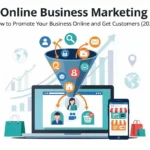
Online business marketing means using the internet to find customers, earn their trust and turn them into buyers. It covers search engines, content, email, social media, paid ads, reviews and partnerships, and it works for an online store, a freelance service, a software product or a blog. The best plan starts with free channels you control, adds paid ads after the basics work, and tracks a few numbers every week.
This guide shows how to market an online business step by step: what to set up first, which free and paid strategies to use, which channels fit your type of business, how much to spend and what to do in the first 90 days. You will also find a table of metrics, the rules you must follow and answers to the questions people ask most.
The short version: build a clear offer and a simple website first, collect emails from day one, pick two or three channels instead of ten, and measure what brings real sales. A small budget used on the right channel beats a large budget spread across everything.
What Is Online Business Marketing?
Online business marketing is every activity that brings attention, visitors and customers to a business that runs on the internet. It includes search engine optimization (SEO), content marketing, email marketing, social media marketing, pay-per-click ads, affiliate marketing, influencer marketing and customer reviews. The goal is the same in every case: get the right people to your offer, and make it easy for them to buy. People also call this online marketing or digital marketing, and the three terms usually point to the same work.
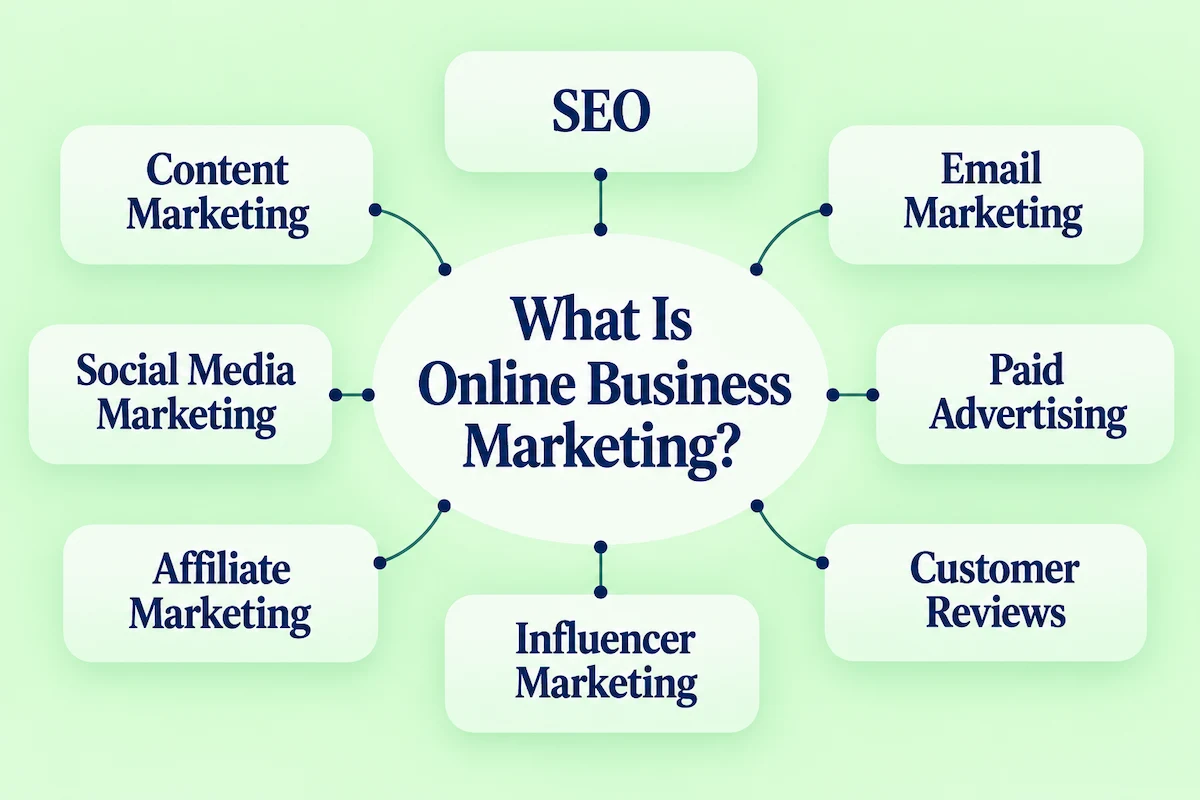
The channels work best as one system. Content gives people a reason to visit, visibility brings them to your site, and a clear funnel turns visitors into leads and customers. If you are new to the model itself, start with this guide on how an online business works, then come back to the marketing steps below.
Online Business Marketing vs Digital Marketing
The two terms overlap. Digital marketing is the wider term and includes every channel that uses a screen: websites, email, apps, social media and paid ads. Online marketing usually means the same thing in everyday speech. Online business marketing is the version that fits a business whose whole operation lives on the internet, so the website, the checkout and the customer support are part of the marketing too.
Why Online Business Marketing Matters
An online business has no shop window on a busy street. Nobody walks past it by accident, so every visitor comes from something you did: a search result, a post, an email, an ad or a recommendation. Online marketing is how the business becomes visible. Without it, even a great product sells to nobody.
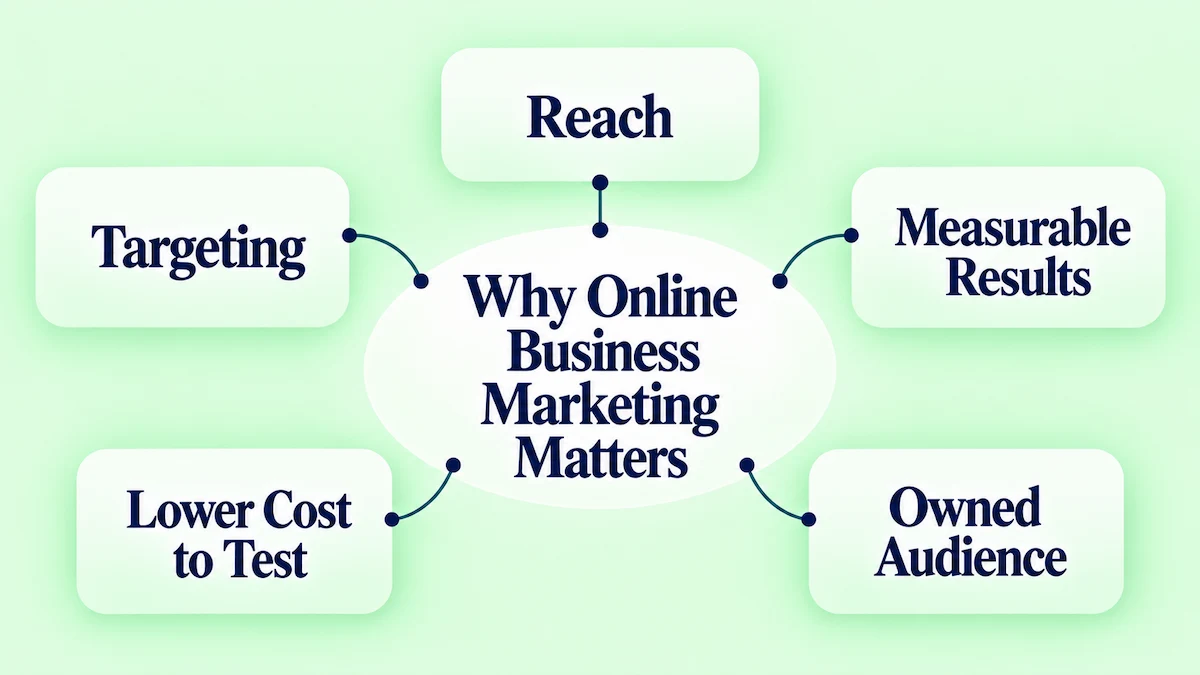
Online marketing also has strengths that print ads and flyers lack. You can target a specific group of people, change a message in minutes and see results in real time, which lets you learn from small tests. These strengths are part of the benefits of an online business, and they make it possible to start with a small budget.
- Reach: customers outside your city or country can find you
- Targeting: ads and content can reach people by interest, location and behavior
- Measurable results: every click, signup and sale can be tracked
- Lower cost to test: you can try an idea for a few dollars a day
- Owned audience: an email list stays yours, whatever happens to a platform
Online Marketing vs Traditional Marketing
Traditional marketing uses print, radio, television, billboards and mail. Online marketing uses the internet, so it can be targeted, measured and changed fast. For an online business, most of the budget belongs online, because that is where your customers already find you and buy.
| Factor | Online marketing | Traditional marketing |
|---|---|---|
| Targeting | By interest, location and behavior | Broad audience |
| Cost to test | Low, from a few dollars a day | Higher, such as printing and airtime |
| Measurement | Clicks, signups and sales in real time | Harder to link to sales |
| Speed of change | Minutes | Days or weeks |
| Reach | Worldwide | Local or regional |
| Best use | Leads, direct sales and retention | Awareness in a local area |
Many businesses mix both. A shop with a website can use flyers to send people to an online offer, and an online store can use local events to build trust.
Online Business Marketing Channels at a Glance
The table shows the main online marketing channels and ways to promote a business online, what each is best for, what it costs and how long results take. Time to results depends on your niche and competition, so treat the numbers as a guide.
| Channel | Best for | Cost | Time to results |
|---|---|---|---|
| SEO and content | Steady, long-term traffic | Low (mostly time) | 3 to 6 months or more |
| Email marketing | Repeat sales and trust | Low | Weeks, once you have a list |
| Social media | Awareness and community | Low (mostly time) | Weeks to months |
| Google Business Profile and local SEO | Businesses with local customers | Free | Weeks |
| Reviews and testimonials | Trust and conversion | Free | Builds over time |
| Search ads (PPC) | Buyers who already search | Medium | Days |
| Paid social and retargeting | Reaching people who showed interest | Medium | Days to weeks |
| Influencer marketing | Niche trust and reach | Low to medium | Weeks |
| Affiliate marketing | Pay-for-results sales | Commission only | Weeks to months |
Build the Foundation First
Online marketing sends people to your business, so the business must be ready for them. A weak offer or a slow site wastes every visitor you pay for. Spend a few days on the basics before you promote anything.
Define Your Customer and Your Offer
Write down who you serve, what problem you solve and why someone should choose you instead of a competitor. Answer three questions: who is this for, what do they get, and why you. If you cannot answer them in two sentences, your messages will be vague, and vague messages do not sell.
Research how competitors present themselves. Search your main keywords on Google, note who ranks, and read their sites, social profiles and reviews. Look for gaps: a question nobody answers, a group nobody serves, a price point nobody offers. A narrow niche is easier to win than a broad market.
Set Marketing Goals
Goals tell you what to measure. Choose one main goal for the first three months, such as 100 email subscribers, 20 sales or 10 booked calls, and write it down with a date. Link each goal to a number you can track, so you know within weeks whether a channel is working. Vague goals such as more visibility are hard to judge and easy to abandon.
Set Up Your Website and Tracking
Your website is the center of your online business marketing. It should load fast, work well on a phone and make the next step obvious: buy, book, call or sign up. Each important offer should have its own landing page with one clear action.
Install web analytics before you spend money, for example GA4, and set up goals for signups and sales. Without tracking you cannot tell which channel works. Add a simple email signup form so every visitor has a way to stay in touch.
How to Start With Web Analytics
Install GA4 on your site and connect Google Search Console, so you can see where visitors come from and which pages they read. Set up conversion events for the actions that matter: purchase, signup, booking or download. Add UTM tags to links in emails, ads and social posts, so each campaign shows up as its own source. Check the reports once a week for traffic sources, top pages, conversion rate and drop-off points, and note what changes after each action you take.
Free Online Business Marketing Strategies
Free online marketing strategies cost time instead of money, and they build visibility that keeps paying off. If you are starting with almost nothing, read this guide to an online business with no money first. Xero advises small businesses to start with free strategies and add paid ads after the basics work, and that order suits most online businesses.
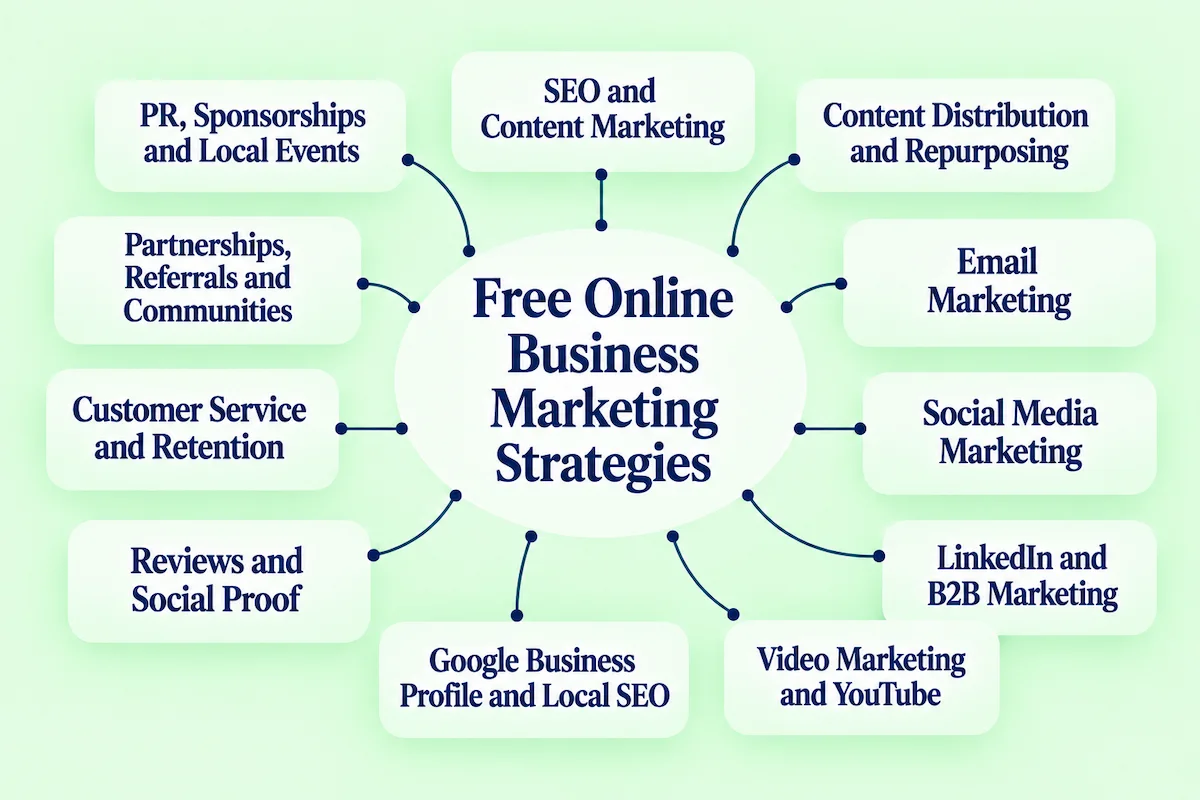
SEO and Content Marketing
SEO makes your site easier to find when people search for what you sell. Start by listing 10 to 15 phrases your customers would type, then check them with a free tool such as Google Keyword Planner and the People also ask box in search results. Use those phrases naturally in titles, headings and page text.
Content marketing gives you something to rank. Write guides, comparisons and answers to real customer questions, and publish on a steady schedule. One strong article each week beats five weak ones. Match the content to each stage of the marketing funnel: broad guides for new visitors, comparisons for people who are deciding, and case studies for people who are ready to buy.
Content Distribution and Repurposing
Content does not sell itself. Publish a guide, then share it with your email list, turn the main points into social posts, record a short video from the same outline and answer related questions in communities. One strong piece can feed a week of posts. Repurposing saves time and reaches people who prefer a different format.
Email Marketing
An email list is the one digital marketing asset you fully own. A social platform can change its rules overnight, but your subscribers stay in your list. Offer a lead magnet, such as a checklist, a template or a discount code, in exchange for an email address, and place the signup form on your most visited pages and at checkout.
Send a regular message with something useful, not only offers. Split your list into new subscribers and customers so each group gets the right message. Track open rates and clicks, and test one change at a time, such as a subject line. Check consent rules such as GDPR before you add anyone in the European Union to a list.
Social Media Marketing
Social media is a digital marketing channel built on attention, so pick two or three platforms where your customers already spend time, instead of trying to be everywhere. Share a mix of helpful posts, behind-the-scenes content and customer stories, and answer comments and messages quickly. Short-form video works well for discovery, but people usually buy after they visit your site or read your emails, so send them there and into your marketing funnel.
Video Marketing and YouTube
Video shows how a product works and builds trust faster than text. Short clips help people discover you, and longer videos on YouTube answer detailed questions and can rank in search. Start with simple topics: a product demo, a customer question, a before and after, or a quick tutorial. Add captions, a clear title and a link to your site in the description.
LinkedIn and B2B Marketing
If you sell to companies or professionals, LinkedIn is often the best social channel. Share useful posts and case studies, connect with people in your target roles, and send short, relevant messages instead of generic pitches. Pair this with a landing page for each offer and a simple way to book a call.
Google Business Profile and Local SEO
If you serve customers in a specific area, even partly, set up a free Google Business Profile. Add accurate hours, a phone number, a website link and clear photos. Keep your business name, address and phone number the same everywhere online, and ask happy customers for reviews. Local SEO helps service businesses, shops with pickup and online stores with a local base.
Reviews and Social Proof
Reviews build trust faster than any ad. Ask for a review right after a good experience, send a direct link to make it easy, and reply to every review, good or bad. Show your best reviews on product pages, landing pages and emails. User-generated content, such as customer photos and short videos, works the same way.
Customer Service and Retention
Existing customers are the cheapest source of new sales. Reply fast, fix problems and follow up after a purchase. A helpful message after delivery, a loyalty discount or a short survey keeps people coming back and gives you ideas for new offers. Happy customers also leave reviews and send referrals, which costs almost nothing.
Partnerships, Referrals and Communities
Work with people who already have your audience. Partner with a business that sells something related, join a community where your customers ask questions and offer real answers, or start a simple referral program that rewards customers for introductions. These channels cost little and bring buyers who already trust the source.
PR, Sponsorships and Local Events
Press mentions and event sponsorships build trust and bring links to your site. Pitch a local newspaper, podcast or industry blog with a story that helps their readers, such as a new data point or a useful tip. Sponsor a small local event, a newsletter or a community group if their audience matches your buyers.
Paid Online Business Marketing Strategies
Paid online marketing puts your offer in front of more people faster. It works best after your website, offer and tracking are ready, because ads send traffic and do not fix a weak page.
Search Ads (PPC)
Pay-per-click ads place your business at the top of search results, and you pay only when someone clicks. Choose keywords that show buying intent, set a daily budget, write a clear ad with one action and limit the location to the areas you serve. Xero suggests starting with small daily budgets while you test, and checking results daily for the first two weeks.
Paid Social and Retargeting
Paid social ads reach people by interest, age, location and behavior. Facebook and Instagram suit consumer brands, and LinkedIn suits business-to-business offers. Retargeting shows ads to people who already visited your site. For example, someone who left a product in an abandoned cart can see a reminder with free delivery, which often costs less than reaching a brand new visitor.
Influencer Marketing
Micro-influencers, creators with a smaller but active audience in one niche, are an affordable way to reach people who trust their opinion. Pick creators whose audience matches your buyer, start with one or two test posts and use a unique discount code or link so you can see which partnership brings sales.
When Not to Pay for Ads
Do not buy ads if your website does not convert, your offer is unclear or you do not track results. In those cases, extra traffic only costs more. Fix the page, the offer and the tracking first, then test with a small budget and increase it only for campaigns that earn more than they cost.
Online Marketing Tools
You do not need many tools to start. Many have a free plan, so test them before you pay.
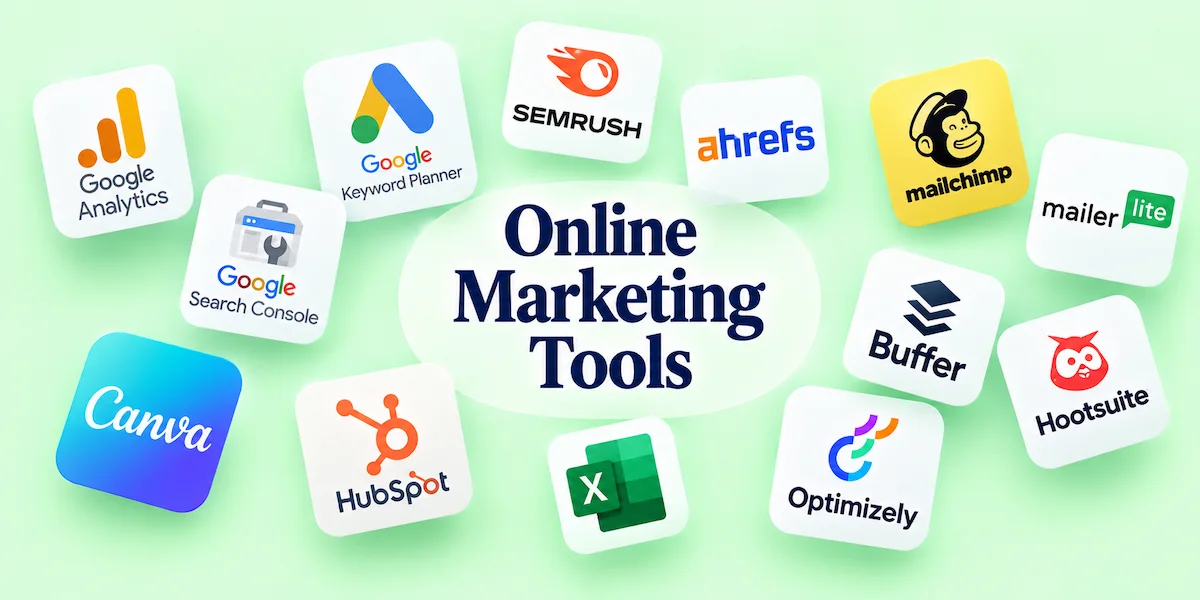
- Analytics: Google Analytics (GA4) and Google Search Console
- SEO and keywords: Google Keyword Planner, Semrush or Ahrefs
- Email: Mailchimp or MailerLite for lists, forms and campaigns
- Social scheduling: Buffer or Hootsuite to plan posts
- Design: Canva for images, social graphics and simple videos
- CRM: HubSpot or a spreadsheet to track leads and customers
- A/B testing: the testing features in your email tool or ad platform, or a tool such as Optimizely
Choose tools that connect with each other and that you will actually use. Three tools used every week beat ten tools used once.
Best Marketing Channels by Type of Online Business
Different online business models need different digital marketing first moves. If you are not sure which one you run, read this overview of the types of online business and match it to the table.
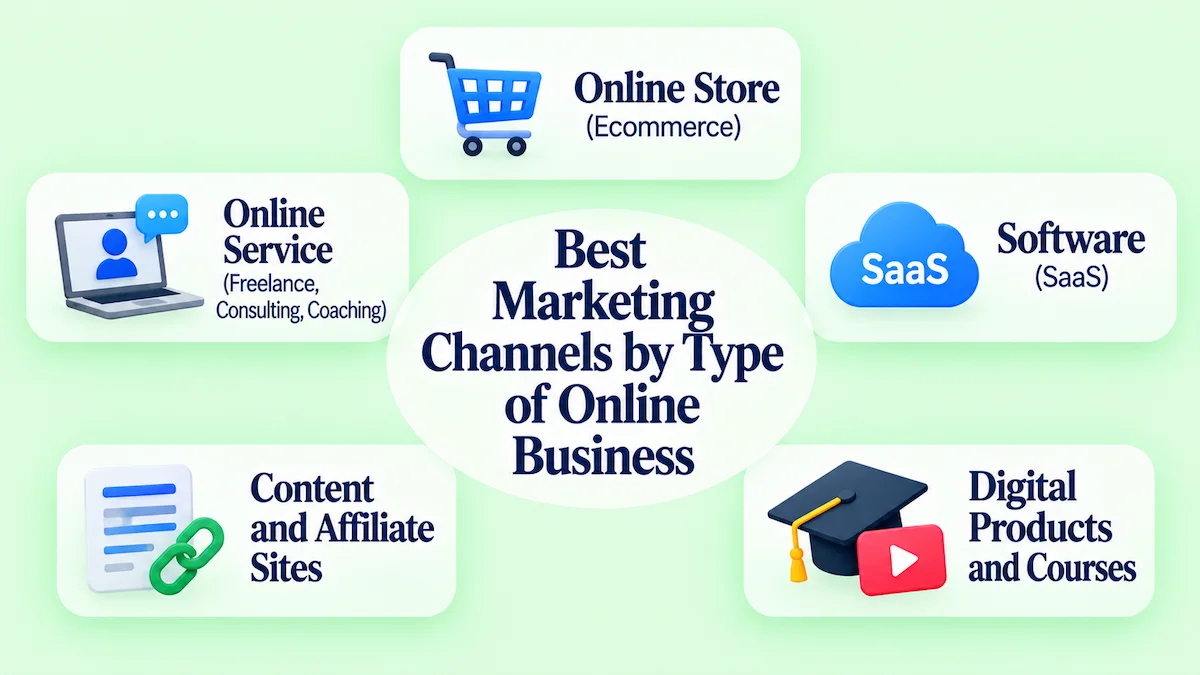
| Type of business | Start with | Add next |
|---|---|---|
| Online store (ecommerce) | SEO for product pages, email list, reviews, social proof | Search ads, retargeting and influencers |
| Online service (freelance, consulting, coaching) | Direct outreach, case studies, referrals, LinkedIn | Content, email and paid search |
| Software (SaaS) | Content and SEO, free trial, comparison pages | Paid search, partnerships and webinars |
| Content and affiliate sites | SEO, email list, social channels | Video, partnerships and paid promotion |
| Digital products and courses | Email list, free lessons, social content | Launch ads, affiliates and influencers |
The difference between selling goods and selling services changes the plan. A store depends on product pages, ads and reviews, while a service depends on trust, proof and personal contact. The guide on online business vs ecommerce explains that split in detail.
Online Marketing Examples
These are simple examples, not case studies. They show how the same ideas work in different types of online business.
- Online store: a shop that sells handmade candles builds an email list with a discount on the first order, sends a short care guide after delivery, asks for reviews and shows them on product pages. It adds retargeting ads only after the email flow works.
- Freelance service: a designer publishes two case studies, writes to ten target clients each week and asks past clients for referrals. One post about a common design mistake brings her best leads.
- Software tool: a small app offers a free trial, publishes comparison pages for what people search, and adds a short onboarding email series that explains the first three steps.
In each case the owner picks a few channels, tracks results and improves one thing at a time.
The Marketing Funnel Explained
The marketing funnel describes the path from a stranger to a customer. At the top are people who do not know you. In the middle are people who compare options. At the bottom are people who are ready to buy. Each stage needs different content and a different goal.
| Stage | Goal | Content and channels | Metric |
|---|---|---|---|
| Top (awareness) | Be found | Guides, short videos, social posts, SEO | Visitors and reach |
| Middle (consideration) | Build trust | Comparisons, case studies, emails, webinars, reviews | Signups and time on page |
| Bottom (decision) | Close the sale | Product pages, demos, free trials, offers, retargeting | Conversion rate and sales |
| After purchase | Keep customers | Follow-up emails, support, loyalty offers, referrals | Repeat purchases and reviews |
Most small businesses lose people between the middle and the bottom. A clear offer, proof and an easy next step fix more problems than extra traffic.
How to Market an Online Business: Step-by-Step Plan
Use this order if you are starting from zero. It follows the marketing funnel: attention, interest, decision and action.
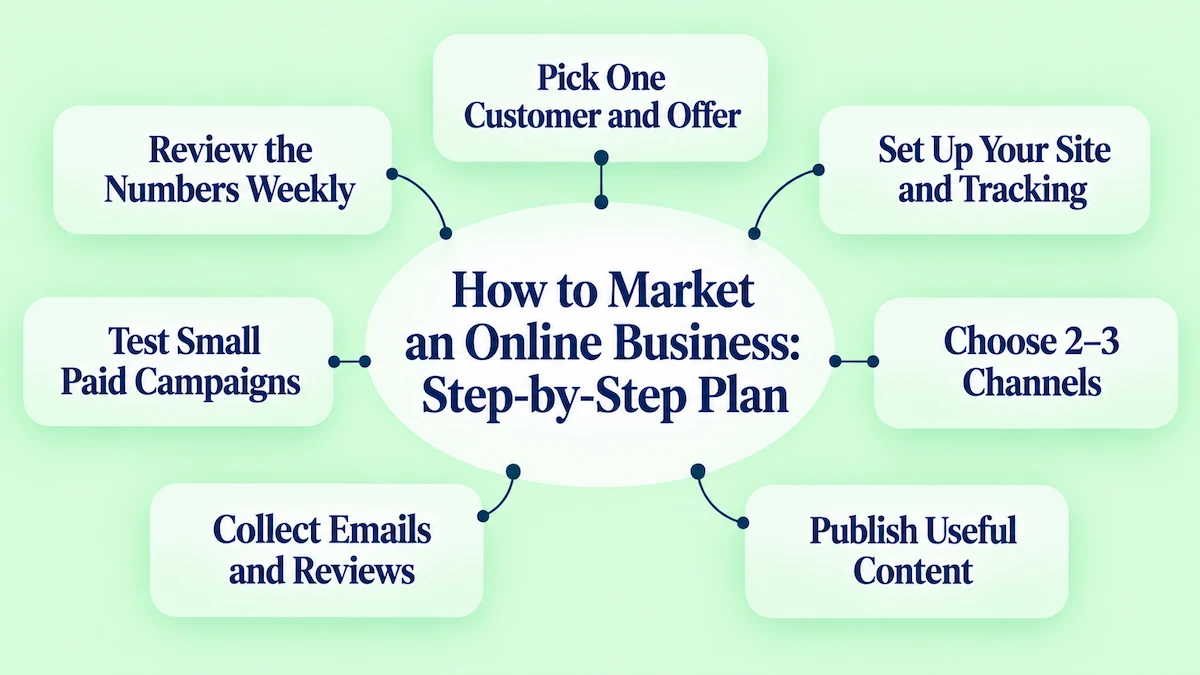
- Pick one customer and one offer. A narrow target makes every message clearer.
- Set up your site and tracking. Add one landing page, one email form and GA4 goals.
- Choose two or three channels. Match them to the table above and to your time and budget.
- Publish useful content. Answer the questions your buyers ask at the top, middle and bottom of the funnel.
- Collect emails and reviews. Offer a lead magnet and ask each happy customer for a review.
- Test small paid campaigns. Start with a low daily budget and one clear goal.
- Review the numbers every week. Keep what works, cut what does not and repeat.
Online Business Marketing Budget
Knowing how to market an online business also means knowing how much to spend. A budget does not need to be large, but it needs a rule. A practical one is the 70/20/10 rule that Xero describes: put 70% of the budget into channels that already work, 20% into promising new ideas and 10% into experiments. At the start, when nothing works yet, put most of the money into one or two channels and test them for three months.
Here is a simple example, not a case study. An online store with 600 dollars per month for marketing could spend 420 dollars on proven channels such as email software and search ads, 120 dollars on a test with paid social, and 60 dollars on one influencer post. If the owner is bootstrapping with very little money, the plan can start with only free channels and add ads after the first sales. For that path, see this explanation of what bootstrapping means.
- Testing period: give each paid channel about three months before you judge it
- Cut rule: if a campaign has not improved after four to six weeks of changes, move the money
- Reinvest: put profits from winning campaigns back into the same channel first
30-60-90 Day Online Marketing Plan
A clear schedule keeps small teams from drifting. Use this plan as a starting point and change it to fit your business.
Days 1 to 30: Set Up and Start
Define your customer and offer, build the landing page, install analytics, set up the email form and the Google Business Profile, and publish your first three helpful pieces of content. Start posting on one or two social platforms and ask your first customers for reviews.
Days 31 to 60: Grow and Learn
Send your first emails to the list, publish weekly content and test one small paid campaign with a low daily budget. Check analytics each week to see where visitors come from and where they leave. Talk to a few customers about why they bought.
Days 61 to 90: Improve and Scale
Look at your numbers and decide where to put more effort. Increase the budget for campaigns that earn more than they cost, stop the ones that do not and run A/B tests on headlines, images and offers. Add a second content format or partnership only if the first channels are running well. For the daily work around marketing, see this guide on how to run an online business.
Metrics to Track
You do not need dozens of numbers. These six show whether marketing pays for itself.
| Metric | What it shows | How to read it |
|---|---|---|
| Conversion rate | The share of visitors who buy or sign up | Low rates point to a weak page or offer |
| Click-through rate (CTR) | How many people click your ad or email link | Low CTR means a weak headline or the wrong audience |
| Cost per acquisition (CPA) | What you pay to get one customer from a campaign | Compare it with the profit from that customer |
| Customer acquisition cost (CAC) | Total marketing cost divided by new customers | Track it by channel, and by month |
| Return on ad spend (ROAS) | Revenue earned for each dollar spent on ads | Increase budget on high-ROAS campaigns |
| Customer lifetime value (CLV) | How much a customer spends over time | CLV should be well above CAC |
Run an A/B test whenever you change a headline, an image or an offer, and compare the conversion rate of both versions. To go deeper on the cost side, read this guide to customer acquisition cost. Review the numbers once a week, and change only one thing at a time so you know what caused a result.
How to Test and Optimize Your Marketing
Testing means changing one thing, measuring the result and keeping what works. Start with the pages and messages that get the most traffic, because small gains there matter most.
- Pick one element: a headline, an image, a price, a call to action or an email subject line.
- Write a guess: for example, a shorter headline will raise signups.
- Run both versions at the same time with a similar number of people.
- Wait for enough data: a few days of very low traffic prove nothing, so give the test at least a couple of weeks.
- Keep the winner and log the result, so you do not repeat the same test.
Optimizing is a habit. A short weekly review of numbers, notes and one new test beats a big redesign once a year.
Marketing Rules You Must Follow
Marketing has legal limits, and breaking them can be costly. The rules below are general information, so check the laws in your country before you launch campaigns.
- Email: in the United States, the CAN-SPAM Act applies to commercial email, including business-to-business messages. Every message must include a clear way to opt out, and you must honor opt-out requests within 10 business days. The FTC compliance guide lists the requirements and says each violating email can bring penalties of up to $53,088.
- Privacy: if you email or track people in the European Union or the United Kingdom, GDPR and similar rules generally require consent and a way to withdraw it. Publish a clear privacy policy.
- Disclosure: say clearly when you earn a commission from an affiliate link or when a post is sponsored.
- Honest claims: do not fake reviews, invent statistics or promise results you cannot prove.
AI and Online Business Marketing in 2026
AI tools now help with many marketing tasks. They can draft outlines and meta descriptions, suggest keywords, write first versions of emails, summarize customer feedback and speed up simple support. Treat the output as a draft. Review facts, tone and brand voice before anything goes live.
Search is changing as well. More people ask AI chat tools for recommendations, so it helps to be clear and easy to quote. Publish accurate pages that answer real questions, keep your business details consistent across the web, collect reviews and earn mentions on trusted sites. These steps help both traditional search and AI answers, and none of them replaces a good product.
Common Bottlenecks and How to Fix Them
When results stall, look for the weak point instead of adding more channels.
| Symptom | Likely cause | Fix |
|---|---|---|
| Few visitors | Weak SEO, no content, no promotion | Publish helpful content and share it by email and in communities |
| Visitors but no signups | Unclear offer or weak call to action | Rewrite the headline, shorten the form, add proof |
| Signups but no sales | Weak follow-up or unclear pricing | Send a welcome email series and show clear prices and reviews |
| Sales but few repeat customers | Poor follow-up or product fit | Ask for feedback, improve support, add loyalty offers |
| High ad costs | Wrong audience or weak landing page | Narrow targeting, test new ads and fix the page |
| Too many tasks | Too many channels | Cut to two or three channels and schedule the work |
Common Online Business Marketing Mistakes
Most beginners repeat the same mistakes. Check this list before you spend money.
- Using too many channels: two or three channels done well beat ten done badly.
- Buying ads before the page converts: traffic cannot fix a weak offer.
- Skipping the email list: without it, every sale depends on a new visitor.
- Not tracking results: you cannot improve what you do not measure.
- Posting without a goal: likes do not pay bills, so link every channel to an action.
- Ignoring reviews: one unanswered complaint can cost more than a week of ads.
- Quitting too early: SEO and content need months before they show results.
DIY or Hire Help?
When you start, doing the marketing yourself keeps costs low and teaches you what customers want. As the business grows, time becomes the limit. A freelancer can take over a single task, such as ads or content, while an agency can manage the whole plan for a monthly fee. Look for work with businesses like yours, clear reporting and honest communication about results.
If your marketing and daily operations both pile up, a role such as an online business manager can take over planning, schedules and team coordination so that you can focus on the work that brings in sales.
Final Verdict: Where to Start
The best way to market an online business is a simple plan. Define one customer and one offer, set up a fast website and tracking, collect emails from the start, and pick two or three channels that fit your business type. Add paid ads in small tests once the basics work, and look at your numbers every week.
You do not need a large budget to begin, but you do need patience and a clear routine. If you want to keep building your skills after this guide, see how to learn online business step by step, and apply one new idea every week.
Frequently Asked Questions
What is online business marketing?
Online business marketing is the use of the internet to find customers and turn them into buyers for a business that runs online. It includes SEO, content, email, social media, paid ads, reviews and partnerships.
How do I market an online business with no budget?
Start with free channels: a clear website, SEO and helpful content, an email list, social media, a Google Business Profile if you serve a local area, and customer reviews. Reach out to people directly and join communities where your buyers ask for help.
What are the best marketing strategies for an online business?
The most reliable ones are SEO and content, email marketing, social media, reviews and, once the basics work, search ads and retargeting. The best mix depends on your type of business, so start with two or three channels.
What is the difference between online marketing and digital marketing?
The terms are used for the same set of activities. Digital marketing is the wider label and covers every channel that uses a screen, while online marketing usually means marketing that happens on the internet.
How long does it take to see results from online marketing?
It depends on the channel. Paid ads can bring visitors within days, email shows results within weeks once you have a list, and SEO and content usually need three to six months or more to build momentum.
How much should I spend on marketing my online business?
There is no fixed number. Start with what you can afford to lose, put most of it into one or two channels and test them for about three months. A common split is 70% on proven channels, 20% on promising ideas and 10% on experiments.
What are the main types of online marketing?
The four most common are SEO, social media marketing, email marketing and pay-per-click advertising. Content marketing, influencer marketing, affiliate marketing and reviews are also widely used.
Which marketing channel is best for a new online business?
For most new businesses, SEO with helpful content and an email list give the best long-term return, and social media helps with awareness. A new service often does best with direct outreach and referrals, while a new store benefits from product page SEO and reviews.
What is the 70/20/10 rule for a marketing budget?
It is a way to split the budget: 70% for strategies that already work, 20% for new ideas that look promising and 10% for experiments. It balances steady results with room to learn.
How do I start online marketing with no online presence?
Set up a simple website or landing page, create a business email address, add a Google Business Profile if you have a local customer base, and open one or two social accounts. Then publish helpful content and collect emails.
Do I need a website to market an online business?
For most businesses, yes. A website gives you a place to explain your offer, collect emails and take payments. A service can start with a profile and a booking page, but a store needs a site from day one.
Can AI do my online business marketing?
AI can help with drafts, ideas, research and routine tasks, but it cannot replace your offer, your customer knowledge or your judgment. Review everything it writes for accuracy and brand voice before you publish it.
Is online marketing worth it for a small business?
In most cases, yes. Online marketing costs less to test than print or television, reaches customers beyond your area and shows what works. Start with free channels and add paid ads only after tracking is set up.
How can a small business compete with larger companies online?
Win on focus, not size. Serve a narrow audience, answer their questions better, show real reviews and reply fast. Local SEO, niche content and personal service are hard for large firms to copy.
What is an online marketing business?
It is a business that sells marketing services, such as SEO, ads, email or social media management, to other companies. It is different from marketing your own online business, which is what this guide covers.
Should I focus on free or paid marketing first?
Free first. Build your website, tracking, email list and content, then add paid ads when you know what converts. Paid ads work best when they send people to a page that already sells.
What are the benefits of online marketing?
The main benefits are wider reach, precise targeting, real-time measurement, a lower cost to test ideas and an audience you can own through email.
What tools do I need for online marketing?
At minimum: web analytics, an email tool, a design tool and a way to track leads. Add SEO and scheduling tools as you grow. Many of them have free plans.
How can I use my offline store to drive online traffic?
Print a QR code on receipts, packaging and signs that links to an offer or signup page, ask in-store customers for reviews, and share your website and social profiles at checkout. Keep your business details the same on your Google Business Profile and on your site.
What is the difference between online and traditional marketing?
Online marketing uses the internet and can be targeted and measured in real time. Traditional marketing uses print, radio, television and mail and reaches a broad local audience. Many businesses mix both.