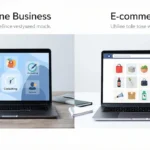
Ecommerce is one type of online business. Ecommerce means buying and selling goods or services over the internet, while an online business is the wider term for any business that runs through the internet: an online store, a freelance service, a software product, a course, or a blog that earns from ads. Every online store is an online business, but not every online business is ecommerce.
This guide explains the difference between online business and ecommerce with simple examples, plus tables that compare startup costs, time to the first sale and the skills you need. If you are asking yourself online business or ecommerce, you will find a clear decision guide and a seven-step plan at the end.
The short answer: if you want to sell products and have money for stock or a supplier, ecommerce is the natural choice. If you have a skill or knowledge but little money, start with a service or a digital product and add a store later.
Online Business vs Ecommerce at a Glance
The table gives a fast answer. The sections below explain each point with examples.
| Question | Online business | Ecommerce |
|---|---|---|
| Definition | Any business that operates through the internet | Buying and selling goods or services online |
| Scope | Wide term | Narrower term, a subset of online business |
| What you do | Sales, marketing, support, services and internal work | Selling and taking payments online |
| Examples | Marketing agency, software, course, blog, freelance work | Online store, dropshipping, print on demand, digital products |
| Startup costs | Often low, especially for services | Low to medium (platform, stock, ads) |
| First income | Often within a few weeks | Weeks to months |
| Main risk | Depends on your time and your clients | Thin margins, shipping and competition |
Because ecommerce is a subset of online business, online business vs ecommerce is not a choice between two unrelated things. It is a question of how widely a business uses the internet and whether it sells goods or services through it.
Ecommerce, E-commerce and E-business: Same Thing or Not?
On the internet you will see several spellings of the same word: ecommerce, e-commerce, e commerce and sometimes ecom. They all mean online buying and selling, and the only difference is spelling. This guide uses ecommerce.
A second pair of terms causes more confusion. E-business (short for electronic business, sometimes written ebusiness) is the term used in textbooks and in much business writing for all business activity done online. In everyday speech most people simply say online business. That is why the difference between online business and e commerce is the same as the difference between e-business and e-commerce: one is the whole business, and the other is only the selling part.
For this reason you may find both terms on the same topic. If you read a source about e-business vs ecommerce, the conclusion matches this guide: ecommerce sits inside the wider online business.
What Is an Online Business?
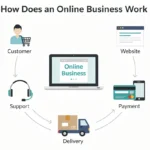
An online business, also called an e-business, is any business that uses the internet for part or all of its work. That can mean sales, marketing, customer support and payments, but also internal tasks such as record keeping, ordering from suppliers and talking to partners.
Here is a simple example. A doctor’s office that lets patients book appointments through a website uses the internet to manage customers, so it counts as an online business. It is not ecommerce, because nothing is sold online. The same goes for a hair salon, a law firm or an auto shop that takes bookings through a website.
Many online businesses earn money without selling a single product. A blog can earn from ads, a freelancer from client contracts and a software tool from monthly subscriptions. What they share is that the internet is not only a sales channel. It is part of the work itself: finding clients, doing the job, communicating and getting paid.
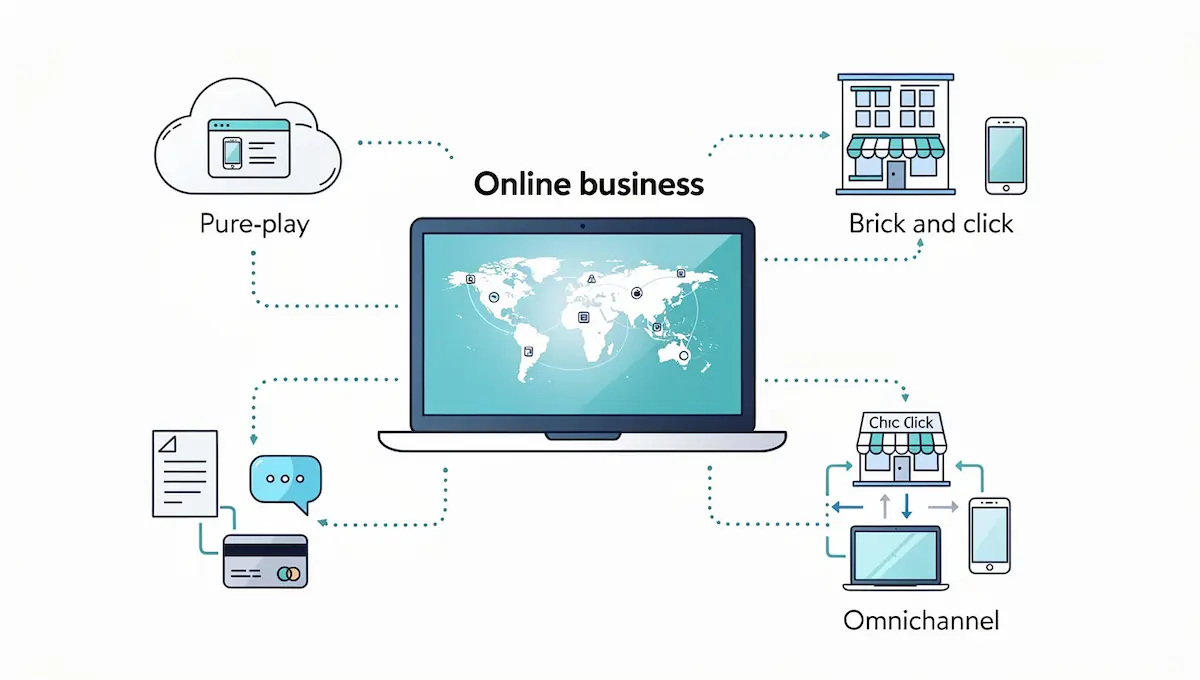
Online businesses fall into two groups. A pure-play business exists only online, such as a software tool or a course. A brick and click business has a physical location and an online presence, such as a restaurant that takes orders through an app. Some brick and click businesses go further and offer omnichannel service, where the shop, the website and the app share stock and customer data, so a buyer can order online and pick up in the store.
Types of Online Business
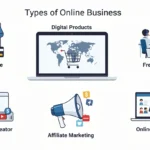
An online business can take many forms. The most common are:
- Services: freelance writing, design, virtual assistance, consulting, coaching and online tutoring
- Content: a blog, YouTube channel, podcast or newsletter that earns from ads, sponsors and affiliate links
- Software: SaaS tools and apps that charge a monthly subscription
- Marketplaces: classified sites and platforms that connect buyers and sellers
- Ecommerce: selling physical or digital products online
You can run many of these without an office, and a tested list of ideas is in the guide to remote business ideas.
What Is Ecommerce?
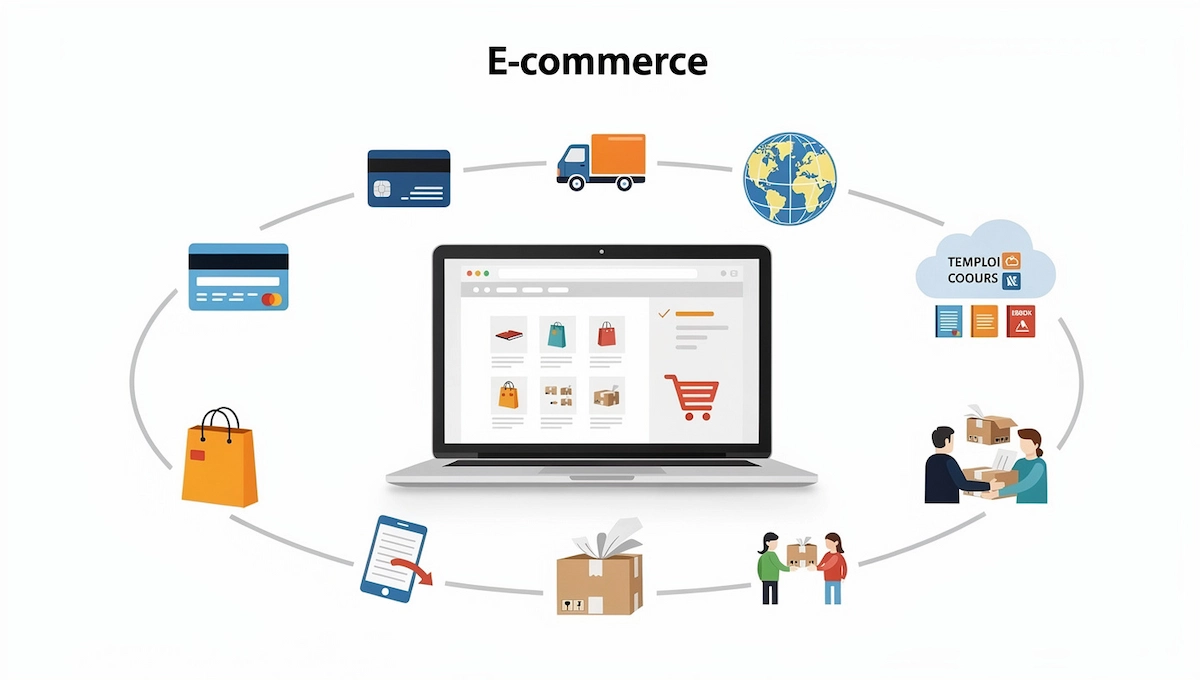
Ecommerce, short for electronic commerce, is the buying and selling of goods or services over the internet, through a website, a mobile app or an online marketplace. The focus is the transaction: the customer chooses and pays, and the seller delivers.
Ecommerce includes online stores, dropshipping, print on demand, subscription boxes and the sale of digital products such as templates, ebooks and courses. It also covers auction sites and classified listings where individuals sell to each other.
An ecommerce store can stay open 24/7, reach customers worldwide and run at a lower cost than a physical shop. Every sale also gives you customer data you can use to improve your marketing and your offer.
Ecommerce has limits too. Customers cannot touch a product before buying, so returns are more common, and shipping and storage add costs. Low barriers to entry also mean that hundreds of other stores may sell the same product, so it is hard to stand out without a clear niche.
Types of Ecommerce Models
Ecommerce is split by who sells to whom:
- B2C (business to consumer): a company sells directly to shoppers, such as an online clothing store
- B2B (business to business): a company sells to another company, such as a wholesaler that ships goods to shops
- C2C (consumer to consumer): one person sells to another, such as used items on a classifieds site
- C2B (consumer to business): a person offers a service to a company, such as a freelancer on a job platform
- Intra-B (intra-business): a company trades with its own departments or staff, such as an internal store for employees
Each model has its own demands. B2B sales usually mean larger orders and longer negotiations, while B2C needs strong marketing and fast delivery.
Difference Between Online Business and Ecommerce
The core difference is scope. Ecommerce is about selling, while an online business covers everything a company does through the internet. These four points show it best.
Scope and Focus
Ecommerce is the narrower term and is always tied to online sales. An online business is the wider term and does not have to sell anything. It can be used to book appointments, manage clients or work with partners. That is why an ecommerce company is always an online business, but the reverse is not true. When someone says they have an ecommerce business, they mean sales. When they say they have an online business, they mean a business that relies on the internet.
Core Business Activities
Ecommerce companies handle selling, payments, packing and delivery. An online business may also run marketing, customer support, client management and data analysis, without any online sales. For example, an agency that builds websites for clients manages projects, sends quotes and invoices online, but sells no product.
Tools and Software
Ecommerce needs a store platform, a payment method and shipping. An online business uses a wider set of tools: a CRM for clients, accounting software, booking tools, communication apps and systems to track stock. Ecommerce firms often use both sets. A store owner may use store software and a CRM, while a solo consultant can get by with a calendar, video calls and an invoicing app.
Income Model
Ecommerce earns on the difference between the cost of a product and its selling price, or on digital product sales. An online business can earn from services, subscriptions, ads, commissions or licenses, so income does not have to depend on stock and shipping. Ecommerce results are measured by margin per product and number of orders, while services are measured by price per hour, per project or per monthly package.
Network and Technology
Ecommerce runs on the public internet, through a website, an app or a marketplace. A wider online business may also use an intranet for staff and an extranet for suppliers and partners, so teams can share files, orders and reports. That is why e-business is often described as the use of digital technology across the whole company, and ecommerce as only the part that touches the customer.
Detailed Comparison Table
| Point | Online business | Ecommerce |
|---|---|---|
| Definition | All business activity done through the internet | Online buying and selling |
| Scope | Wide: sales, services, support and internal work | Narrow: transactions |
| Main goal | Run and grow the whole business online | Sell goods or services and take payments |
| People involved | Clients, staff, suppliers and partners | Mostly buyers |
| Technology | CRM, accounting, booking tools and a website | Store platform, payment tools and shipping tools |
| Networks | Internet, and sometimes intranet and extranet | Public internet |
| Examples | Marketing agency, software, course, booking site | Online store, marketplace, digital product sales |
| Income | Sales, services, subscriptions, ads and commissions | Product sales and related fees |
| Typical risks | Data security, tech dependence, a few big clients | Fraud, returns, shipping and competition |
| Relationship | The whole | A part of the whole |
How Online Business and Ecommerce Relate
The easiest way to picture it is a large circle with a smaller circle inside it. The large circle is the online business and the smaller one is ecommerce. Every ecommerce sale is part of an online business, but the online business has other parts that are not about selling goods.
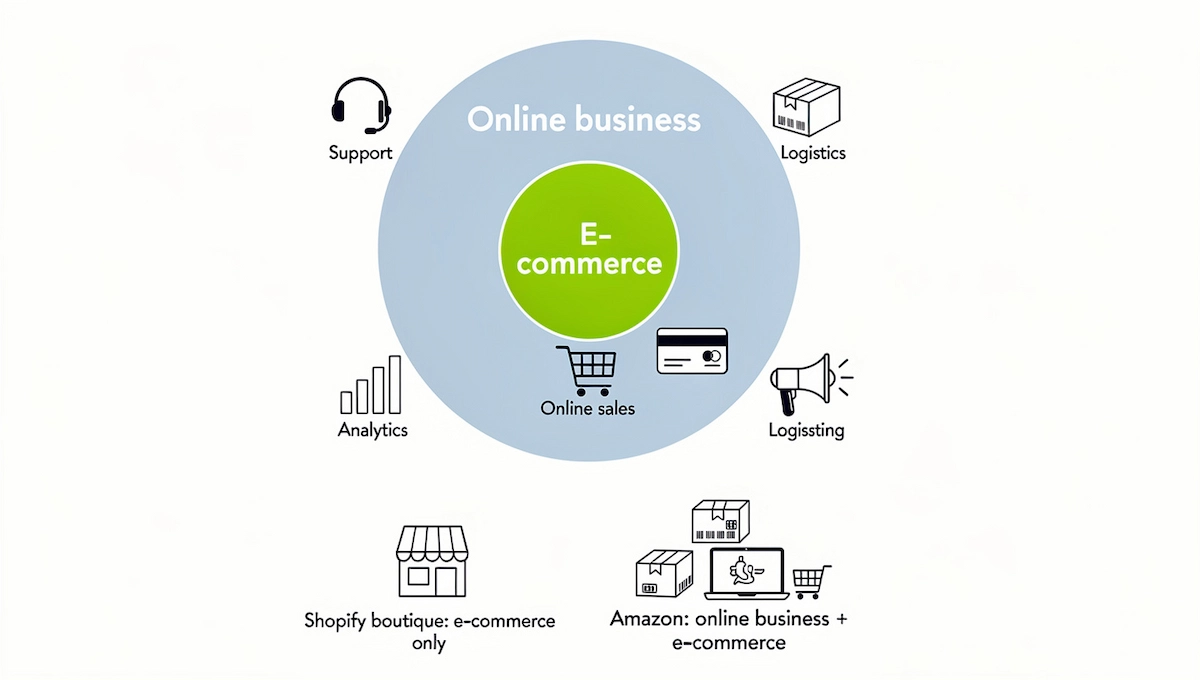
Amazon does both: it sells goods online (ecommerce) and also runs warehouses, support, analytics and partner systems (the wider online business). A boutique that sells only through a Shopify store is ecommerce. A marketing agency that sells no products is an online business and not ecommerce. Shopify describes the same split through the terms e-business and ecommerce.
Why the Difference Matters
Knowing the difference is more than a point of vocabulary. It changes how you plan, price and promote your business.
- Business plan: an ecommerce plan needs product sourcing, stock and shipping numbers, while a plan for an online service needs a way to find clients and a limit on how much work you can take.
- Taxes and rules: selling physical goods can bring sales tax, VAT and customs, while services often follow other rules. Check both before your first sale.
- Marketing: a store depends on product search, ads and email, and a service depends on content, referrals and direct outreach.
- Tools and hiring: a store needs help with stock, packing and support, and a service business needs people with the same skill you sell.
- Career choices: ecommerce jobs focus on merchandising, ads and logistics, while wider online business roles include operations, client management and software.
If you mix the two terms, you can plan the wrong budget, pick the wrong tools or ask an accountant the wrong question.
Online Business Examples That Are Not Ecommerce
If you do not want stock, shipping and returns, look at online businesses that earn from knowledge, time or audience:
- Freelance services: writing, design, programming, translation and video editing for clients anywhere
- Consulting and coaching: advice in the field where you have experience, charged by the hour or by package
- Online tutoring: private lessons and group classes by video call
- Affiliate marketing: a commission when a reader buys through your link
- Content: a YouTube channel, blog or newsletter that earns from ads and sponsors
- SaaS software: a small tool that solves one problem and charges a monthly subscription
For software companies the registration rules differ by country, as the guide on how to start a SaaS business in Dubai shows.
The advantage of these models is that you need no stock, storage or delivery, and startup costs are low. The weaker side is that service income grows with your hours, while content and software need patience, since the first income often comes after several months.
Ecommerce Business Examples
Ecommerce always involves selling products or services online. The most common models are:
- Online store with your own products: you make or buy goods and sell them through your own site
- Dropshipping: you sell goods that a supplier stores and ships to the customer, so you hold no stock
- Print on demand: you sell shirts, mugs and posters that are printed only after an order
- Subscription box: customers receive a package of selected products every month
- Digital products: templates, planners, ebooks and courses that download right after payment
- Marketplace selling: a classifieds site, Etsy or eBay as your sales channel
Dropshipping and print on demand have a lower starting cost because there is no stock. In return, margins are smaller and competition is strong, so choose a clear niche.
For most beginners the easiest options are digital products and print on demand, since there is no stock and no shipping. Dropshipping needs more work with suppliers and customer support, and a store with your own products needs the most money but gives you the most control over brand and margin.
Pros and Cons: Ecommerce vs Online Services
Ecommerce
Advantages:
- the store works 24/7 without you being present
- global reach and room to grow without opening a new shop
- lower costs than a physical store
- customer data for better marketing and offers
Limitations:
- shipping, delivery and returns add costs
- low barriers to entry mean heavy competition
- customers cannot touch the product, so returns are more common
- risk of fraud and payment problems
- dependence on a platform and on ads
In short, ecommerce offers wide reach and growth, but it needs money, logistics and constant marketing.
Online Business Without Selling Goods
Advantages:
- no stock, storage or delivery
- low startup costs, especially for services
- fast first income, often within a few weeks
- higher margins, because you sell knowledge instead of goods
Limitations:
- service income depends on your time
- you need a reputation and the trust of clients
- content and software take months before the first income
- less data about the mass market than a store has
In short, an online business without selling goods offers a fast start and lower risk, but growth is slower or depends on your hours.
Online Business vs Ecommerce Compared: Cost, Time and Skills
This table puts the common models side by side. Figures depend on the niche and the market, so treat them as a guide.
| Factor | Ecommerce store | Online services | Digital products and content | Software |
|---|---|---|---|---|
| Startup costs | Low to medium | Low | Low | Medium |
| Time to first income | Weeks to months | Weeks | Weeks to months | Six to twelve months |
| Skills needed | Marketing, sourcing, sales | Expertise and communication | Design, writing, promotion | Development and support |
| Logistics | Stock, shipping, returns | None | None | None |
| Scalability | High | Medium | High | High |
| Main risk | Thin margins and competition | Depends on your time | Slow path to buyers | Maintenance and support |
If your budget is tight, see also these business ideas under 5k, where many of these options can start with little money.
Online Business vs Traditional Business
A traditional business works through a physical location and direct contact with customers. An online business works through the internet. The main differences are:
- Reach: a traditional business serves local customers, while an online business can serve customers worldwide
- Hours: a shop has opening hours, and an online store runs all the time
- Costs: rent, utilities and staff compared with technology and marketing
- Data: an online business tracks customer behavior, while a shop relies on experience
- Speed of change: you can change a price or an offer online in a few minutes
Most businesses today mix both approaches. A bakery that takes orders through an app is a brick and click business.
How Marketing Differs: Online Business vs Ecommerce
Both models need customers, but they reach them in different ways. An ecommerce store sells a product that people can compare, so it relies on search, ads and reviews. An online service sells trust, so it relies on proof of results and personal contact.
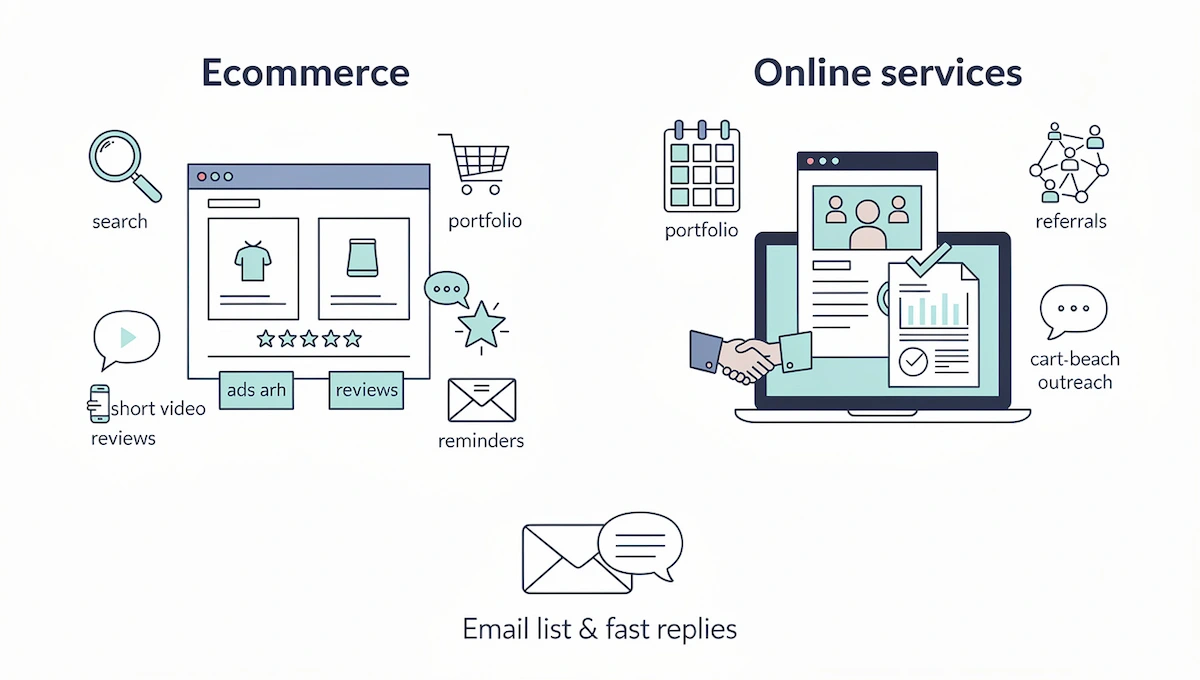
- Ecommerce: product pages that answer questions, search and shopping ads, email reminders for abandoned carts, customer reviews, photos and short videos, and partnerships with creators
- Online services: case studies, a clear portfolio, direct outreach, referrals, guest content, and answers in groups where your buyers ask for help
- Both: an email list, a clear offer and fast replies to every message
For a store, a good product page is the sales pitch. For a service, a good conversation and one proven result usually close the sale.
Online Business or Ecommerce: Which Should You Start?
This is not a question of which is better, but which is better for you. The answer depends on your knowledge, your money and your time.
Choose Ecommerce If
- you want to sell physical or digital products
- you have money for stock, ads or a platform
- you enjoy building a brand and selling to many customers
- you have a supplier, a product or an idea you can adapt to a niche
Choose an Online Service or Digital Business If
- you have a skill or knowledge that others pay for
- you have little money to start
- you want your first income as soon as possible
- you do not want to deal with stock and shipping
If you are starting with no money, read the guide to an online business without investment.
Start With Both
Many owners start with a service, find out what customers ask for, and then add a product, a course or a store. This order lowers risk, because you spend money only after you see that demand exists.
| Your situation | Best way to start |
|---|---|
| I have a skill and little money | Online service |
| I have money for stock and like selling | Ecommerce store |
| I like creating content | Digital products, blog or newsletter |
| I have an idea for a tool that solves a problem | SaaS or software (slower, but it scales) |
| I already have a physical shop | Brick and click, add an online store |
Buy an Existing Online Business or Store
There is a third route: buy a business that already runs. It costs more at the start, but you skip the first months of testing. Before you pay, ask for revenue records, traffic sources, the customer list, supplier terms and the reason the owner is selling. A business that depends on one ad account or one big client is riskier than it looks.
Two Example Paths: Service First vs Store First
These are simple examples, not case studies. They show how the same idea can start in two ways.
Path one: service first. A designer with no savings offers logo and social media design to local shops. After two clients, she sees that many ask for the same templates, so she turns them into digital products and sells them on a marketplace. Later she opens a small store with her own brand. She started as an online business and grew into ecommerce, and she spent money only after she had proof of demand.
Path two: store first. A buyer finds a supplier of kitchen tools and opens an online store. He pays for a platform, samples and ads, and he must handle shipping and returns from the first order. The margins are thinner, but he builds a brand and a customer list. After a year he adds a recipe newsletter and a small course, which widens his online business beyond the store.
Neither path is better. The first one starts faster with less money, and the second one fits people who want to sell products from day one.
How to Start an Online Business or Ecommerce Store in 7 Steps
The same framework works for both models. The difference is in the platform and shipping step.
- Pick an idea and a customer. Decide what you sell and to whom. One clear niche is better than a general offer, because it is easier to write a message and find the first buyers.
- Check demand. Ask ten people from your target group whether they would pay for your offer at a given price. If three say yes, move on. Polite interest does not count.
- Work out costs and price. Write down startup costs, costs per sale and the profit you want, then set a price. For products, include shipping, returns and platform fees.
- Choose a model and a platform. A service needs only an offer and a way to get paid, while a store needs a platform such as Shopify, WooCommerce or Wix. Do not switch platforms in the first months.
- Build a simple brand and page. A logo, colors and one page with your offer are enough at the start. For first logo drafts, AI tools for 3D logo design can help, but finish the final version yourself.
- Set up payments and delivery. Choose how you will get paid, and for products arrange a supplier or a courier. Go through the whole customer path yourself before the first order.
- Get the first sale and track results. Tell people you know, post your offer in two or three groups and write down what works and what does not. The first sale tells you more than any estimate.
Costs, Legal and Tax Basics
Costs depend on the model. Services can start with a laptop and an internet connection. An online store needs a platform, stock or a supplier, and ads. Software needs development time and maintenance. You can test most models before you spend a larger amount.
- Ecommerce store: platform, domain, stock or supplier, packaging, shipping, payment fees and ads
- Online service: laptop, internet, design and video call tools, and a domain if you want one
- Digital products and content: a tool to create them, hosting or a sales platform, and your time
- Software: development, hosting, security and customer support
The legal form depends on the country. According to Shopify, you do not need a limited liability company to sell through ecommerce, although one can protect your personal assets if you are sued. Some activities require a license, insurance or tax registration. The rules differ by country, as the guide on an online business in Ireland shows.
Taxes apply to a small online business as well. In the United States, for example, you must file a return when net profit from self-employment reaches $400 in a year, and the IRS Self-Employed Individuals Tax Center explains the details. Other countries have different limits and forms, so ask a local accountant before your first sale.
Payments, Security and Customer Trust
Both models need a safe way to take money. An ecommerce store usually connects a payment processor to the checkout, while a service business can send invoices and take deposits before work begins. In both cases customers need to feel safe.
- use a secure site (HTTPS), strong passwords and two-factor login on every account
- show a clear refund policy, a privacy policy and real contact details
- keep records of every payment, refund and invoice
- watch for fraud signs, such as orders with mismatched addresses or unusual large purchases
- use contracts and written scopes for services, so both sides know what is included
Trust grows from small things: fast replies, honest descriptions and a refund that arrives when promised. These matter more than a polished design.
Tools and Platforms to Start
You need few tools at the start. Choose only what you will use.
- Store platform: Shopify, WooCommerce or Wix
- Design: Canva or a similar tool for logos, social posts and product images
- Payments: card processing or a payment service that works in your country
- Shipping: a courier service or a supplier that ships the goods
- Email: a tool for messages to customers and sales tracking
- Accounting: a spreadsheet or program to record income and costs
Do not buy paid plans right away. Most tools have a free plan or a trial, so check that you really need them, and upgrade what you use every day once sales begin.
Common Mistakes
Most beginners make the same mistakes, whether they start an online business or an ecommerce store. Check this list before you spend money.
- Spending before checking demand: first confirm that someone pays, then buy stock or tools.
- An offer that is too broad: a store with everything or a service for everyone attracts no one.
- Ignoring margin: include shipping, returns, platform fees and ads.
- Depending on one platform or client: if it disappears, your income disappears with it.
- Skipping rules and taxes: small problems grow when you ignore them.
- Working alone for too long: when work piles up, look at what an online business manager does and which tasks you can hand off.
If you avoid these mistakes and keep to small steps, your risk stays low and you learn from real customers instead of guesses.
What Is Changing in 2026
AI tools are entering both models. Ecommerce stores use them for product descriptions, recommendations, customer support and demand estimates. Online services use them for writing, design, task automation and faster replies to clients.
For that reason product descriptions and service pages should answer real customer questions, because both people and automated tools read them. A clear offer, accurate prices and quick replies are worth more than decoration.
Tools do not replace an idea and customers. Start with a clear offer, and add automation when you see which tasks repeat. If that direction interests you, see the guide on how to start an AI business with no money.
Final Verdict: Online Business or Ecommerce?
Ecommerce is one part of an online business, so the choice is not between two unrelated things. If you want to sell products and have money to start, an ecommerce store is a reasonable choice. If you have knowledge but little money, a service or a digital product gives a faster first income with less risk.
Whatever you choose, start small: one offer, one customer, one first sale. When you see what customers really pay for, widen the offer. The question of online business vs ecommerce then becomes a decision about how to grow, not where to begin.
Frequently Asked Questions
What is the difference between online business and ecommerce?
Ecommerce is the sale of goods or services over the internet. An online business is a wider term that covers any business run through the internet, including sales, but also services, software, content and internal processes.
Is ecommerce an online business?
Yes. Ecommerce is a subset of online business. Every online store is an online business, but not every online business is ecommerce, for example a marketing agency or a freelance service.
Can ecommerce and online business be used interchangeably?
In everyday speech they are often swapped, but they are not the same. Ecommerce means online selling, and online business means any business that uses the internet. For SEO, a business plan or a talk with your accountant, the difference matters.
Which is better: online business or ecommerce?
The question online business or e commerce has no single answer, because it depends on you. Ecommerce suits people who want to sell products and have money to start. Online services and digital products suit people with a skill and little money. Many owners start with a service and add a store later.
Is an online business cheaper to start than ecommerce?
Often yes. Services and digital products need a laptop, internet and free tools, while an online store needs a platform, stock or a supplier and ads. The gap depends on the model, so check costs before you invest.
Do I need a company for ecommerce or an online business?
It depends on the country and the activity. In some places you can start as a sole proprietor, and a separate company protects personal assets. Check the local rules with an accountant or a lawyer.
What is the difference between e-business and e-commerce?
E-business (electronic business) is the wider term and covers all business activity online, including CRM, ordering and internal processes. E-commerce is only buying and selling online. It is the same difference as between online business and ecommerce.
What are the types of ecommerce?
The main types are B2C, B2B, C2C and C2B. B2C is selling to shoppers, B2B is selling to companies, C2C is selling between individuals, and C2B is individuals offering services to companies.
What is the most profitable ecommerce business?
There is no single answer, since profit depends on niche, margin, marketing and effort. Digital products usually have higher margins, while selling physical goods can bring higher turnover. The best choice is a niche you know, tested with a small investment.
Can I start an online business with no money?
Yes. Choose a service you already know, use free tools for design and video calls, and sell the first job to someone you know. The first income pays for everything else.
Is dropshipping an online business or ecommerce?
Dropshipping is an ecommerce model, and therefore also an online business. You sell products through an online store, and the supplier stores them and ships them to the customer.
Do I need a website for an online business?
Not at the start. For services, a profile on a social or professional network, direct messages and a simple booking page are often enough. A website helps once you have examples of your work and a clear offer, while an ecommerce store needs one from day one.
What is the full form of e-business?
E-business stands for electronic business, which means running business activities through the internet and digital tools. E-commerce stands for electronic commerce, which is buying and selling online.
What are the types of e-business?
E-business follows the same models as ecommerce: B2C, B2B, C2C and C2B. Many sources also list intra-business transactions inside a company and business-to-government dealings. In terms of form, a business can be pure-play, brick and click or omnichannel.
What are the challenges of ecommerce?
The main challenges are heavy competition, shipping and returns, thin margins, payment fraud, customer trust, taxes in different countries and dependence on a platform or on ads. A clear niche and a tested offer lower most of these risks.
What is the impact of e-business on a company?
E-business lowers some costs, widens the market, speeds up communication and gives more data about customers. It also adds risks, such as data security and dependence on technology, so a company needs clear rules for both.
Can my online store be both ecommerce and an online business?
Yes. A store that sells products is ecommerce, and it is also part of your online business. If you also use online tools for support, supplier orders, bookings or client management, it is an online business in the wider sense as well.
How does AI change online business and ecommerce?
AI tools help stores write product descriptions, answer customer questions and spot demand. They help online services with writing, design and routine tasks. The results still need a human check, and the offer, the customer and the trust you build remain your job.
What is the best ecommerce platform for beginners?
Shopify, Wix and WooCommerce are the most common choices for beginners. Shopify is the simplest for a quick store, Wix is affordable for small projects, and WooCommerce gives more control if you use WordPress. The choice depends on your budget and technical skills.