Knowing how to write a business plan comes down to ten steps: describe your company, define what you sell, research your market and competitors, plan marketing and operations, describe your team, build the financials, add a funding request and write the executive summary last. A good business plan is short enough to read, backed by numbers and written for one specific reader.
This guide shows you how to write a business plan step by step. You will pick a format, follow ten steps with a table for each, and see a worked example for a small online shop. It also covers the financial section in detail, plans for loans and investors, free templates, mistakes and a checklist.
The numbers in the example are made up to show how the math works. Use your own figures, and ask an accountant to review your final plan.
How to Write a Business Plan at a Glance
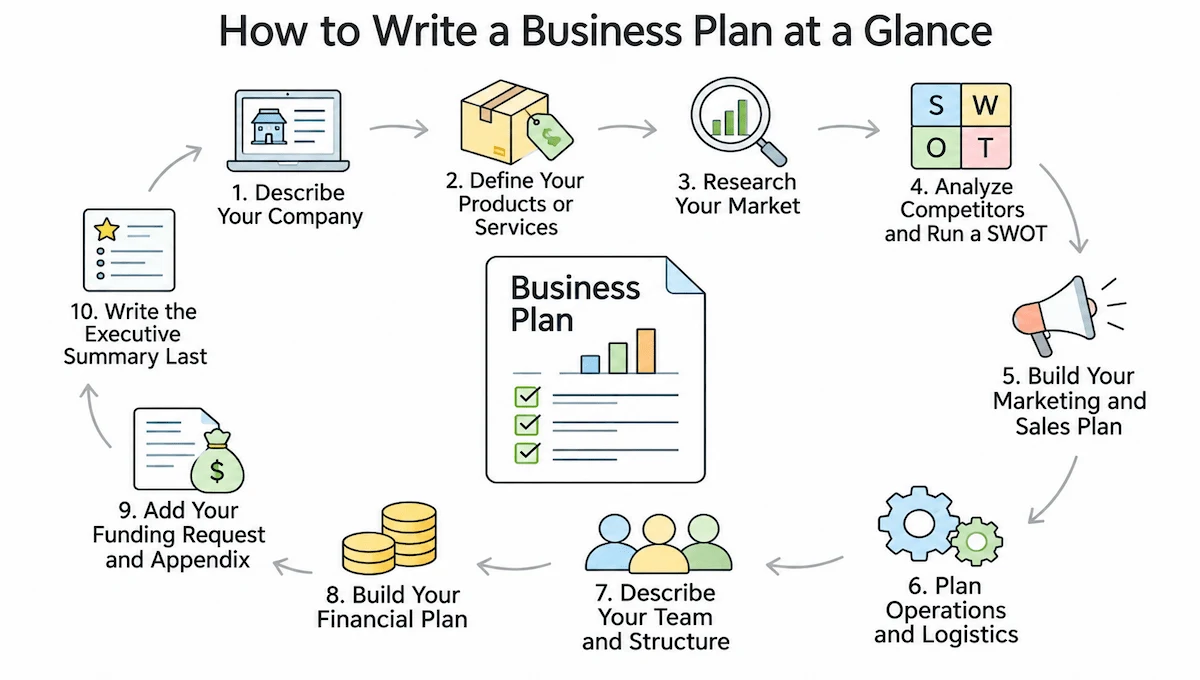
Here are the ten steps to write a business plan, in the order we recommend.
- Step 1: Describe your company – Who you are, what you do and your mission
- Step 2: Define your products or services – What you sell, to whom and at what price
- Step 3: Research your market – Size, trends and your target customer
- Step 4: Analyze competitors and run a SWOT – Who else serves your customers
- Step 5: Build your marketing and sales plan – How customers find and buy from you
- Step 6: Plan operations and logistics – How the business runs every day
- Step 7: Describe your team and structure – Who runs it and how it is set up
- Step 8: Build your financial plan – Costs, revenue, profit and break-even
- Step 9: Add your funding request and appendix – What you need and the proof behind it
- Step 10: Write the executive summary last – The whole plan in one page
What Is a Business Plan?
A business plan is a written document that explains what your business sells, who it serves, how it will run and how it will make money. The SBA describes it as a guide for how to structure, run and grow a business. Lenders and investors use it to judge a request for money, and owners use it to test ideas and guide decisions.
Why Write One Even If You Do Not Need Funding
Writing the plan forces you to think through every part of the business before you spend money. You find gaps in your idea, see how much cash you need and set goals you can measure. Even a short plan helps. If you are new to all of this, read how to start an online business with no experience first.
Business Plan vs Business Model vs Pitch Deck
These documents are often mixed up, but each one has its own job. A business plan covers the whole business, while the others focus on one part of it.
| Document | What It Is | Who Reads It | Length |
|---|---|---|---|
| Business plan | Full description of how the business runs and earns | Lenders, investors, partners and you | One page to dozens of pages |
| Business model | How the business makes money | You and your partners | Often one page |
| Pitch deck | Short slide presentation | Investors | Usually 10 to 15 slides |
| Strategic plan | Long-term goals for an existing company | Leaders and managers | Varies |
What a Business Plan Helps You Achieve
A business plan does more than help you get a loan. It gives you a clear picture of the business and a way to check your decisions against it. Here is what a written plan does for you.
- Plan strategically: it sets your goals and shows the steps to reach them, so you act on purpose instead of reacting.
- Evaluate your idea: writing the numbers shows early if the idea can earn a profit.
- Clarify your selling points: you have to say why customers should pick you, and that sharpens your message.
- Prepare for funding talks: lenders and investors expect a plan, and having one ready speeds up the conversation.
- Keep partners and staff aligned: everyone works from the same goals and numbers.
If you plan to work online, you can also read about the main benefits of an online business before you write your first draft.
Choose Your Business Plan Format
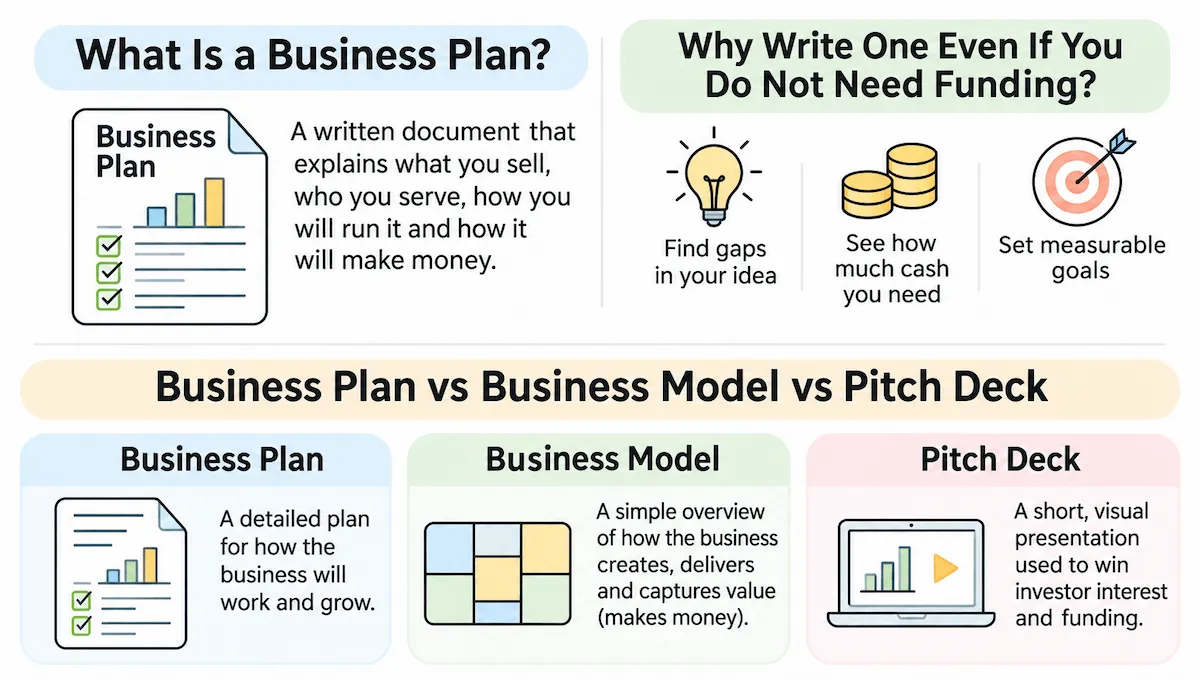
There is no single right way to write a business plan, and no fixed business plan format. Most plans follow one of two formats, and the SBA says that what matters is that the plan meets your needs.
Traditional Business Plan
A traditional business plan is detailed, takes more time to write and can run dozens of pages. Lenders and investors usually ask for this format. It has the standard sections you will see in the steps below.
Lean Business Plan
A lean business plan is a short version that lists only the key points. It uses a handful of blocks such as key partners, key activities, value proposition, customer segments, channels, cost structure and revenue streams. It can take as little as an hour to write and works well for testing an idea or for a business that may change direction.
The SBA lean plan uses nine blocks. Write one to three short lines for each.
| Block | What to Write |
|---|---|
| Key partnerships | Suppliers and partners you rely on |
| Key activities | The main things you must do to deliver |
| Key resources | People, equipment and money you need |
| Value proposition | Why customers should choose you |
| Customer relationships | How you keep and grow customers |
| Customer segments | The groups you serve |
| Channels | How you reach customers |
| Cost structure | Your main costs |
| Revenue streams | How money comes in |
One-Page Business Plan
A one-page business plan squeezes the main points into a single sheet: what you sell, who buys it, how you reach them and what the numbers look like. It suits side businesses, quick pitches and internal planning. You can expand it later into a full plan if you need funding.
Which Format Should You Use?
Pick the business plan format by your reader and your goal.
| Format | Length | Best For |
|---|---|---|
| Traditional | Many pages | Bank loans, SBA loans and investors |
| Lean | One to two pages | Testing an idea and early-stage businesses |
| One-page | One page | Side businesses and quick pitches |
Before You Write: Audience, Research and Numbers
A little preparation saves hours of rewriting. Before you open a blank page, decide who will read the plan, collect your research and list your numbers.
Define Your Audience
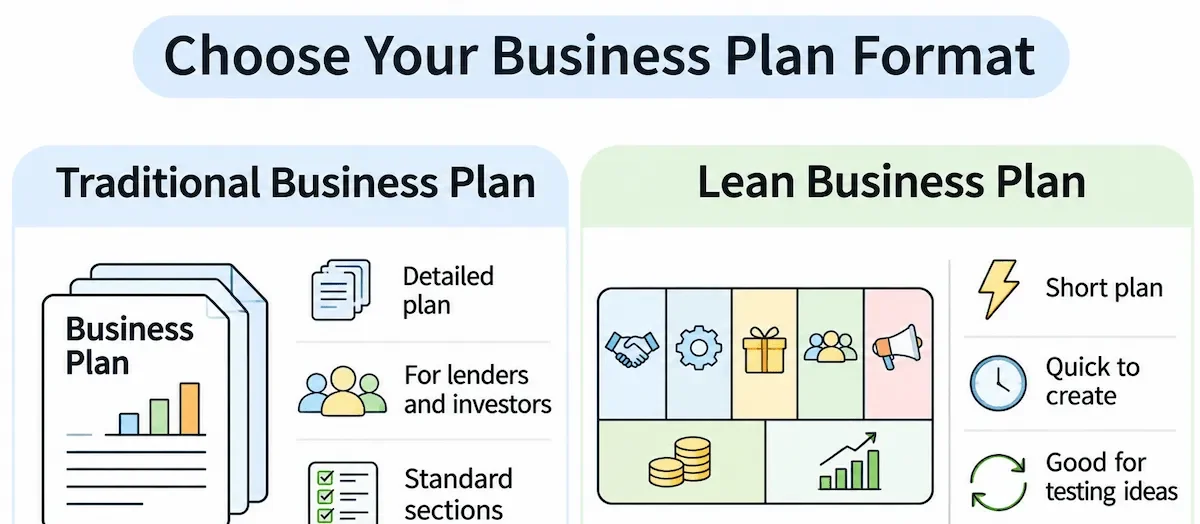
A lender looks for proof that you can repay the loan. An investor looks for growth and return. A partner wants to see how you will work together, and a new hire wants your mission. Write your plan for one reader and keep their questions in mind.
Do Market Research First
Find out if people want what you sell, how many they are and what they pay now. Use existing sources such as census data and industry reports, then talk to real customers through surveys or short interviews. Research on your target market and your competitors feeds the market analysis and the marketing plan.
Market Research Methods You Can Use
Use a mix of two types of research. Secondary research uses data that others collected, such as census figures, industry reports and trade group studies. Primary research is data you collect yourself.
- Surveys: ask 30 to 50 people in your target market short questions about what they buy and what they pay.
- Interviews: talk to a few customers one on one to learn what they need.
- Competitor checks: read reviews, price pages and social accounts to see what customers like and dislike.
- Test sales: sell a small batch or take pre-orders and see if people pay.
- Public data: use census and industry sources for market size and trends.
Gather Your Numbers
List your startup costs, such as equipment, inventory, licenses, insurance, software and marketing. Add your monthly costs and your expected prices. If money is tight, read how to start an online business with no money for ways to cut early costs.
Mission, Vision and SMART Goals
Three short statements at the start of your plan set the direction for everything that follows. Write them in plain words, one or two sentences each.
- Mission statement: what the business does and who it serves. Example: “We make simple, clean-burning candles for gifts.”
- Vision statement: where you want the business to be in a few years. Example: “To be the first name people think of for small-batch gift candles.”
- SMART goals: goals that are specific, measurable, achievable, relevant and time-bound. Example: “Sell 150 candles a month by month six.”
Short-term goals cover the next year, and long-term goals cover three to five years. Every goal should link to a number you can track.
How to Write a Business Plan in 10 Steps
Here is how to write a business plan from start to finish. Each step has a short guide and a table with the purpose, length, key question, data sources and the most common mistake.
Step 1: Describe Your Company
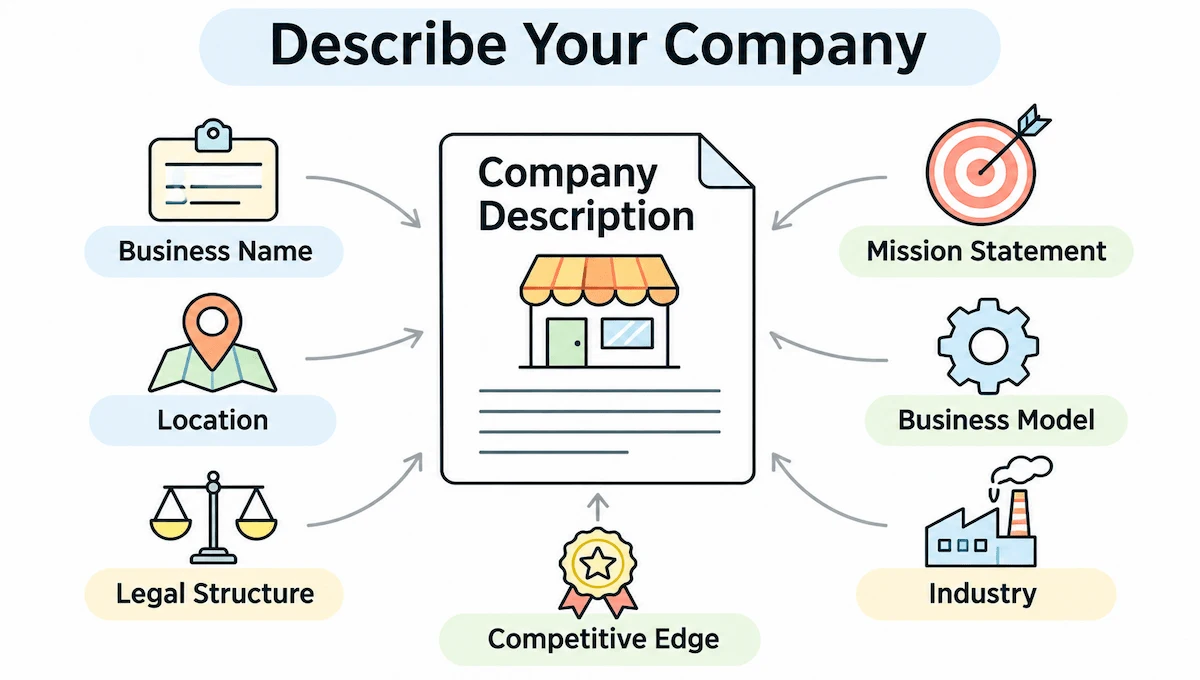
The company description tells the reader who you are and what you plan to do. Start with your business name, location, legal structure and a short mission statement. Add your business model, your industry and what gives you an edge over competitors. Keep it factual and short, since the reader should understand the business after one page.
| Detail | Info |
|---|---|
| Purpose | Explain who you are and what the company does |
| Typical Length | One page |
| Key Question | What problem do you solve and for whom? |
| Where to Find Data | Your own plans, your registration papers and your industry research |
| Common Mistake | Writing a long story instead of clear facts |
Step 2: Define Your Products or Services
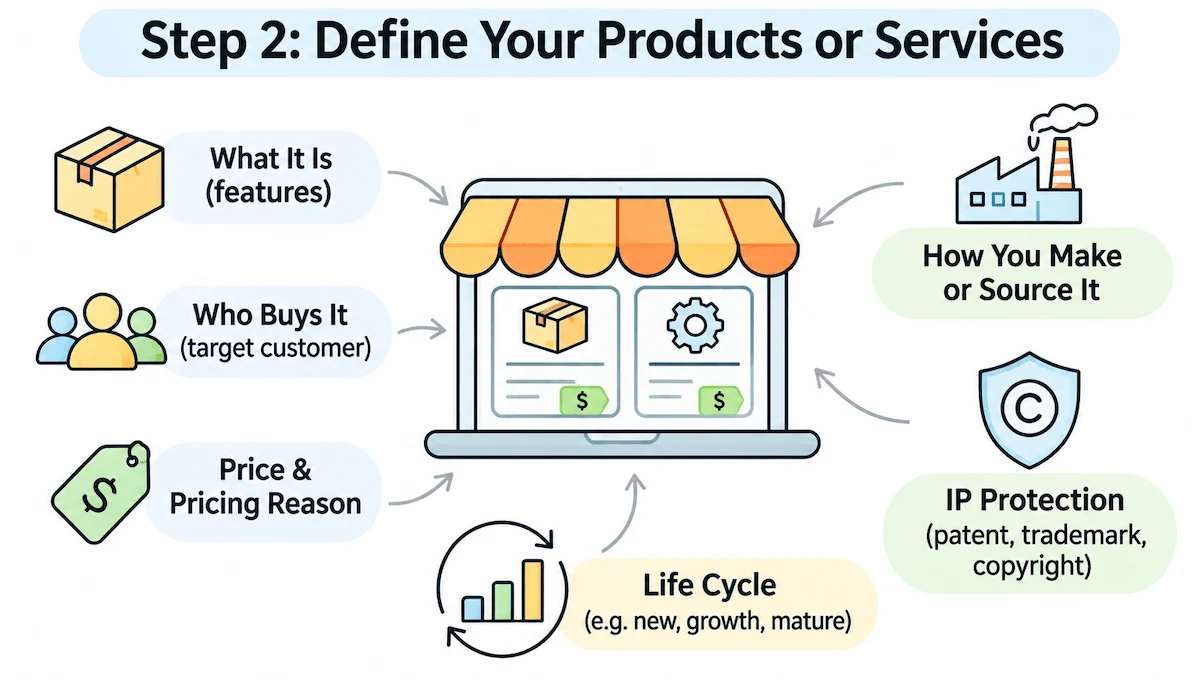
Describe every product or service you sell or plan to sell. Explain what it does, who buys it and how much it costs. Say how you decided on the price and where each item stands in its life cycle. List how you make or source it, and mention any patent, trademark or copyright that protects it.
| Detail | Info |
|---|---|
| Purpose | Show what you sell and why people will pay for it |
| Typical Length | One to two pages |
| Key Question | Why would a customer pick your product over another? |
| Where to Find Data | Supplier quotes, competitor price lists and customer feedback |
| Common Mistake | Listing features and skipping the price logic |
Step 3: Research Your Market and Target Customer
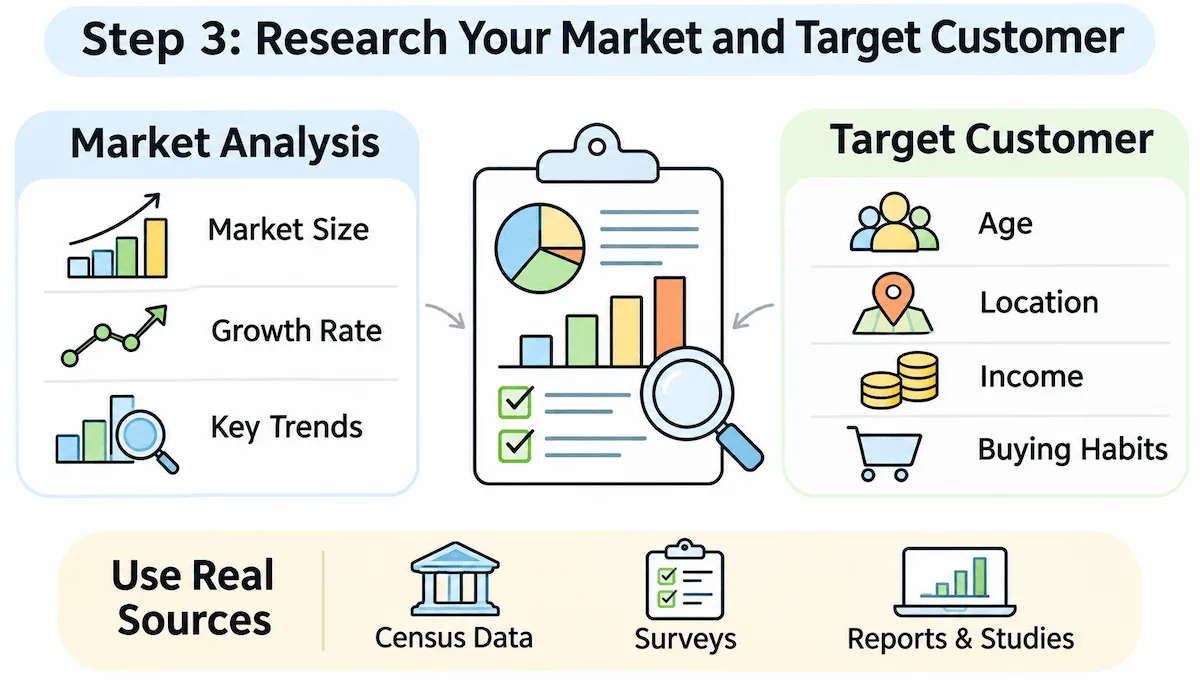
A market analysis shows that people want what you sell. Describe the size of your market, how fast it grows and the trends that affect it. Then define your target customer by age, location, income and buying habits. Use real sources such as census data and surveys, and back every claim with a number or a source.
| Detail | Info |
|---|---|
| Purpose | Prove that demand exists |
| Typical Length | Two to three pages |
| Key Question | How many people want this and what do they pay now? |
| Where to Find Data | Census data, industry reports, surveys and interviews |
| Common Mistake | Saying everyone is your customer |
Step 4: Analyze Competitors and Run a SWOT
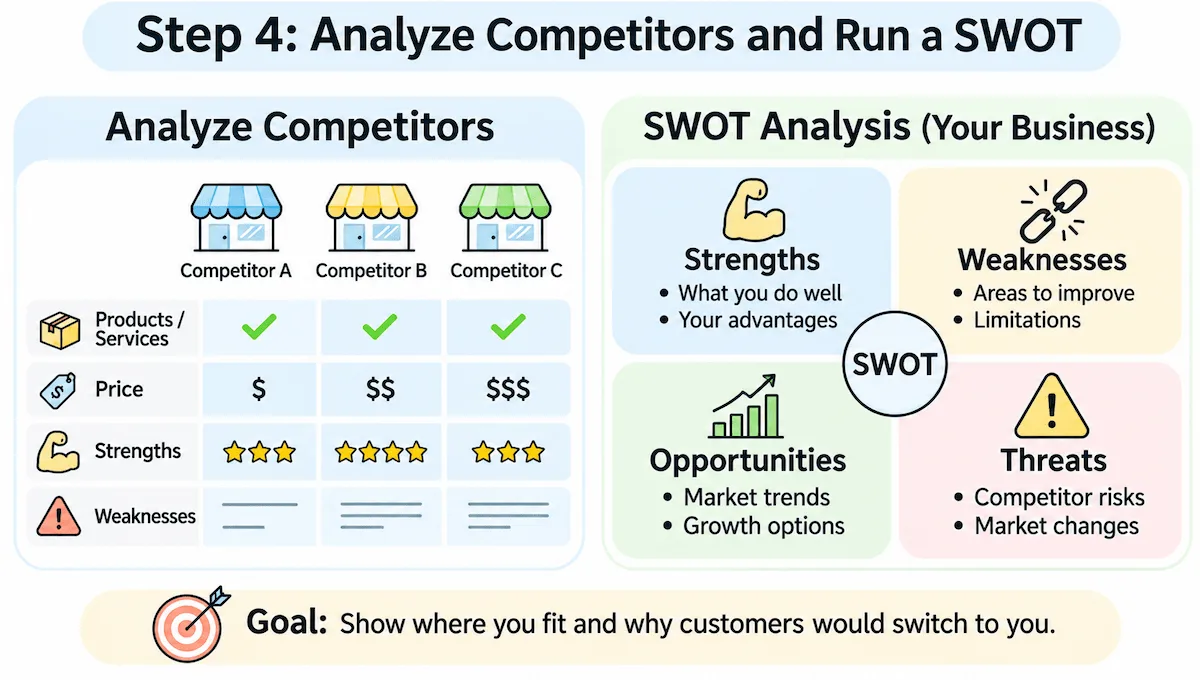
List the businesses your customers already buy from. Note their products, prices, strengths and weaknesses. Then write a SWOT analysis for your own business: strengths, weaknesses, opportunities and threats. The goal is to show where you fit and why a customer would switch to you.
| Detail | Info |
|---|---|
| Purpose | Show your place in the market |
| Typical Length | One to two pages |
| Key Question | Who else serves your customers and how are you different? |
| Where to Find Data | Competitor websites, reviews, price pages and local searches |
| Common Mistake | Claiming you have no competitors |
Step 5: Build Your Marketing and Sales Plan
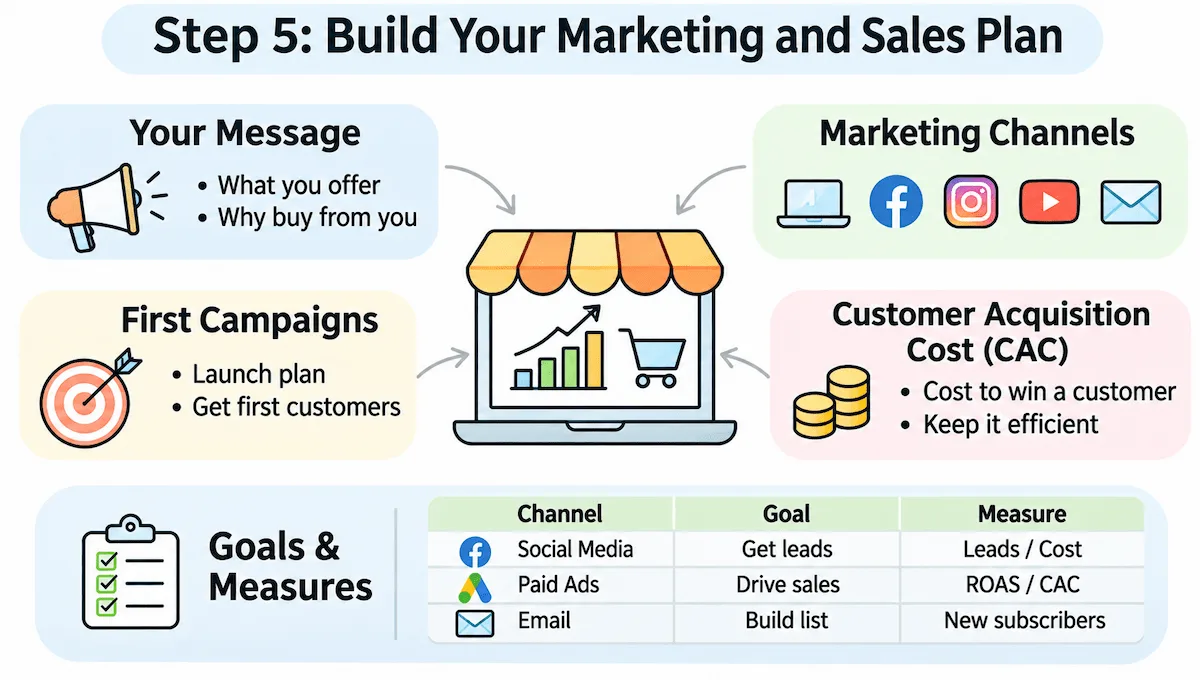
This section explains how customers will find you and why they will buy. Describe your message, your channels and your first campaigns. Include how you plan to win each customer and what it costs, which is your customer acquisition cost, covered in our guide on what CAC is. Set a goal and a measure for every channel.
| Detail | Info |
|---|---|
| Purpose | Explain how you will reach and win customers |
| Typical Length | Two to three pages |
| Key Question | Where do your customers spend time and what makes them buy? |
| Where to Find Data | Ad platform data, search tools and early customer surveys |
| Common Mistake | Listing every channel with no budget or goal |
Step 6: Plan Operations and Logistics
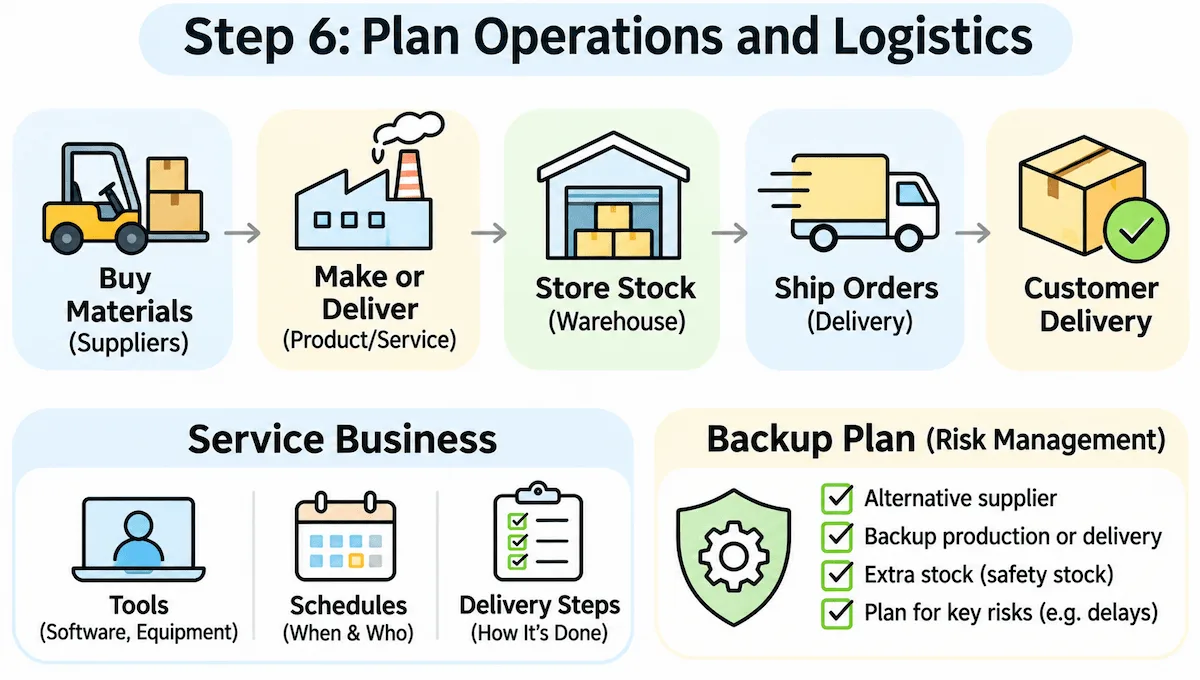
The operations plan explains how the business runs day to day. Cover where you buy materials, how you make or deliver your product, where you store stock and how you ship orders. Add backup plans for anything that could stop sales, such as a supplier that fails. Service businesses should describe tools, schedules and delivery steps.
| Detail | Info |
|---|---|
| Purpose | Show how the business works every day |
| Typical Length | One to two pages |
| Key Question | What could stop you from serving customers and what is your backup? |
| Where to Find Data | Supplier terms, shipping quotes and equipment prices |
| Common Mistake | Relying on one supplier with no backup |
Step 7: Describe Your Team and Structure
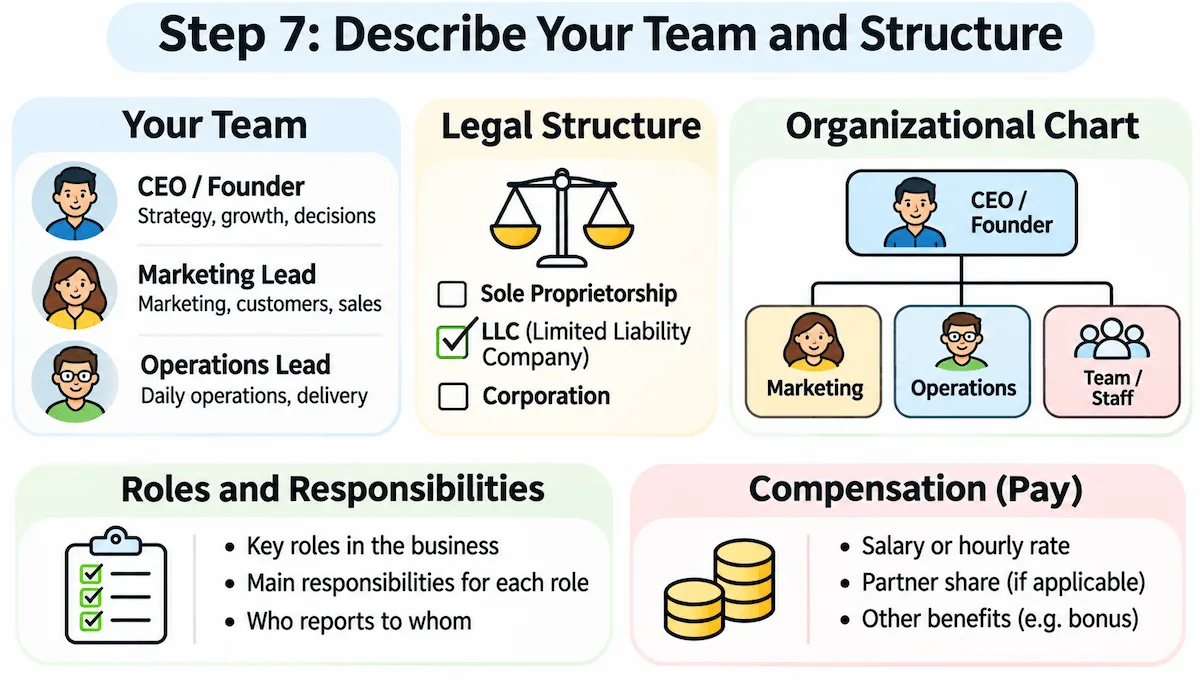
Introduce the people who will run the business, even if it is only you. Give a short background for each person and say what they will do. State your legal structure, such as sole proprietorship, LLC or corporation. If you have partners or hire staff, add an organizational chart and list roles and pay.
| Detail | Info |
|---|---|
| Purpose | Show who runs the business and why they can do it |
| Typical Length | One page |
| Key Question | Does the team have the skills the plan needs? |
| Where to Find Data | Resumes, role descriptions and your registration papers |
| Common Mistake | Leaving out gaps in skills |
Step 8: Build Your Financial Plan
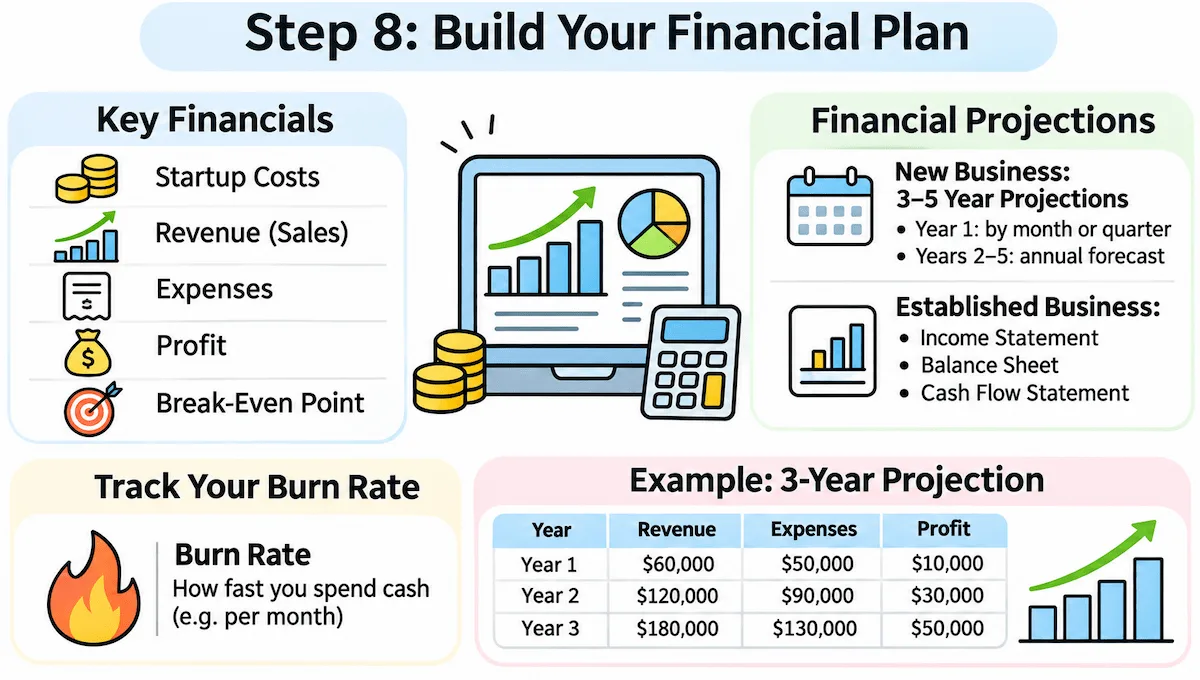
The financial plan turns your ideas into numbers. Show startup costs, expected revenue, expenses, profit and the point where you break even. New businesses add projections for the next three to five years, with the first year by month or quarter. Established firms add income statements, balance sheets and cash flow statements. Cash goes out fast in early months, so track your burn rate, explained in our guide on what burn rate is.
| Detail | Info |
|---|---|
| Purpose | Show that the business can pay its bills and earn a profit |
| Typical Length | Two to five pages, plus tables |
| Key Question | When do you break even and how much cash do you need until then? |
| Where to Find Data | Quotes, price lists, past sales and industry benchmarks |
| Common Mistake | Projections with no stated assumptions |
Step 9: Add Your Funding Request and Appendix
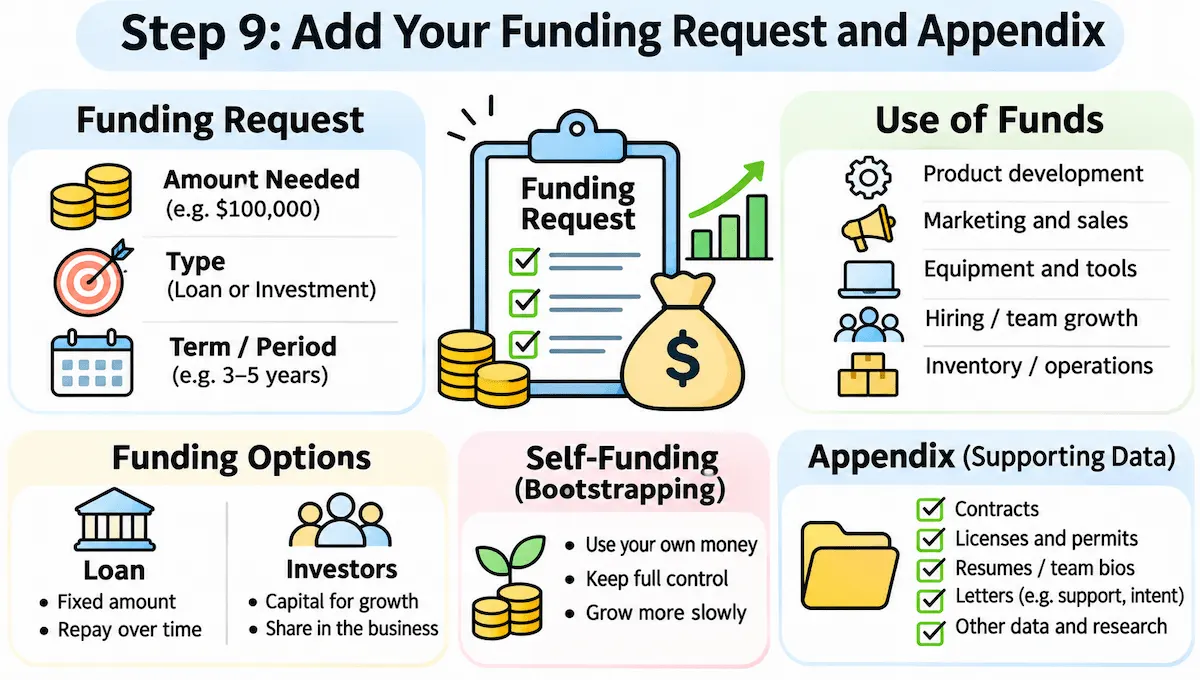
If you need money, say how much, what type and what you will use it for. Say if you want a loan or investors, and over what period. If you plan to fund the business yourself, our guide on bootstrapping explains the trade-offs. Put contracts, licenses, resumes, letters and supporting data in an appendix, so the main plan stays short.
| Detail | Info |
|---|---|
| Purpose | Explain what you need and how you will use it |
| Typical Length | One page, plus appendix |
| Key Question | How much do you need and how will you repay or return it? |
| Where to Find Data | Startup cost list, quotes and your own savings |
| Common Mistake | Asking for a number with no breakdown |
Step 10: Write the Executive Summary Last
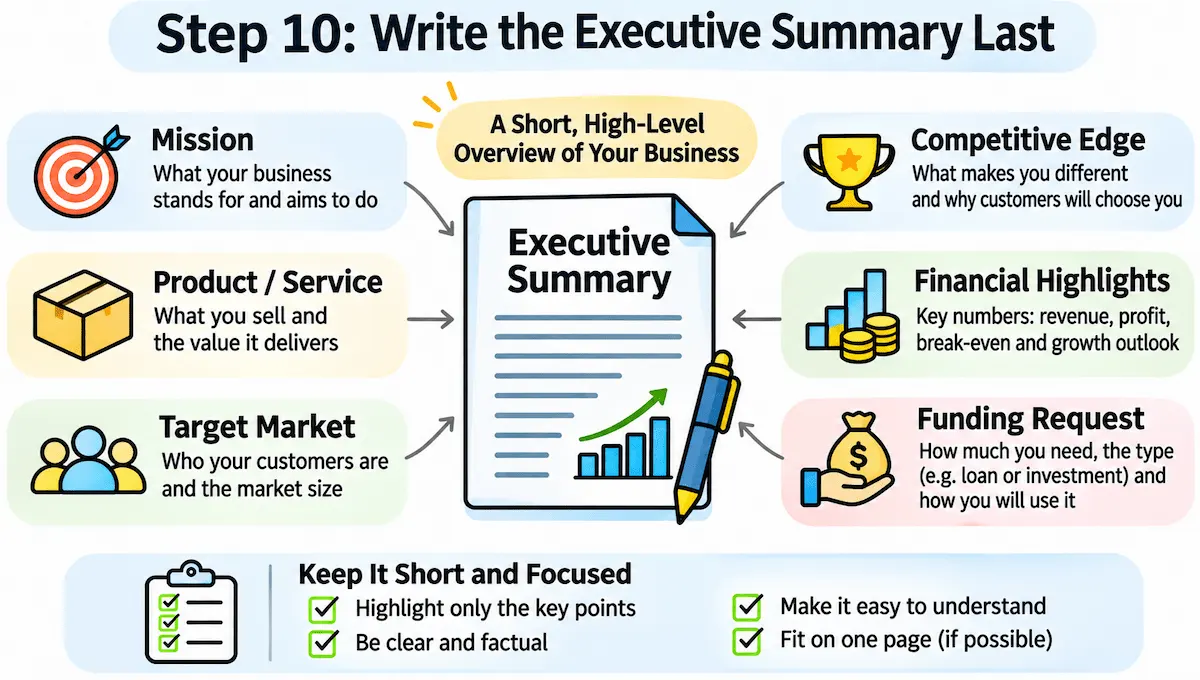
The executive summary comes first in the plan, but you write it last. Pull the key points from every section: mission, product, target market, competitive edge, financial highlights and funding request. Keep it short enough that a busy reader can understand the business before reading anything else. Many readers will not go past this page.
| Detail | Info |
|---|---|
| Purpose | Give the busy reader the whole business in one page |
| Typical Length | Half a page to one page |
| Key Question | Would a stranger understand and want to read on? |
| Where to Find Data | Your finished plan |
| Common Mistake | Writing it first and never updating it |
Marketing Plan in Detail
The marketing section is where many plans stay too vague. Cover these five parts so the reader sees exactly how you will win customers.
- Positioning and message: who you are, who you serve and what makes you different.
- Acquisition channels: where you will reach customers, such as search, social media, email, events or partners.
- Platforms and tactics: the specific actions on each channel, such as weekly posts, a monthly email or a local ad.
- Tools and technology: the software for your website, email, ads and reporting.
- Goals and measurement: the number you will track on each channel, such as visits, leads, sales and cost per customer.
Operations and Logistics for Online Sellers
If you sell products online, the operations section needs more detail than a service business does. Cover four areas.
- Suppliers: who you buy from, lead times and a backup supplier.
- Production: where and how you make or source each item, and how many you can make a week.
- Shipping and fulfillment: who packs and ships, which carrier you use and what shipping costs per order.
- Inventory management: how much stock you keep, how you track it and how you handle returns.
What to Put in an Executive Summary
The executive summary should fit on one page and cover six points: your business name and what it does, your mission, your product or service, your target market, your competitive edge and your financial highlights. If you are asking for money, add the amount and what you will use it for. Write it last, so it reflects the final plan.
Business Plan Examples by Type of Business
Different businesses need to stress different parts of the plan. Use this list to decide what to highlight.
- Online store: suppliers, stock, shipping costs, platform fees and marketing channels.
- Freelancer or consultant: your skills, your price per project or hour and how you find clients.
- Restaurant or food business: location, permits, menu costs, staffing and food safety.
- Local retail shop: rent, foot traffic, stock and local competitors.
- Service business: equipment, travel, scheduling and repeat contracts.
Business Plan Example: A Mini Plan for an Online Candle Shop
This business plan example is fictional and shows how the sections fit together. The business, the names and the numbers are made up. A real plan has more detail, but the structure is the same.
| Section | Example |
|---|---|
| Company description | Willow Lane Candles is a sole proprietorship that sells small-batch soy candles online. Mission: simple, clean-burning candles made for gifting. |
| Products and services | Three scents in two sizes, priced at $28 and $42, plus a monthly gift box. Wax and jars come from two suppliers. |
| Market analysis | Target buyers are adults aged 25 to 45 who buy home goods online and spend $20 to $50 on gifts. |
| Competitors and SWOT | Strength: low overhead and a local brand story. Weakness: small budget. Opportunity: growing gift market. Threat: low-price imports. |
| Marketing and sales | Instagram and Pinterest content, a monthly email, local craft fairs and a referral discount. Goal: 150 orders a month by month six. |
| Operations | Candles are made at home in batches, packed in two days and shipped with a flat-rate carrier. A second jar supplier is the backup. |
| Team and structure | One owner who handles production and marketing, with a part-time helper at busy times. |
| Financial plan | Startup cost of $4,000. Fixed costs of $1,500 a month. Break-even at about 94 candles a month. |
| Funding request | $4,000 from personal savings, with no outside funding needed. |
| Executive summary | One page that pulls the points above together and states the goal of reaching break-even by month two. |
Use this business plan example as a model for how to write a business plan section by section, and swap in your own facts.
The Financial Section in Detail
This is the part most people find hardest, and it is the part lenders read most closely. Build it in four pieces.
Startup Costs
List every cost you must pay before you earn your first sale, and split them into one-time and monthly costs. Common items include:
- Equipment and supplies
- Inventory
- Licenses and permits
- Insurance
- Lawyer and accountant
- Website and software
- Marketing and printed materials
Count at least one year of monthly costs. Many owners add about 10% for costs they cannot predict.
Break-Even Point
The break-even point is the sales level where your revenue equals your costs, so you make no loss and no profit. The SBA gives this formula: fixed costs divided by the price minus the variable cost per unit. In our candle example, fixed costs are $1,500 a month, the price is $28 and the variable cost is $12. That gives $1,500 divided by $16, which is about 94 candles a month.
Revenue and Expense Projections
Project your monthly results for the first year, then yearly for three to five years. Be specific in year one and explain each assumption. Here is a simple three-month example, with made-up numbers. If your plan includes recurring revenue, our guide on what ARR is shows how to measure it.
| Month | Candles Sold | Revenue | Variable Costs | Fixed Costs | Net Result |
|---|---|---|---|---|---|
| Month 1 | 60 | $1,680 | $720 | $1,500 | -$540 |
| Month 2 | 110 | $3,080 | $1,320 | $1,500 | $260 |
| Month 3 | 160 | $4,480 | $1,920 | $1,500 | $1,060 |
Cash Flow, Income Statement and Balance Sheet
Established businesses add three statements: an income statement (revenue and expenses over a period), a cash flow statement (cash coming in and going out) and a balance sheet (assets and liabilities). New businesses can show forecasts of each. Add a schedule to compare real results with your forecasts, so you can correct the plan early.
Funding Options for a New Business
If you need money, your plan should say which source you will use and why. These are the common options.
- Personal savings: the cheapest source, and it shows others you are committed.
- Family and friends: flexible, but put the terms in writing.
- Bank or credit union loans: they look for a plan, an expense sheet and projections.
- SBA-backed loans: partly guaranteed by the government and offered through approved lenders.
- Microloans: small loans from nonprofit lenders for early-stage businesses.
- Grants: money you do not repay, but they are rare and competitive.
- Investors: angel investors and venture firms, usually for businesses with fast growth.
- Crowdfunding: many small backers, often through a pre-sale.
How Long Should a Business Plan Be?
There is no required length. Include enough to support the business and the numbers, then cut anything that does not help the reader decide.
| Format | Typical Length | Time to Write |
|---|---|---|
| One-page plan | One page | About an hour |
| Lean plan | One to two pages | As little as an hour |
| Traditional plan | Often dozens of pages | Several days to a few weeks |
How Far Ahead Should a Business Plan Look?
Most plans look three to five years ahead, with the first year in monthly detail and later years by quarter or year. Lenders often ask for five years of projections. Some founders plan further, but long forecasts rest on guesses, so keep them simple and update them when real numbers arrive.
How to Write a Business Plan for a Loan
A loan plan must show how the business will earn enough cash to repay the debt. The SBA suggests preparing a business plan, an expense sheet and financial projections for the next five years before you ask a bank or credit union. State the amount, the type of loan and what you will use the money for. If you apply for an SBA loan, you will also need a NAICS code for your industry. Compare offers from several lenders before you choose, and show your own investment in the business.
How to Write a Business Plan for Investors
Investors want to see growth and a path to a return. Emphasize the size of your market, your edge, your team and how fast you can scale revenue. State what you are asking for, how much of the company you will give up and how the investor gets paid back, such as a later sale or a buyout. Keep the executive summary tight, since many investors read only that page first.
How to Write a Business Plan for a Startup or Online Business
New and online businesses usually do best with a lean plan that you update often. Test demand before you spend, and show how you will get your first customers. Online sellers should cover stock, shipping, platforms and payment fees. Not sure which model fits? See our guide to the main types of online business before you write.
Business Plan Outline Template
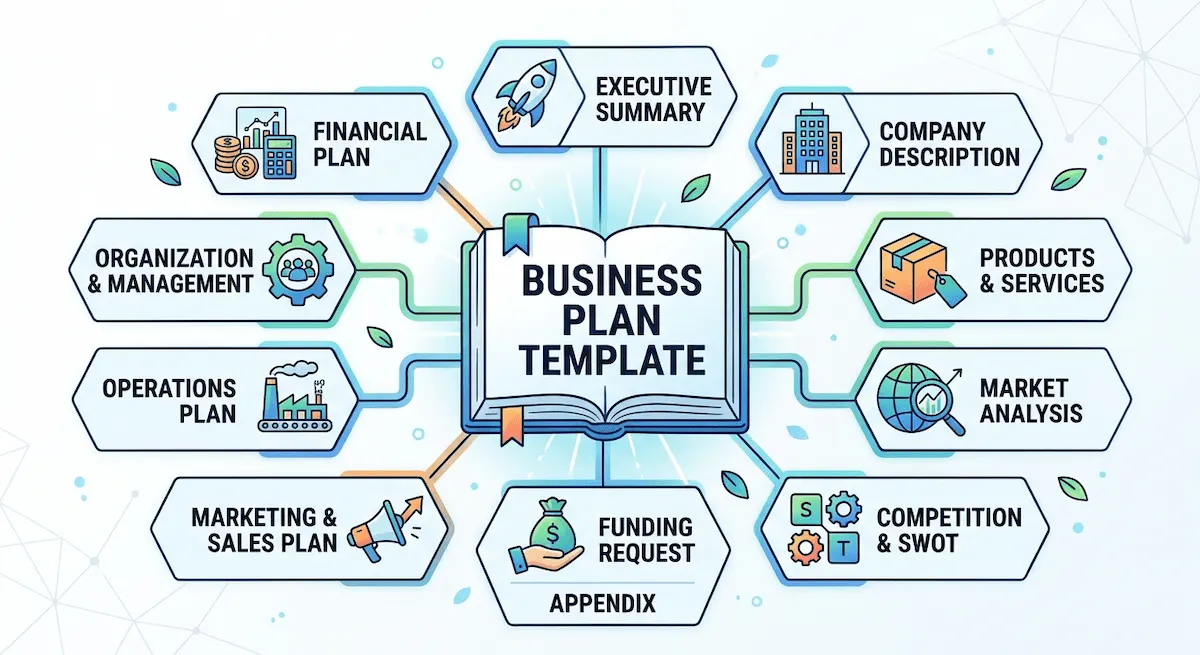
Copy this outline into a document and fill in each part. It works for a traditional plan, and you can shorten it for a lean plan.
- Executive summary: business, mission, product, market, edge, financial highlights and funding request.
- Company description: name, location, structure, mission, goals.
- Products or services: what you sell, price, how it is made or delivered.
- Market analysis: market size, trends and target customer.
- Competitive analysis and SWOT: competitors and your place among them.
- Marketing and sales plan: message, channels, tactics and goals.
- Operations plan: suppliers, production, shipping and backups.
- Organization and management: team, roles and structure.
- Financial plan: startup costs, projections, break-even and cash flow.
- Funding request: amount, use of funds and repayment or return.
- Appendix: contracts, licenses, resumes and supporting data.
Business Plan Templates and Free Resources
You do not need to start from a blank page. A free business plan template gives you a ready structure, and these resources are a good place to find one.
- SBA: a guide with fictional traditional and lean sample plans. See the SBA business plan guide.
- SCORE: a startup template with worksheets and free mentoring. See the SCORE business plan template.
- HubSpot: free one-page and detailed templates.
- Bank of America: an 11-step guide with a downloadable workbook.
- Shopify and Bplans: templates and sample plans for online shops.
Whatever business plan template you pick, change the wording to fit your own business. Copied text with no real details is easy to spot.
Using AI to Write a Business Plan
Tools like ChatGPT can help you write a first draft, tighten a paragraph or suggest what to include. Treat the output as a rough draft. Check every figure and claim, remove anything you cannot prove and replace general language with details about your business. A human review is a must, because AI tools can state wrong facts with confidence.
A useful prompt gives the tool your facts, for example: “Write a one-paragraph company description for a small online candle shop that sells soy candles for gifts, and keep it under 100 words.” Then edit the result in your own voice.
Common Mistakes to Avoid
Most weak plans fail in the same few places.
- Unsupported projections: every revenue number should trace back to data or a stated assumption.
- Too much optimism: sales and costs that look perfect make readers doubt the rest.
- Goals with no measure: “grow sales” is vague, while “grow monthly sales by 10% in six months” is clear.
- No competitors: every business has competition, even if it is a habit or a free option.
- No proof of demand: enthusiasm is not evidence.
- Writing for yourself: a reader needs to understand without your help.
- Never updating it: a plan that is two years old no longer matches the business.
Writing and Formatting Tips
A clear plan is easier to trust. These habits make a plan easier to read.
- Use plain words and short sentences. Skip jargon the reader may not know.
- Use the same heading style and order in every section.
- Add a table or chart where numbers need to be compared.
- Put the main point first in every section and the detail after it.
- Cite your sources for market data, with the year.
- Proofread twice and ask another person to read it.
- Keep the main plan short, and move long documents to the appendix.
Business Plan Checklist
Run through this list before you share the plan.
- The executive summary is one page and written last.
- The company description states what you do and for whom.
- Every product has a price and a reason for the price.
- The market section uses real data with sources.
- Competitors are named and compared.
- Each marketing channel has a goal and a measure.
- The operations plan has a backup for key suppliers.
- The team section shows who does what.
- Financial projections list every assumption.
- The break-even point is calculated.
- The funding request has an amount and a breakdown.
- The appendix holds contracts, licenses and resumes.
How to Update Your Business Plan
A business plan is a living document. New or fast-changing businesses should review it every quarter, and stable ones once a year. At each review, compare real results with your projections, then adjust costs, prices and goals. Update it sooner if a major competitor appears, a key supplier changes terms, demand shifts, you hire a lot of staff or you launch a new product.
What to Do After You Write Your Business Plan
Finishing the plan is the start, not the end. Do these things next.
- Check your assumptions: compare sales, cost and market numbers with current data.
- Get feedback: ask an accountant, a SCORE mentor or an SBA counselor to read it.
- Tailor it to the reader: stress repayment for a lender and growth for an investor.
- Collect documents: contracts, licenses and statements for the appendix.
- Assign first actions: give every short-term goal an owner and a deadline.
- Set a review date: put the next update in your calendar.
Once the plan is ready, learn how to run an online business day to day.
How We Wrote This Guide
We compared guides from the SBA, SCORE, banks and business publishers, and focused on the sections they all share. The example business is fictional, and all figures in it are made up for teaching. This guide is general information, not financial or legal advice. Details were last checked in October 2026.
Frequently Asked Questions
How Do I Write a Business Plan for Beginners?
Pick a format, then work through ten sections: company description, products, market, competitors, marketing, operations, team, finances, funding request and executive summary. Start with a lean plan if you only need to test an idea.
What Should a Business Plan Include?
It should explain what you sell, who buys it, how the business runs and how it earns. Core sections are the executive summary, company description, market analysis, marketing plan, operations, team, financial projections and, if needed, a funding request.
How Long Should a Business Plan Be?
There is no required length. A lean or one-page plan can fit on one to two pages, while a traditional plan for a lender can run to dozens of pages. Include only what helps the reader decide.
How Do You Write a Business Plan for a Loan?
Show how the business will earn enough cash to repay the debt. State the amount and use of funds, and include an expense sheet and five years of financial projections. Compare offers from several lenders.
What Are the Different Types of Business Plans?
The two main types are traditional and lean. A traditional plan is detailed and suits lenders and investors. A lean plan is a short summary that suits early-stage businesses. A one-page plan is a popular short version.
How Do I Write a Simple Business Plan?
Use a lean or one-page format. Write short answers for what you sell, who buys it, how you reach customers, what it costs and how you will earn money. Add a basic break-even calculation.
Do I Need a Business Plan to Start a Business?
Not by law, but a plan helps you test the idea and see what money you need. You will need one if you apply for a loan or seek investors. Even a short plan can prevent costly mistakes.
Can I Write a Business Plan Myself?
Yes. Most owners write their own, using a template and free help from groups like SCORE and SBA counselors. You can ask an accountant to check the numbers. Hiring a writer is optional.
How Much Does It Cost to Have a Business Plan Written?
Prices vary widely, from a few hundred dollars on freelance sites to much more for a firm. You can write one for free with a template and free mentoring. Check the writer’s samples and who owns the final file.
How Long Does It Take to Write a Business Plan?
A lean or one-page plan can take about an hour once you know your facts. A traditional plan often takes several days to a few weeks, mostly because of market research and financial projections.
What Is the Most Important Part of a Business Plan?
Most readers start with the executive summary, and lenders focus on the financial section. The most important part depends on your goal, but a clear summary and believable numbers matter most.
How Often Should I Update My Business Plan?
Review a new or fast-moving business every quarter and a stable one once a year. Update sooner after big changes such as a new competitor, a supplier change or a major hire.
What Is the Difference Between a Business Plan and a Business Model?
A business model explains how the business makes money, often on one page. A business plan covers the whole business, including market, operations, team and finances, and usually contains the business model.
Can I Use AI to Write a Business Plan?
Yes, for a first draft or to improve wording. Always check every number and claim yourself, and replace general text with real details. Have another person review the final plan before you share it.
Where Can I Find a Free Business Plan Template?
The SBA, SCORE, HubSpot and Bank of America all offer free templates or guides. Choose one that matches your format, and rewrite the text to fit your own business.
What Is a One-Page Business Plan?
A one-page plan fits the main points on a single sheet: what you sell, who buys, how you reach them, your costs and your goals. It suits side businesses, quick pitches and testing ideas.
What Is the First Step in Writing a Business Plan?
Decide who will read it and pick a format. A lender needs a traditional plan, while a lean plan works for testing an idea. Then gather your research and numbers before you start writing the sections.
What Are the Main Parts of a Business Plan?
The main parts are the executive summary, company description, products or services, market analysis, marketing and sales plan, operations plan, management team, financial plan, funding request and appendix. A lean plan covers the same ground in short blocks.
What Do Banks Look for in a Business Plan?
Banks look for proof that you can repay the loan: realistic cash flow projections, an expense sheet, your own investment, the experience of your team and a clear use of the money. They also check your credit and collateral.
What Makes a Good Business Plan?
A good plan is clear, short and backed by numbers and sources. It names competitors, states every assumption, sets goals you can measure and is written for one reader. It is also updated when the business changes.
Is a Business Plan the Same as a Marketing Plan?
No. A marketing plan covers how you reach and win customers and is one section of the business plan. The business plan also covers operations, team and finances.
How Do I Write a Business Plan for a Small Business?
Use a lean or one-page format, then follow the same steps: describe the company, define what you sell, research the market, plan marketing and operations, and build simple financials. Expand it into a traditional plan only if you need funding.
How Do I Write a Business Plan With No Money?
Use a free template, free research sources and free mentoring from SCORE or an SBA counselor. Choose a low-cost business model, keep startup costs small and show how you will reach break-even quickly. The plan itself costs nothing to write.
What Is an Executive Summary in a Business Plan?
It is a one-page overview of the whole plan that appears first but is written last. It covers your business, mission, product, market, competitive edge, financial highlights and, if needed, your funding request.
Final Thoughts
Learning how to write a business plan is mostly about being clear and using real numbers. Choose a format, follow the ten steps, write the executive summary last and keep the plan alive with regular reviews. A short plan you actually use beats a long plan that sits in a folder. To keep building your skills, see how to learn online business step by step.