Many beginners want to learn business online but do not know where to start. The good news is that you do not need a degree or a big budget. This guide shows how to learn online business step by step, from picking one business model to building a practice project and tracking your first numbers.
You can build business knowledge from books, free courses, podcasts and real projects, and the best plan mixes all of them. Courses teach the basics, projects show what the basics mean, and other owners tell you what works. If you plan to start an online business, this mix saves time and money.
Below you will find the skills to study, eight steps to follow, the best courses for beginners, tools to practice with, and the time and costs to expect.
Key Takeaways
These are the main points to remember before you begin:
- You can learn online business without a degree by combining free courses, books and a practice project.
- Pick one business model first, because learning everything at once slows you down.
- Free courses cover the basics, and a paid certificate helps when you need proof of your skills.
- A small store, blog or email funnel teaches more than theory alone.
- Every store, blog or funnel depends on digital marketing, so learn it early.
Why Learn Online Business?
Business skills pay off if you want to run your own store, freelance or get hired. A good online business course or a self-made study plan gives you five clear gains:
- The language of business. You understand terms like margin, revenue and cash flow, so you can talk with suppliers, clients and partners.
- Data-driven decisions. You read numbers from your store or ads and decide what to change.
- Strategy skills. You learn how to pick a market, set a price and plan growth.
- A support network. Courses and communities connect you with other owners who face the same problems.
- Proof of your skills. A certificate or a live project shows clients and employers what you can do.
These skills also carry across careers. A designer, a teacher or an engineer can use the same basics of finance, marketing and management in any job or side project.
What You Need To Learn To Run an Online Business
Before you pick a course, you should know what you are learning. An online business needs two sets of skills: core business skills and online skills. Add a business model on top, and you have a clear list to study. This is how to learn online business without wasting weeks on topics you do not need.
Core Business Skills
Every owner needs the business fundamentals: how money comes in and goes out, how to price a product, and how to find a target market. Start with accounting basics, simple finance, marketing and management. You do not have to learn business like a student in a classroom, but you should be able to read a profit report and make decisions with numbers instead of guesses. When your business grows, you can hire an online business manager to handle daily tasks while you focus on strategy.
Business Subjects To Study
Most beginner programs cover the same set of subjects. You do not need all of them on day one, but this list helps you plan:
- Introduction to business: how companies make money and serve customers
- Accounting basics and finance: profit, costs, taxes and budgets
- Marketing: finding and keeping customers
- Management: planning, hiring and working with a team
- Operations and supply chain: sourcing, stock and delivery
- Business law and ethics: contracts, registration and fair practice
Online Skills Every Beginner Needs
Selling online adds a second layer. You need digital marketing, which includes search engine optimization, social media and email marketing. You also need basic analytics to see what works, plus simple website skills. All of these can be learned step by step, and most are covered by free courses from Google, HubSpot and Shopify.
Online Business Models To Learn First
Pick one model and learn it well before you try another. Popular models include:
- Online store with products you sell directly or through dropshipping
- Print-on-demand, where a partner prints and ships each order
- Digital products such as templates, planners and ebooks
- Online course or paid group program
- Services such as freelance writing, social media management or virtual assistant work
- Niche blog that earns from ads or affiliate links
If cash is tight, read this guide to an online business without investment before you choose.
Four Types of Ecommerce
Ecommerce is not one thing. The common types are business to consumer (B2C), where a store sells to shoppers, business to business (B2B), where you sell to other companies, consumer to consumer (C2C), where people sell to each other on marketplaces, and direct to consumer (D2C), where a brand sells its own products without a middleman. Most beginners start with B2C or D2C.
Five Ways To Sell Products Online
If you choose a product business, you can sell in one of these ways:
- Resell: buy products at a low price and sell them for a profit
- Dropship: sell products without stock, while a supplier ships to the customer
- Print-on-demand: create custom products only when a customer orders
- Wholesale: buy in bulk at a discount and sell items one by one
- Own brand: make and sell your own products, which takes more work but builds loyalty
How To Learn Online Business Step by Step
These nine steps take you from a blank page to a working project. Follow them in order, and repeat any step when you need more practice.
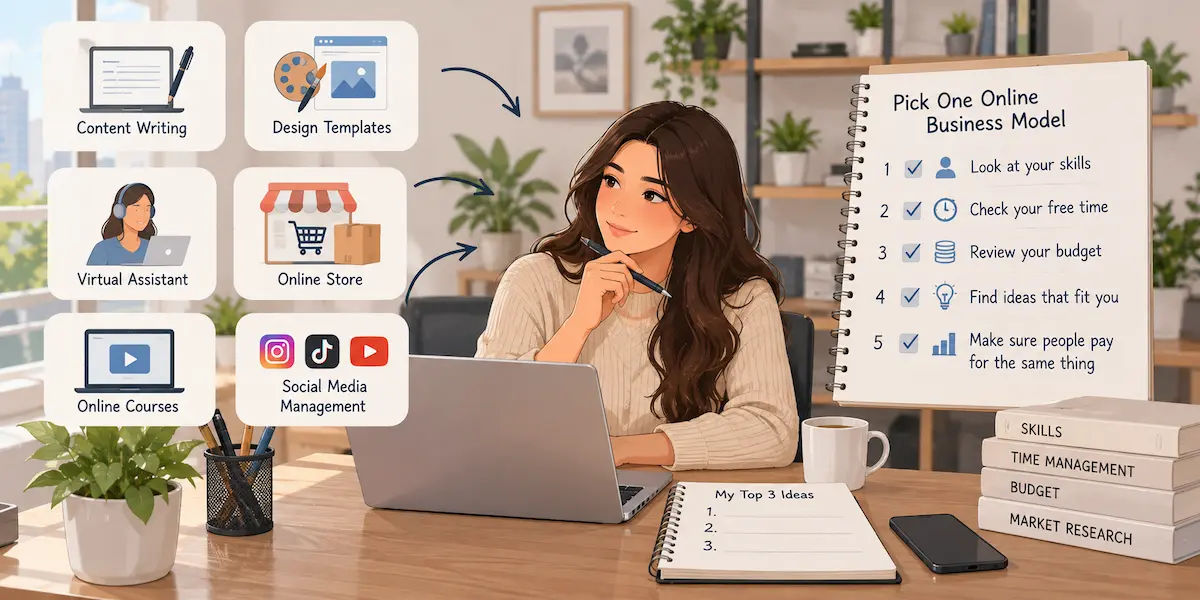
1. Pick One Online Business Model
Look at your skills, free time and budget. A writer can sell content, a designer can sell templates, and an organized person can offer admin support. Read a few lists of ideas, write down three that fit you, and pick one. Check that people already pay for the same thing, because that proves demand. This also gives you a short list of online business ideas to test.
2. Start With a Free Online Course
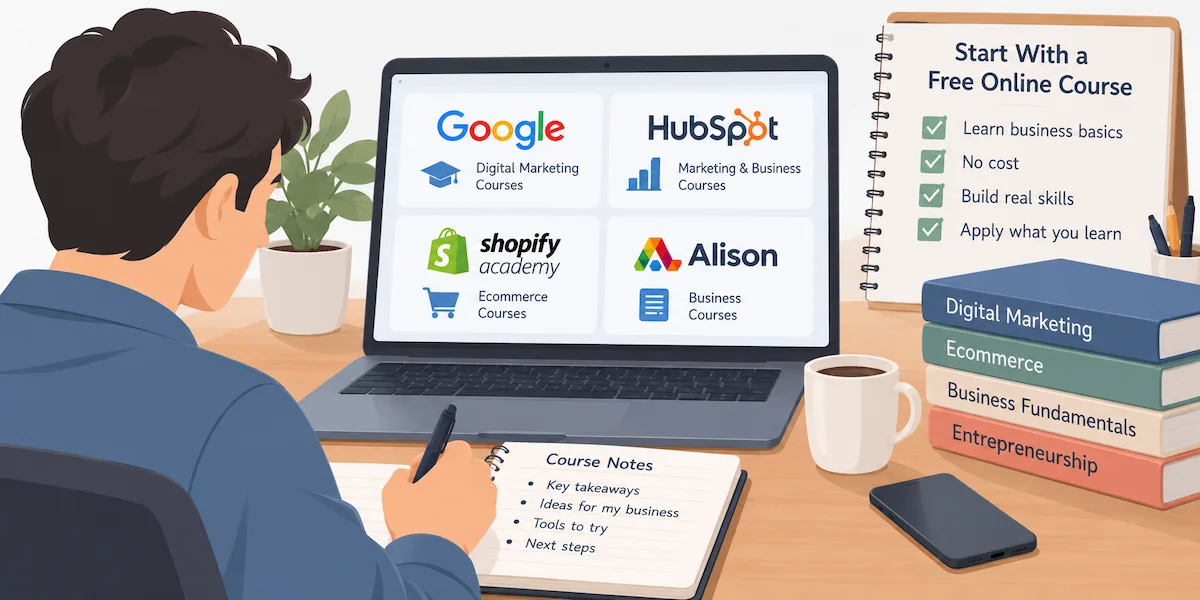
Free online courses teach the language of business and the business fundamentals without risking money. Google, HubSpot Academy and Shopify Academy offer beginner courses on digital marketing and ecommerce, and Alison offers business courses with no fee. Students who want extra ideas can browse these business ideas for students. Finish one course before you start another, and take notes you can use in your own project.
3. Read Business Books and Follow Podcasts
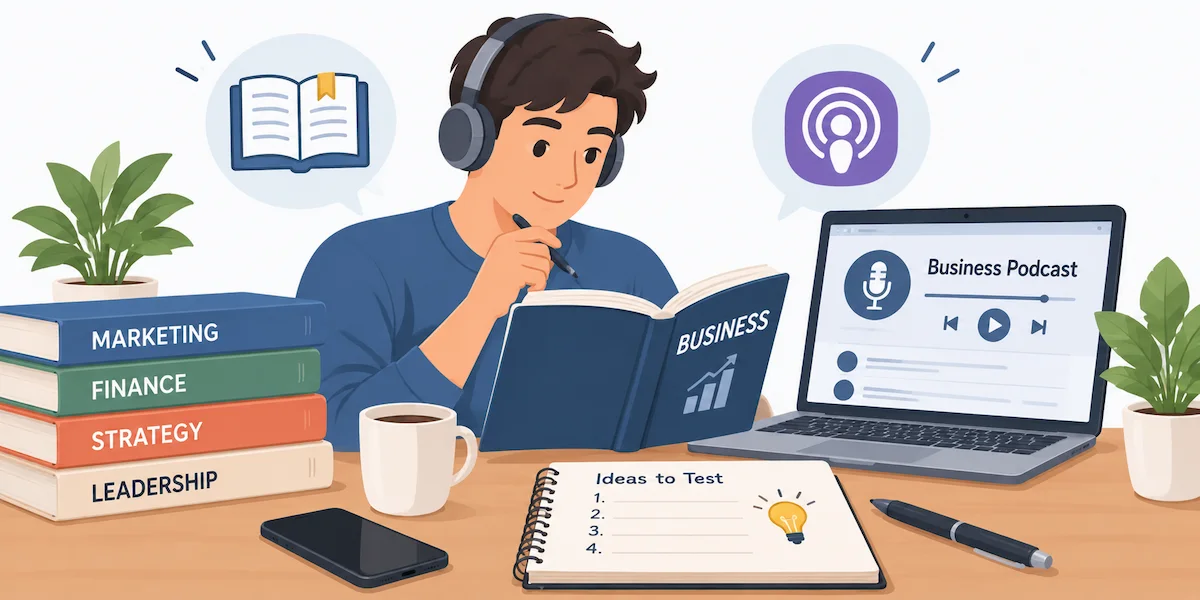
Books and podcasts build business knowledge and business skills at your own speed. Pick three or four popular business books and read a chapter a day. Add a business podcast for your commute or your walk. When you read, write down one idea you can test this week, so reading turns into action. A short DIY MBA reading list of marketing, finance and strategy titles works well too.
4. Study Successful Online Businesses
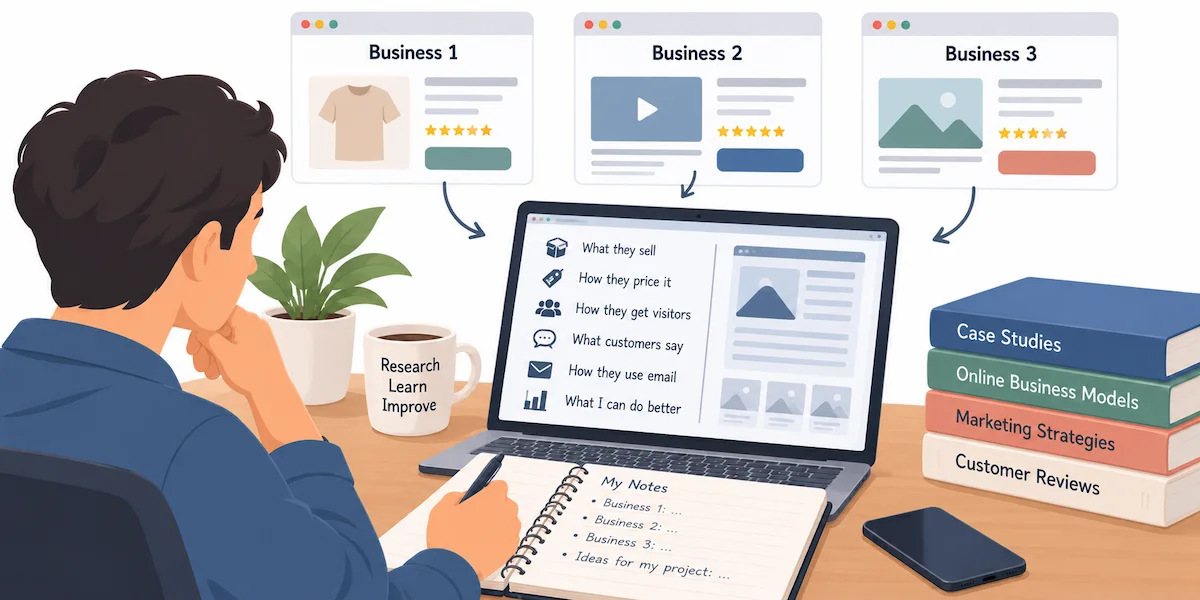
Learn from people who already earn online. Pick three businesses in your niche and write down what they sell, how they price it, how they get visitors and what customers say in reviews. Read their blogs, check their social media and sign up for their emails. Then ask yourself what you would do better. Case studies teach you how a business model works in real life, and they give you ideas for your own project.
5. Build a Practice Project
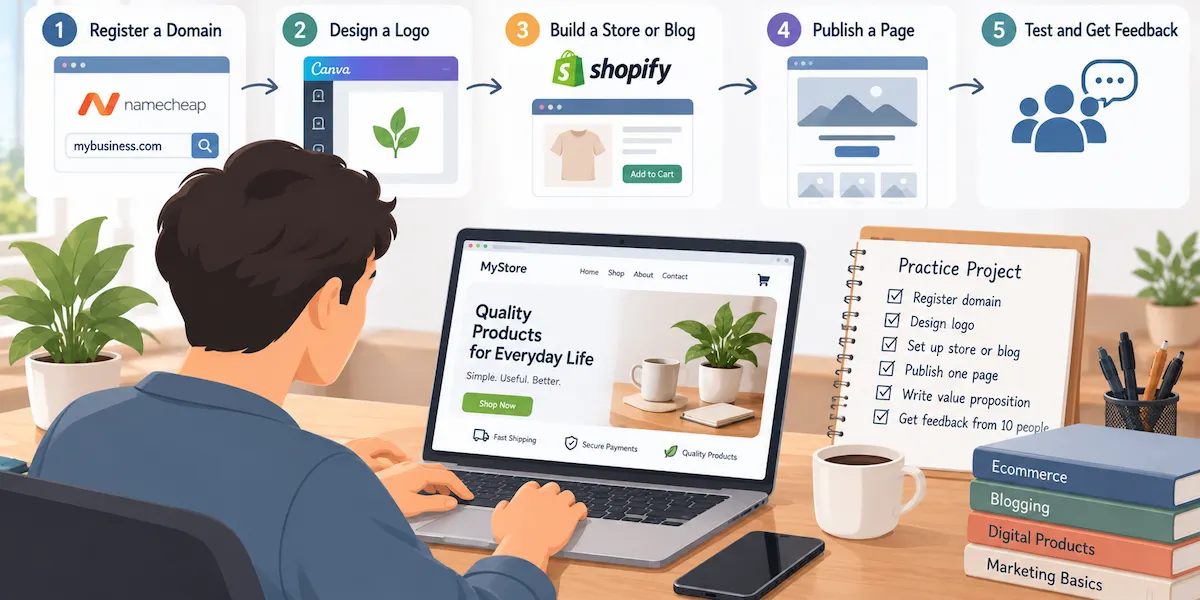
Theory only goes so far, so set up a real project. A practice store on Shopify, a blog on Hostinger or a small digital product made in Canva all work. You do not need to sell much. The goal is to see how a store, a domain, payments and a landing page fit together. Register a domain on Namecheap, design your logo in Canva and publish one page. If you want ideas that cost little, see these business ideas under 5k. Before you take payments, read the local rules for business registration and taxes. Then treat the project as a test: write a short unique value proposition and show it to ten people.
6. Learn Digital Marketing
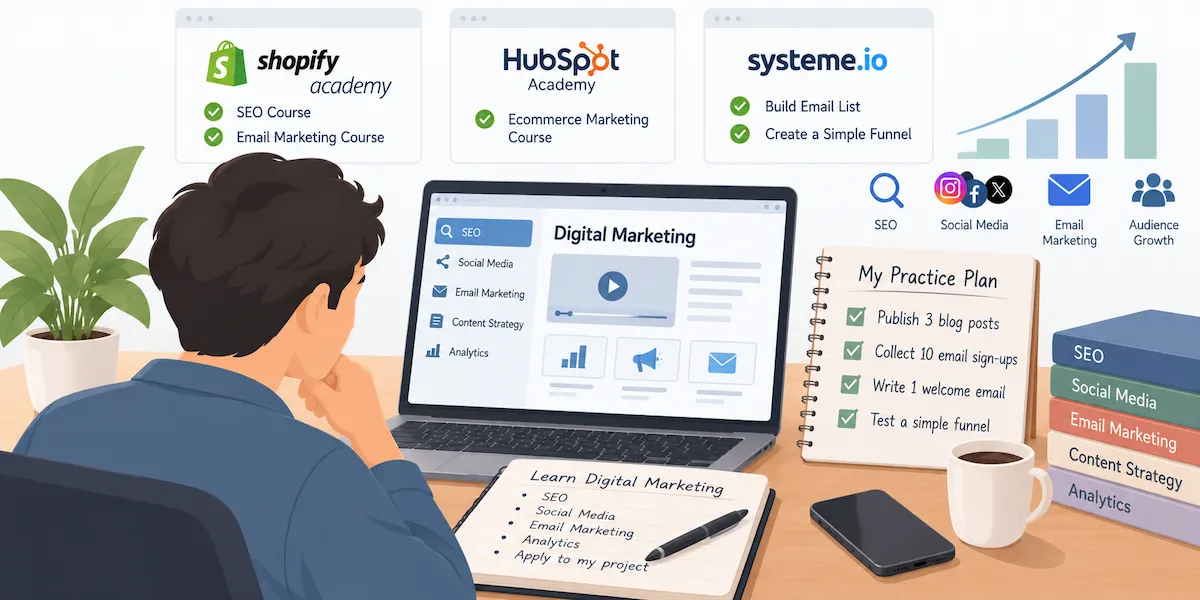
Without traffic, no store or blog earns anything. Spend a few weeks on search engine optimization, social media and email marketing. Shopify offers a short SEO course and an email marketing course, and HubSpot teaches ecommerce marketing for free. Then practice on your own project: publish three posts, collect ten email sign-ups and write one welcome email. Systeme.io lets you build the email list and a simple funnel on its free plan, so you can test the whole thing at no cost.
7. Talk to Owners and Join Communities
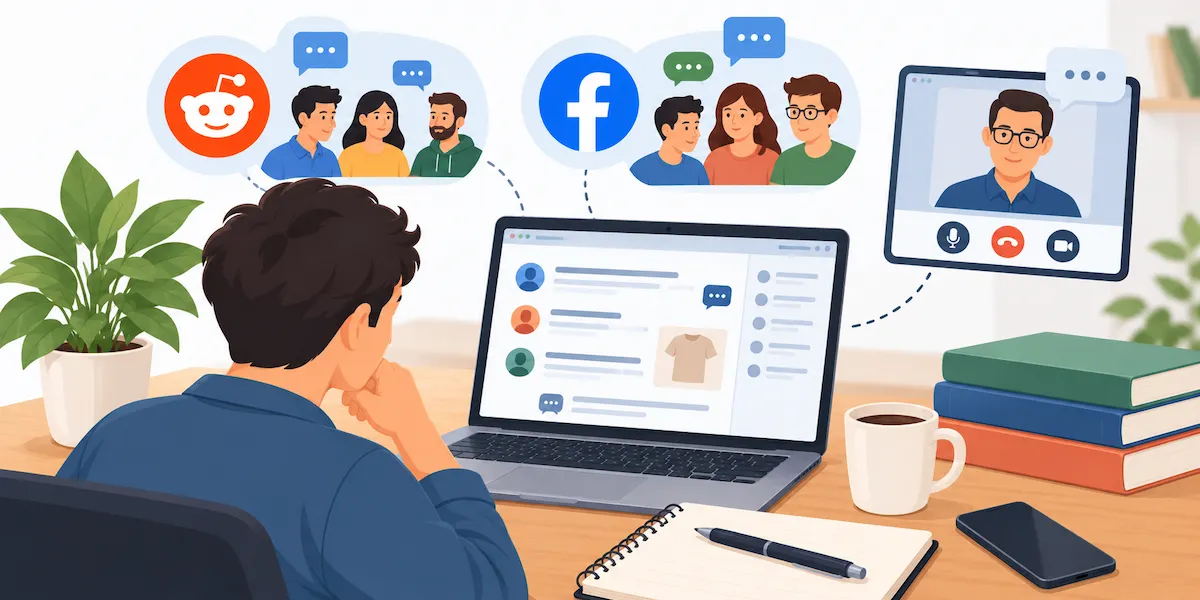
Learning alone is slow. Join an ecommerce community on Reddit or Facebook, ask owners what they wish they had known, and read the reviews and complaints customers leave. Keep your questions specific, because most people ask generic ones they could have answered with a quick search. A friend who also wants to study business makes a good study partner too. If you get stuck, a mentor or a subject tutor can explain what a course does not, so ask for help once you have a clear question.
8. Get Experience With Freelance or Part-Time Work
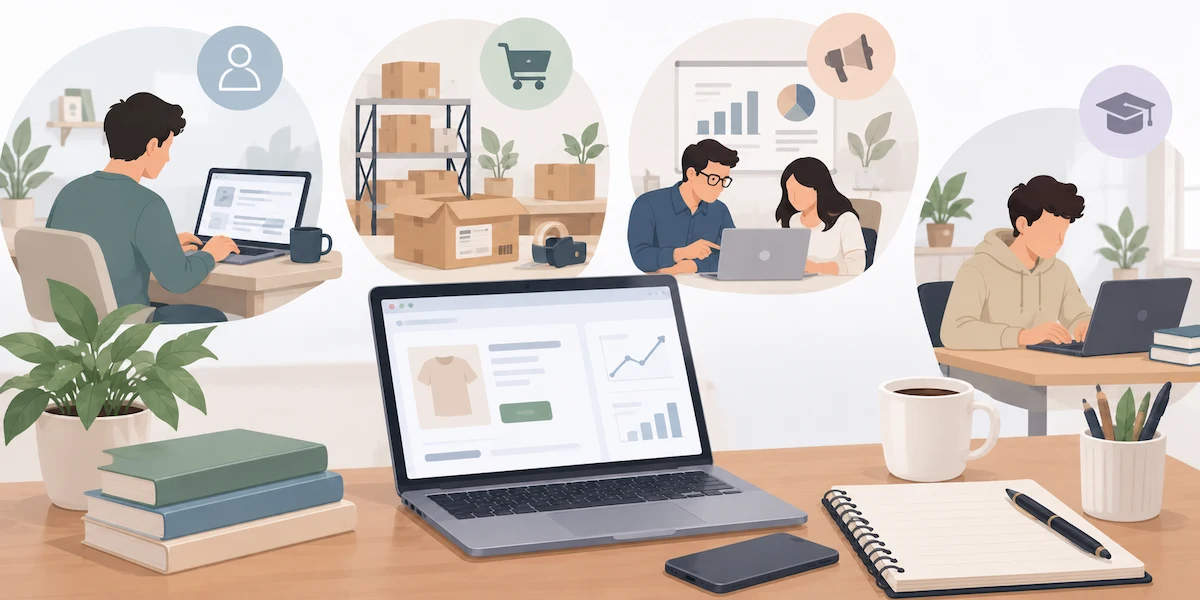
Industry experience is one of the fastest teachers. Take a part-time job, a freelance gig or an internship at a store, an agency or a startup, and you will see how orders, customers and ads work every day. If you are younger, read how to start an online business at 15 to find options that fit your age. Even a few hours a week add up, and every task builds business skills you can use later.
9. Track Your Numbers and Improve
Analytics turn guesses into decisions. Track visitors, sign-ups, sales and costs every week in a simple sheet. If something does not work after a few months, change it: adjust the price, the target market or the offer. Keep an eye on industry trends, but do not chase every new tool. Small, steady changes teach you more than big, rare ones.

Best Online Business Courses for Beginners
The list below mixes free and paid options. Each review covers what the course is, who it fits, and the pros and cons, so you can pick one online business course and build the business skills you need.
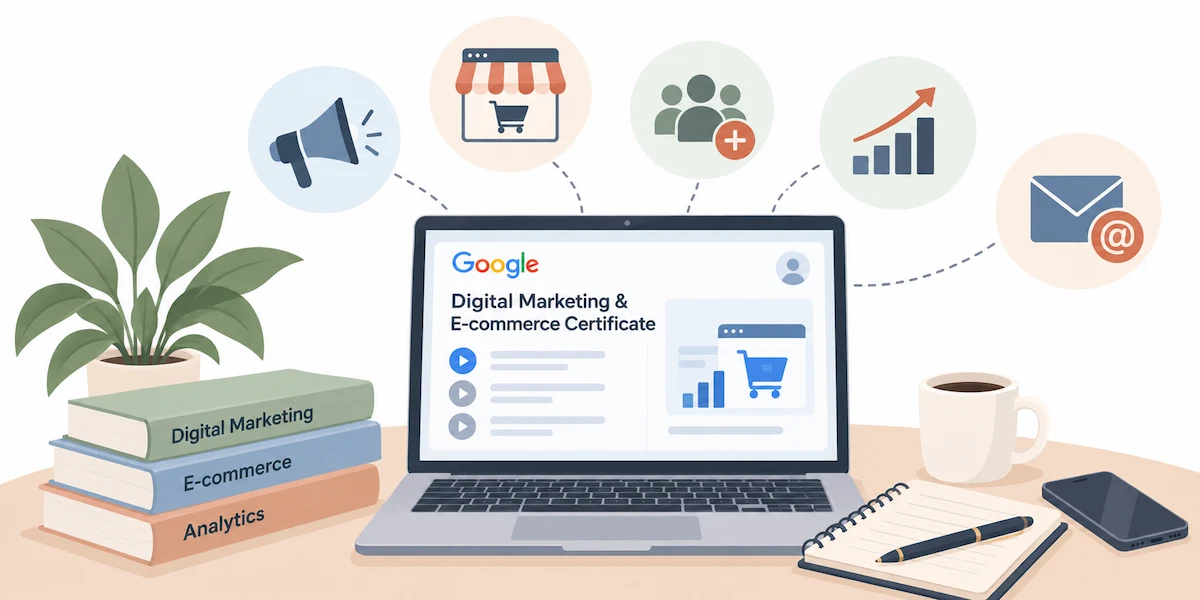
Google Digital Marketing and E-commerce Certificate
This is a certificate program for beginners that covers digital marketing and ecommerce basics, including online stores, customer care and analytics. The first Foundations course is listed as free, while the full certificate is a paid program. It suits people who want proof of skills for a job or a client.
| Detail | Estimate |
|---|---|
| Best for | Beginners who want a certificate |
| Cost | Free first course, paid certificate |
| Level | Beginner |
| Topics | Digital marketing, ecommerce, analytics |
Pros
- Trusted brand on your resume
- Covers both marketing and ecommerce
- Free entry course lets you test the format
Cons
- Full certificate costs money
- Less focused on one business model
HubSpot Academy Ecommerce Marketing Course
HubSpot Academy offers a free ecommerce marketing course built on the inbound marketing method. You learn how to attract visitors, keep customers and build a marketing strategy for an online store. It is a good second course after the basics.
| Detail | Estimate |
|---|---|
| Best for | Store owners who need marketing skills |
| Cost | Free |
| Level | Beginner |
| Topics | Inbound marketing, customer retention |
Pros
- Free and self-paced
- Clear marketing strategy lessons
- Works with any store platform
Cons
- Focused on marketing, not on finance or operations
- Some tools it mentions are paid
Shopify Academy
Shopify Academy gives free courses on starting and growing a store, from search engine optimization to email marketing. The lessons are short, so you can finish one in a single evening. It fits anyone who plans to sell on Shopify.
| Detail | Estimate |
|---|---|
| Best for | People who plan to open a Shopify store |
| Cost | Free |
| Level | Beginner to intermediate |
| Topics | SEO, email marketing, store setup |
Pros
- Free and short lessons
- Matches a real platform you can try
- Good for the practice store step
Cons
- Tied to one platform
- Few lessons on other business models
Amazon Seller University
Amazon Seller University is a free training for people who plan to sell on Amazon. It explains how to create a seller account, list products and use fulfillment, so Amazon packs and ships your orders. It fits product sellers who want to learn one marketplace well.
| Detail | Estimate |
|---|---|
| Best for | People who plan to sell on Amazon |
| Cost | Free |
| Level | Beginner |
| Topics | Seller account, listings, fulfillment |
Pros
- Free and made by the marketplace itself
- Shows how listings and orders really work
- Good fit for resale and own-brand products
Cons
- Tied to one marketplace
- Seller fees apply once you start selling
Skillshare E-Commerce Essentials
Skillshare is a membership platform with classes on ecommerce, design and creative work. The E-Commerce Essentials class explains how to start a successful business online and gives a simple overview of the steps. It suits creative people who like short video lessons.
| Detail | Estimate |
|---|---|
| Best for | Creative beginners |
| Cost | Paid membership |
| Level | Beginner |
| Topics | Store basics, branding, online selling |
Pros
- Many classes in one membership
- Short video format
- Good for design and branding skills
Cons
- Quality depends on the teacher
- Monthly fee adds up if you stop using it
Alison Business Courses
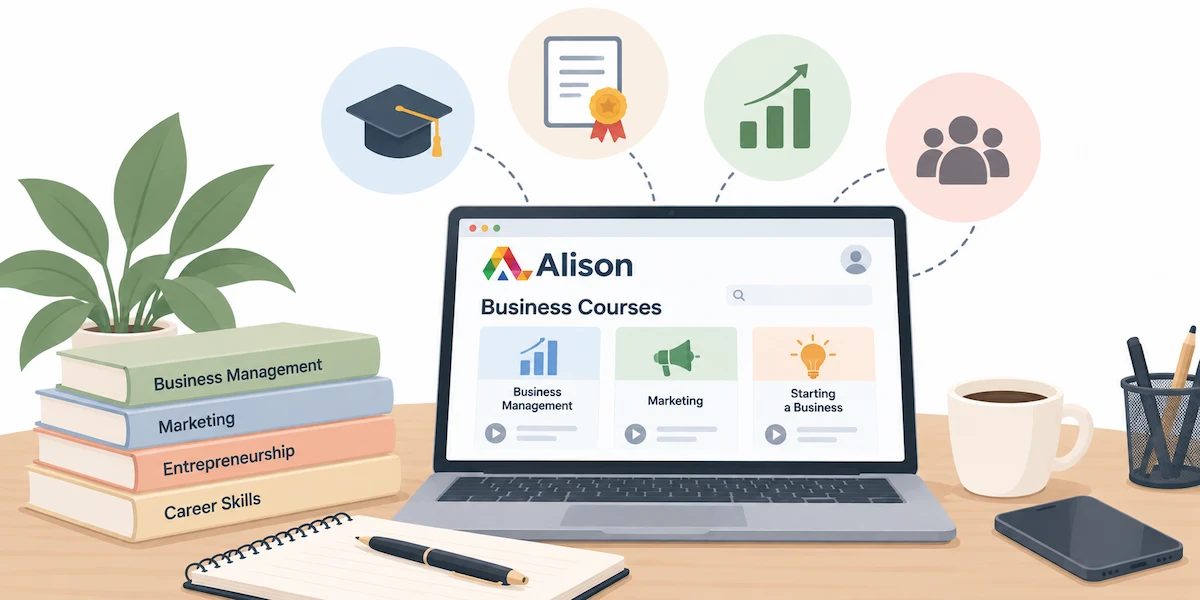
Alison offers free business courses with a wide range of topics, such as business management, marketing and starting a business. The courses are free to take, and a certificate is available for a fee. It fits learners who want to study at home with no upfront cost.
| Detail | Estimate |
|---|---|
| Best for | Learners on a tight budget |
| Cost | Free courses, paid certificate |
| Level | Beginner to intermediate |
| Topics | Business management, marketing, accounting |
Pros
- Large catalog at no cost
- Covers core business subjects
- Study at your own pace
Cons
- Not focused on online selling
- Certificate is not free
Udemy Ecommerce and Business Courses
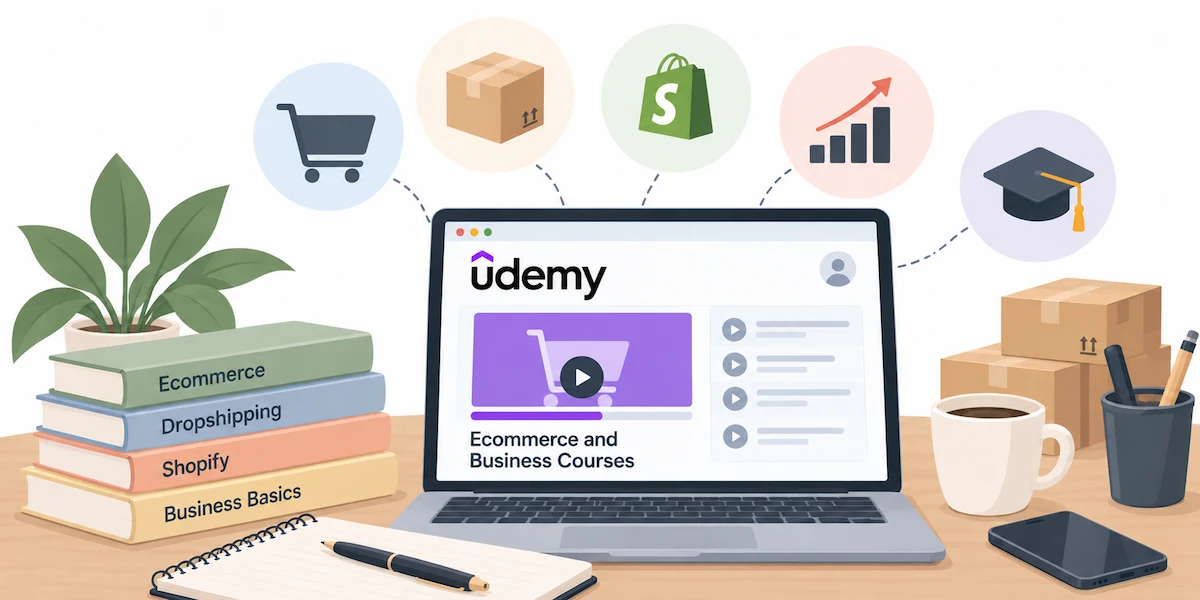
Udemy is a marketplace where teachers sell self-paced courses on ecommerce, dropshipping, Shopify and business basics. You pay per course, and prices are often lower during sales. It is a good choice when you want a deeper course on one model.
| Detail | Estimate |
|---|---|
| Best for | Learners who want one topic in detail |
| Cost | Paid per course |
| Level | Beginner to advanced |
| Topics | Dropshipping, Shopify, marketing |
Pros
- Affordable and self-paced
- Huge choice of topics
- Reviews help you compare courses
Cons
- Quality varies from course to course
- Read the reviews before you buy
How To Choose the Right Online Business Course
A good course matches your goal, your level and your time. Use these checks before you pay or sign up.
Set Your Goal and Check Your Level
Decide what you want: a first store, a new job, or a better understanding of marketing. A complete beginner needs an introduction course, while someone who already sells can go straight to SEO, ads or analytics. Pick a course that covers one topic well instead of ten topics lightly.
Compare Time and Budget
Look at how many hours a week the course asks for and when you can finish. A free course with a clear plan beats an expensive one that you never complete. Check if the price includes a certificate, tools or feedback.
Check the Teacher, Reviews and Credentials
Look for experienced instructors, student reviews and clear learning outcomes. If you need proof for a job, check whether the provider is known and whether the certificate is recognized. For platform skills, such as a Shopify store, check that the course uses the same tools you plan to use.
Where To Find Business Courses
You can find courses on learning platforms such as Coursera, edX and Udemy, on company academies such as HubSpot Academy and Shopify Academy, and on free sites such as Alison. Many universities also publish online certificates.
Online or In Person?
Most beginners choose online courses because they cost less and fit around a job. In-person classes can still help if you like live teaching and want to meet people nearby. Check your local university, community college or chamber of commerce for options.
Free vs Paid Online Business Courses
Free and paid courses both have a place. Free online business courses are the best start because they cost nothing and show you what you like. Paid courses add structure, feedback and a certificate. If you want to learn the basics on a small budget, begin free and pay only when you know what you need.
Pros and Cons of Free Courses
Pros
- No cost, so no risk
- Easy to compare several providers
- Good for learning the language of business
Cons
- Fewer live tutors or feedback
- Certificates often cost extra
- Easy to quit without a deadline
When a Paid Certificate Is Worth It
A paid certificate proves your business skills and helps if you want a job in marketing or ecommerce, work with clients, or need a deadline to stay on track. It does not replace a real project, so pair the certificate with a practice store or a freelance gig.
Do You Need a Degree To Learn Business?
No. A degree helps if you want a corporate job or a specialized career, but most online owners learn from courses, books and projects. Earning an MBA gives you a strong network and wide skills, though it is a big commitment in time and money. According to HBS Online, a full-time MBA usually takes one to two years and costs about $66,300 on average. A short online course costs a fraction of that, so you can test your interest before you decide.
Should You Learn AI Tools for Business?
AI tools can write product descriptions, suggest keywords, draft emails and summarize customer reviews. They save time, but they do not replace business skills. You still need to know your target market, your numbers and your offer. Try one tool at a time on your practice project, and check every result before you publish it.
Tools To Practice What You Learn
Courses help most when you apply them right away. These five tools let you build a store, a site, a funnel and a brand without code. If you want to test an AI idea, see how to start an AI business with no money.
Some links on this page are affiliate links, so the site may earn a commission at no extra cost to you. We follow the FTC guidance on disclosing affiliate links. Prices are US prices at the time of writing and can change, so check each site before you buy.
- Shopify: a practice store, from $29 a month on yearly billing
- Hostinger: a blog or site, from $2.99 a month on a 48-month term
- Systeme.io: email list, funnels and a course, free plan and paid plans from $17 a month
- Canva: logo and designs, free plan and Pro at $144 a year
- Namecheap: a domain name, a .com at about $11 for the first year
Shopify for a Practice Store
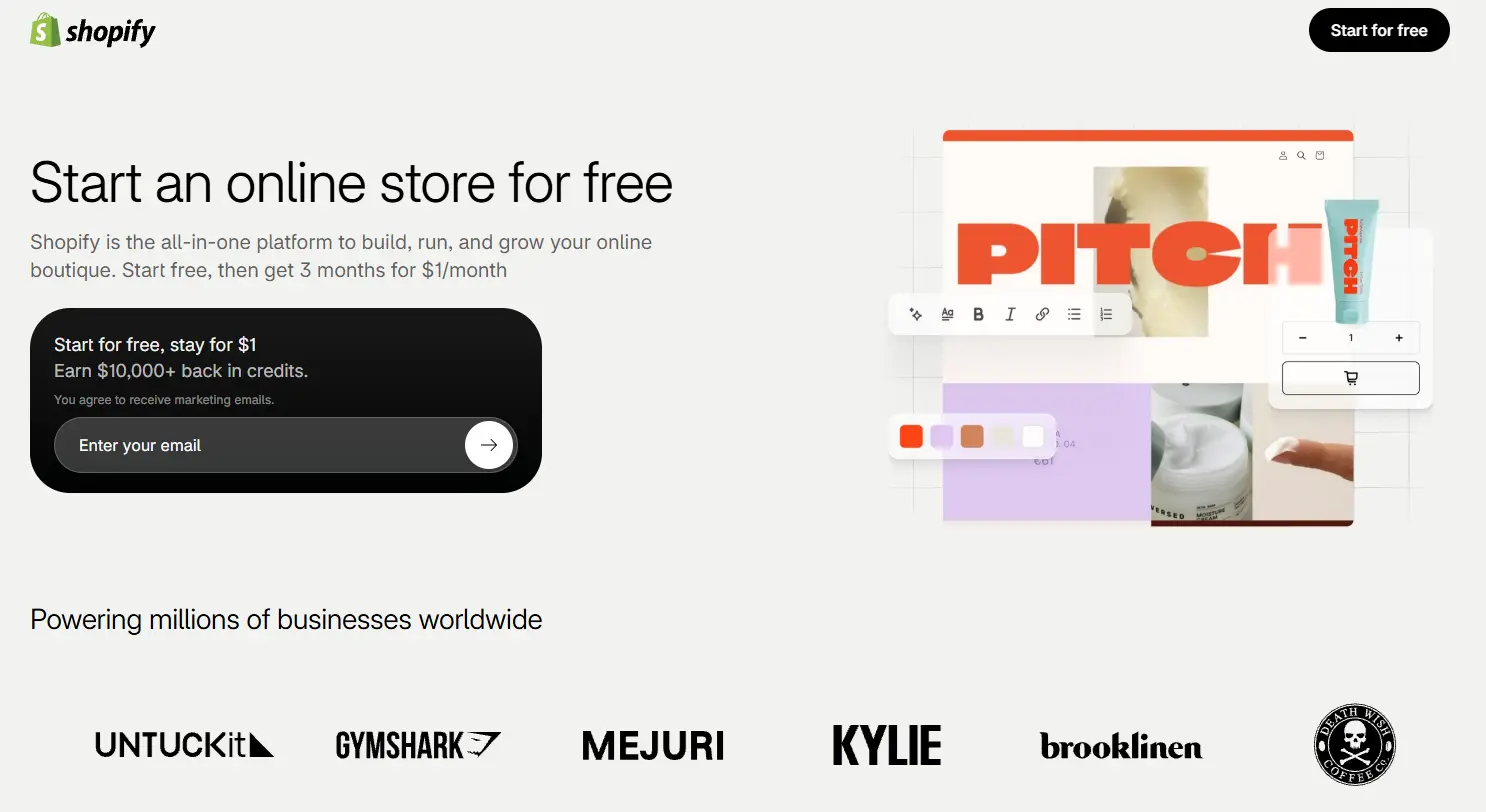
Shopify is a platform for building an online store, taking payments and managing orders. The Basic plan starts at $29 a month on yearly billing, and the trial is currently three days free, then $1 a month for three months. Card payments carry a fee of 2.9% plus 30 cents on Basic in the US. A practice store teaches product pages, checkout and orders in one place.
| Detail | Estimate |
|---|---|
| Best for | Online stores and print-on-demand |
| Starting price | From $29 a month on yearly billing |
| Trial | 3 days free, then $1 a month for 3 months |
| Card fee | 2.9% plus 30 cents on Basic in the US |
Pros
- Store, payments and orders in one place
- Large app library for print-on-demand
- Easy to set up without code
Cons
- Monthly fee starts before you sell
- Card fees and app fees add up
Hostinger for a Blog or Website
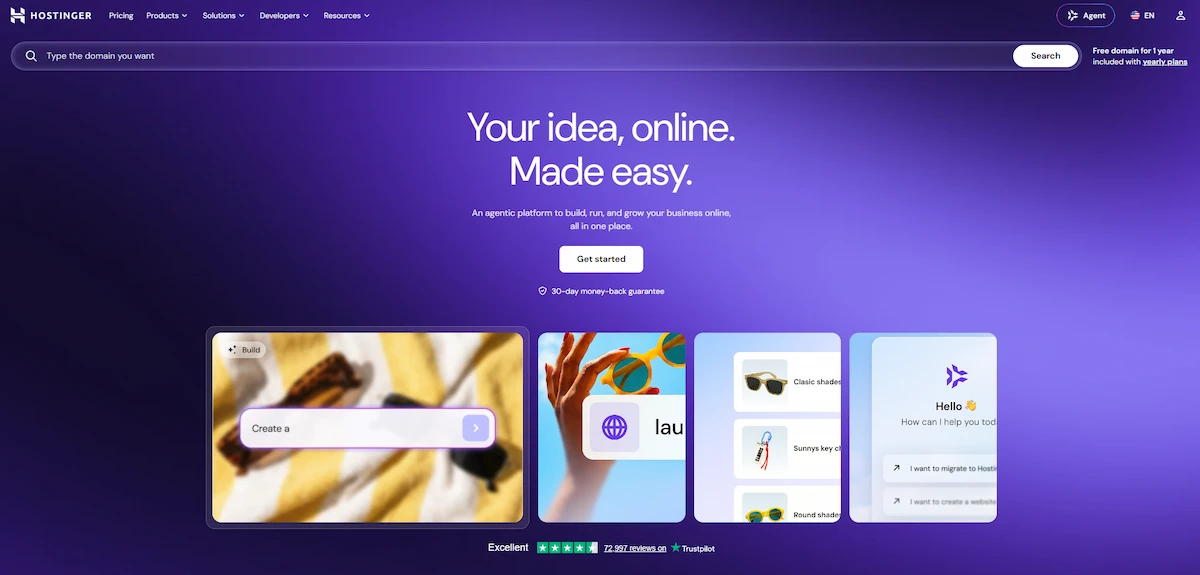
Hostinger sells web hosting and a website builder, and it supports WordPress. The Premium plan is listed from $2.99 a month on a 48-month term, with a higher renewal price, and it includes a free domain for the first year and free SSL. A niche blog is a cheap way to learn content, search engine optimization and affiliate marketing.
| Detail | Estimate |
|---|---|
| Best for | Blogs, review sites and landing pages |
| Starting price | From $2.99 a month on a 48-month term |
| Included | Free domain for the first year and free SSL |
| Watch out for | Higher renewal price |
Pros
- Very low entry price
- WordPress setup is simple
- Domain and SSL included
Cons
- Long term needed for the lowest price
- Renewal costs more than the first bill
Systeme.io for Email, Funnels and Courses
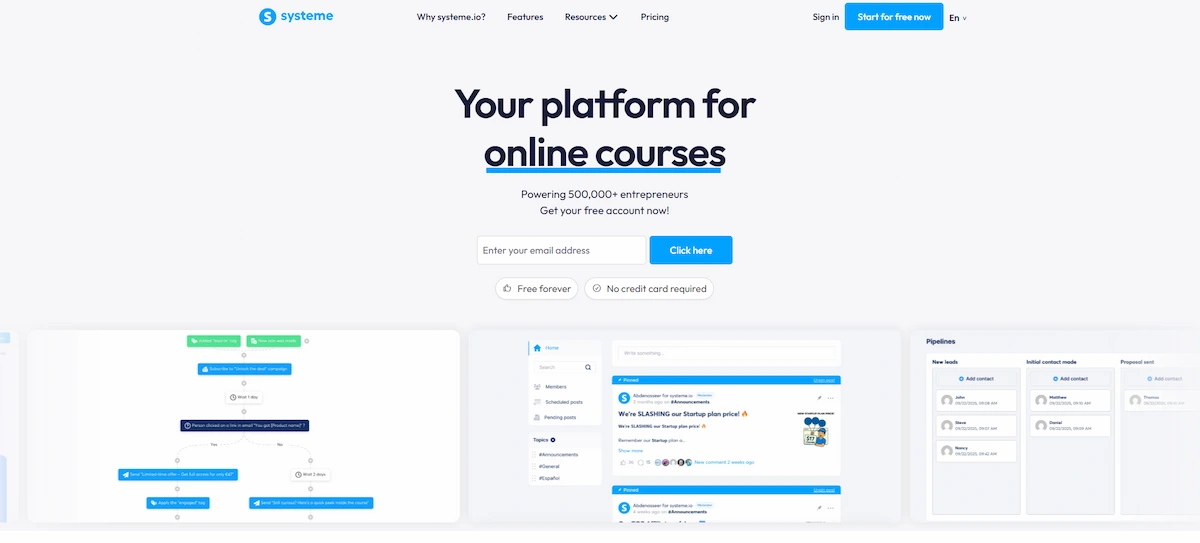
Systeme.io combines sales funnels, email marketing, online courses, a blog and an affiliate program in one account. The free plan includes 2,000 contacts, 3 funnels and 1 course, and paid plans start at $17 a month. It lets you practice email marketing and funnel building without paying for separate tools.
| Detail | Estimate |
|---|---|
| Best for | Email list, funnels and courses |
| Starting price | Paid plans from $17 a month |
| Free plan | 2,000 contacts, 3 funnels, 1 course |
| Watch out for | Fewer design options than some builders |
Pros
- Funnels, email and courses in one account
- Free plan is enough to start
- Built-in affiliate program
Cons
- Templates look plain
- Learning curve for new users
Canva for Logos and Digital Products
Canva is a design tool with templates for logos, social posts, presentations and printable products. The free plan covers basic work, and Pro costs $144 a year in the US with a bigger template library and more brand kits. It helps you practice branding and create digital products to sell.
| Detail | Estimate |
|---|---|
| Best for | Logos, social posts, printable products |
| Starting price | Pro at $144 a year |
| Free plan | Basic templates |
| Watch out for | Premium templates need Pro |
Pros
- Easy for people with no design skills
- Huge template library
- Brand kits keep posts consistent
Cons
- Many people use the same templates
- Best features sit behind Pro
Namecheap for a Domain Name
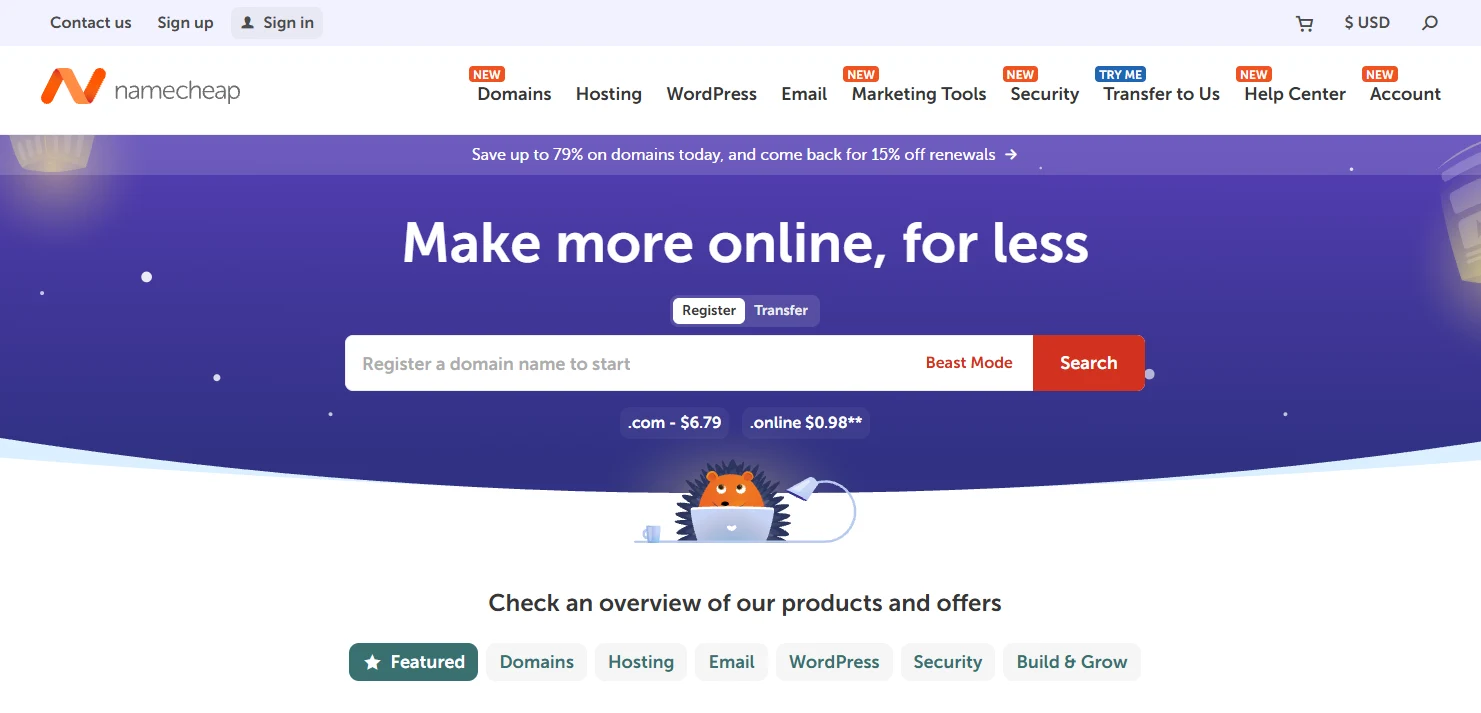
Namecheap is a domain registrar that also sells hosting, SSL and email. A .com is listed at about $11 for the first year, and the renewal price is higher, so check it before you register. Domain privacy is listed as free. Buying a domain for your practice project teaches you how names, hosting and email connect.
| Detail | Estimate |
|---|---|
| Best for | Domain names and simple hosting |
| Starting price | A .com at about $11 for the first year |
| Included | Free domain privacy |
| Watch out for | Higher renewal price |
Pros
- Low first-year prices
- Easy domain search and comparison
- Hosting, SSL and email available
Cons
- Renewal costs more
- Extras can raise the final bill
How Long Does It Take To Learn Online Business?
The time depends on your hours, your goal and your model. These are rough estimates for someone who studies a few hours a week, and they change by person and project.
| Stage | Rough time |
|---|---|
| Basics with a free course | 2 to 4 weeks |
| Digital marketing skills | 4 to 8 weeks |
| Practice project live | 4 to 8 weeks |
| First sale or first client | 2 to 6 months |
Most people can pick up the basics in a few months, but real skill grows with practice. A blog or a store needs months before traffic appears, so patience matters as much as the course you take.
How Much Does It Cost To Get Started?
You can start for free, and most beginners spend a few hundred dollars in the first year. Free courses cover the basics, and your main costs come from the practice project. Laws and fees differ by country, so check local rules first, for example in this guide to an online business in Ireland.
| Cost item | Typical range |
|---|---|
| Free online courses | $0 |
| Paid course or certificate | Price varies by course |
| Domain name (Namecheap) | About $11 for the first year |
| Web hosting (Hostinger) | From $2.99 a month |
| Online store platform | From $29 a month plus card fees |
| Email and funnel tool | Free to $17 a month |
| Design tool | Free to $144 a year |
Pick only the items your model needs. A blogger does not need a store platform, and a freelancer may need nothing more than a free portfolio page.
Common Mistakes Beginners Make
Most beginners slow themselves down in the same few ways. Watch for these five:
- Taking too many courses. Finish one, then apply it before you start another.
- Skipping the practice project. Theory alone does not teach you how a store or a blog really works.
- Trying every model at once. Stay with one business model until you see results, and compare a few remote business ideas before you choose.
- Ignoring digital marketing. A site without traffic earns nothing.
- Trying to study alone. Ask owners, join communities and read reviews.
Conclusion
Now you know how to learn online business without a degree: pick one model, take a free course, read a few books, build a practice project, learn digital marketing, talk to owners and track your numbers. You can start today with a free course and a domain from Namecheap that costs about $11, then add a Hostinger blog when you are ready.
Do not wait until you feel ready. The fastest way to learn business is to build something small and improve it each week.
Frequently Asked Questions
How to learn online business with no money?
Start with free courses from Google, HubSpot Academy and Alison. Read library books, follow business podcasts and build a practice project on a free plan, such as the Systeme.io free plan or a free Canva account. You only pay when you need a domain or a paid plan.
Can you learn business without a degree?
Yes. You can learn business from books, online courses, podcasts, experience and your own projects. A degree helps for some careers, but most online owners learn by doing. Use courses for the basics and a real project for practice.
How long does it take to learn online business?
Most beginners learn the basics in two to four weeks of study and need a few months before the first sale or client. The time depends on your hours per week, your model and how fast you build a practice project.
How much do online courses cost?
Many courses are free, including HubSpot Academy and Alison. Paid options such as Skillshare, Udemy and a full certificate cost money, and prices vary by provider. Start with a free course and pay only when you need more structure.
Are free online courses worth it?
Yes, for the basics. Free courses teach the language of business, marketing and ecommerce at no risk. They have fewer tutors and feedback than paid courses, so pair them with a practice project to build real skill.
Can I study business for free?
Yes. Alison, Google and HubSpot Academy offer free courses, and you can add free books, podcasts and communities. A certificate may cost extra, but the learning itself can stay free.
Can I earn a certificate from a business course?
Yes. Google, Alison and many other providers offer certificates, often for a fee. A certificate helps with jobs and clients, but a real project shows your skills better.
How do I choose the right online course?
Check your goal, level, budget and time. Choose a free beginner course first, read reviews, and look at the topics covered. If you plan to sell on a platform, pick a course from that platform.
Is it hard to learn how to run an online store?
Not inherently. The basics are simple and free to study, but the work covers marketing, design, finance and customer care. The hard part is applying these skills together to earn money, and that takes practice and patience.
Are courses necessary to start a business online?
No. Many owners start with a free course, a few videos and a small test project. Courses save time because they show the basics in order, but you can also learn from books, communities and your own mistakes.
What topics do business courses cover?
Common topics include digital marketing, ecommerce basics, accounting, management, SEO, email marketing and social media. Platform courses add store setup, listings and payments. Check the course outline before you enroll.
Do certificates help you get a job?
They can help with entry-level jobs in marketing or ecommerce, because they show effort and basic knowledge. Employers also look at real projects, so add a practice store or a portfolio to your resume.
Can I run an online business part-time?
Yes. Many people start with a few hours a week, using freelance services, digital products or a niche blog. A part-time schedule means slower growth, but it lowers risk while you keep your income.
What are the types of ecommerce?
The common types are business to consumer, business to business, consumer to consumer and direct to consumer. Beginners usually start with business to consumer or direct to consumer, because the buyer is an individual shopper.