Annual recurring revenue (ARR) is the predictable subscription revenue a company expects to earn over twelve months from its active customers. If you are asking what is ARR, the short answer is monthly recurring revenue times 12, with one-time fees left out.
ARR is the number that investors, founders and finance teams use first when they look at a subscription business. It shows how big the recurring base is, how fast it grows and how much of it survives renewals.
This guide explains what ARR means, how to calculate it with one example from start to finish, how it differs from MRR and run rate, what counts as a good ARR in 2026, which mistakes make the number look better than it is and what the same three letters mean in other fields.
What is ARR?
ARR definition: what does ARR stand for?
ARR stands for annual recurring revenue. It is the yearly value of all active subscriptions and contracts that renew on a regular basis, shown on a 12-month basis no matter how often customers are billed.
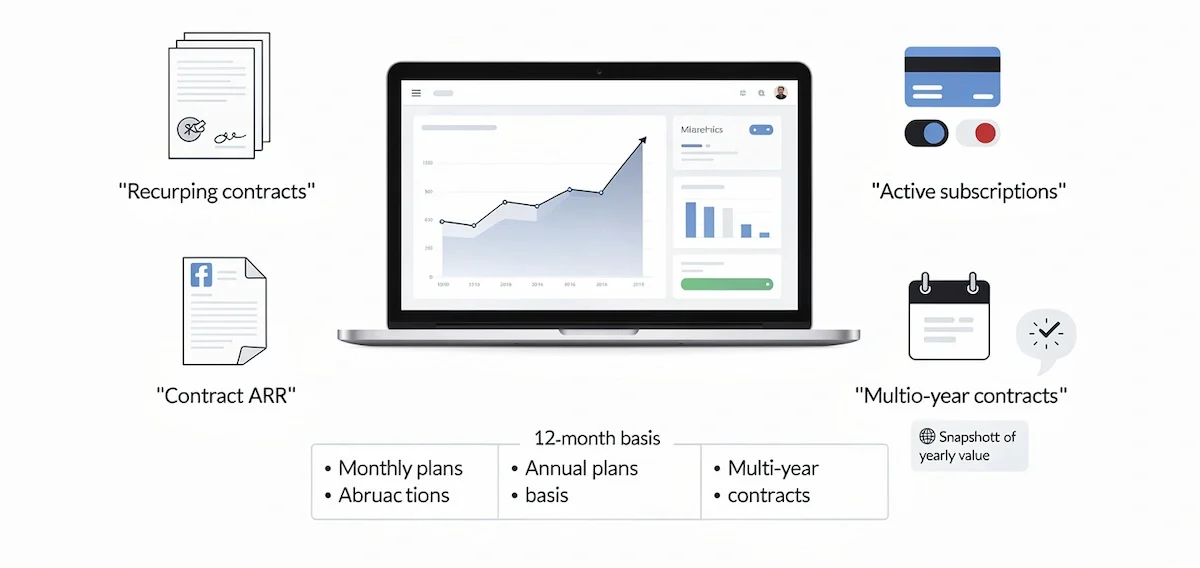
Think of it as a snapshot. On any given day you add up what your current customers will pay over the next year if nobody joins, leaves or changes plan. Monthly plans, annual plans and multi-year contracts can all be reported as ARR, because each one is converted to a yearly amount.
ARR is not a line on the income statement. It is a management and investor metric, so there is no legal definition, and every company has to say what it includes. That is why two firms with the same ARR on paper can be counting different things.
What counts as ARR
The test is simple: does the money repeat on a contract or a subscription? If yes, it belongs in ARR. If it is a one-off, it stays out.
- Included: subscription fees, recurring add-ons such as extra seats or premium features, license fees and committed maintenance contracts.
- Excluded: setup and onboarding fees, professional services, training, hardware and any other one-time charge.
Usage-based revenue sits in a gray area, and a later section covers how to treat it. The rule that holds everywhere is to write down your definition and keep it the same from month to month.
Who should use ARR?
Annual recurring revenue fits any business that sells access over time: SaaS, apps, memberships, software licenses and maintenance contracts. It works best when contracts last a year or longer, because then the number reflects revenue you can plan around.
Founders who are still choosing a model can start from our guide on how to start a SaaS business in Dubai, since a software company starts tracking ARR from its first paying customer. A company that sells one-time projects or goods has no recurring base, so it should use run rate or total revenue instead.
Small businesses can use ARR as well. A gym with yearly memberships, a newsletter with paid subscribers or an agency with fixed monthly retainers all have recurring revenue, and each of them can annualize it.
How to calculate ARR
The math is easy, and the hard part is deciding what goes into it. The steps below follow one example company from the basic formula to a full year of changes, so every number connects to the next.
The basic ARR formula
If customers pay monthly, take the monthly recurring revenue (MRR) and multiply it by 12.
ARR = MRR x 12
Our example company has an MRR of $50,000. That gives an ARR of $50,000 x 12 = $600,000. This is the quick version, and it is the one most guides and glossaries start with.
ARR from annual and multi-year contracts
If customers sign annual plans, you can also multiply the number of customers by the yearly price.
ARR = number of customers x annual price
Suppose the example company has 250 customers on a $2,400 yearly plan. The result is 250 x $2,400 = $600,000, the same as before. For a multi-year deal, divide the total contract value by the number of years. A three-year contract worth $90,000 adds $30,000 to ARR.
Plans with several tiers work the same way. Say four customers pay $2,500 a month on the top tier and six pay $400 on the entry tier. MRR is (4 x $2,500) + (6 x $400) = $12,400, so ARR is $12,400 x 12 = $148,800.
Billing frequency does not change the answer. A customer who pays three years upfront has the same ARR as one who pays monthly, because ARR measures the yearly value of the contract and not the cash you received.
The full ARR formula with churn and expansion
A snapshot is useful, but investors want to see what moved. The full ARR formula adds every change during the period.
ARR = New ARR + Renewal ARR + Expansion ARR – Churned ARR – Contraction ARR
- New ARR: yearly value of customers you signed during the period.
- Renewal ARR: customers who renewed at the same price, which keeps your base in place.
- Expansion ARR: extra revenue from upgrades, added seats and cross-sells.
- Churned ARR: yearly value of customers who cancelled.
- Contraction ARR: revenue lost when customers downgrade but stay.
Many teams also report net new ARR, which is new plus expansion minus churn and contraction. It shows how much the base actually grew.
A worked example from start to finish
Here is annual recurring revenue for the same company across one year, shown as a roll-forward from starting ARR to ending ARR.
| Detail | Estimate |
|---|---|
| Starting ARR | $600,000 |
| New customer ARR | + $180,000 |
| Expansion ARR | + $60,000 |
| Contraction ARR | – $24,000 |
| Churned ARR | – $36,000 |
| Ending ARR | $780,000 |
| Onboarding fees (not counted in ARR) | $15,000 |
Ending ARR is $600,000 + $180,000 + $60,000 – $24,000 – $36,000 = $780,000. The $15,000 in onboarding fees is real money, but it does not repeat, so it stays out.
From these numbers you can read two growth signals. ARR grew by $180,000, which is 30% year over year. Net revenue retention (NRR) is the starting ARR plus expansion, minus contraction and churn, divided by the starting ARR: ($600,000 + $60,000 – $24,000 – $36,000) / $600,000 = 100%. The company replaced exactly what it lost from existing customers and grew through new sales.
Discounts, free trials, price changes and currencies
Real contracts are messier than the formula. There is no official rule, so pick a practice, write it down and apply it every month.
- Discounts: count the price the customer actually pays, not the list price.
- Free trials: add the customer to ARR when the first paid period starts, not when the trial begins.
- Price increases: update ARR from the date the new price takes effect.
- Ramped deals: decide whether to count the current-year amount or the contracted run rate, and say which one you use.
- Currencies: convert at one fixed rate for the period, so exchange swings do not look like growth or churn.
These are common practices, not standards, so state them in any report that investors will read.
ARR vs MRR, run rate, revenue and other metrics
ARR has several cousins, and mixing them up is the fastest way to report a wrong number. The table gives the quick comparison, and the sections below explain each one.
| Metric | What it measures | Period | Best use |
|---|---|---|---|
| ARR | Recurring subscription revenue, annualized | Yearly | Forecasting, investor reporting, valuation |
| MRR | Recurring subscription revenue | Monthly | Short-term trends, churn, month-over-month growth |
| Annual run rate | Current revenue projected over a year, any source | Extrapolated | Rough estimate when history is short |
| Total revenue | Everything the company earned, recurring or not | Any | Accounting and tax |
| CARR | ARR plus signed contracts not yet live | Yearly | Pipeline view of future ARR |
| Bookings | Value of new contracts signed in a period | Period | Sales performance |
| LTV | Revenue one customer brings over their lifetime | Lifetime | Customer value and acquisition budget |
ARR vs MRR
Annual recurring revenue and MRR measure the same recurring income at different scales. MRR is the monthly view and ARR is the yearly view, so ARR = MRR x 12 when billing is monthly. MRR is better for spotting changes quickly, while ARR is better for long-term planning and for talking to investors. Most teams track both.
ARR vs annual run rate
Some sources use the three letters for annualized run rate instead of annual recurring revenue, and the two are not the same. Annual run rate takes a recent period, such as one month or one quarter, and projects it over a year. It includes any revenue source and ignores churn. ARR counts only recurring contracts. ChartMogul’s explanation of the two meanings is a good reference. A new restaurant that earns $3,000 a month can say it has a $36,000 run rate, but it has no ARR in the subscription sense.
ARR vs revenue
Revenue is what the accounting rules say you earned, recognized over the service period under ASC 606. It includes one-time items. ARR is a non-GAAP figure that shows the yearly value of recurring contracts at a point in time. A company can have high revenue and low ARR if most of its income is from projects.
Deferred revenue is a third idea. It is cash collected for service you have not delivered yet, and it sits on the balance sheet. A customer who prepays two years creates deferred revenue, but their ARR is still the yearly value of the plan.
ARR vs CARR, ACV and TCV
CARR (contracted ARR) adds signed deals that have not started yet. If you have $100,000 in live subscriptions and $50,000 in contracts that begin next quarter, ARR is $100,000 and CARR is $150,000. ACV (annual contract value) is the yearly value of a single contract. TCV (total contract value) is the value of the whole contract, including one-time fees. A three-year deal with $36,000 a year and a $9,000 onboarding fee has an ACV of $36,000 and a TCV of $117,000.
ARR vs profit, bookings and LTV
ARR measures recurring revenue before any costs, so a company can grow ARR fast and still lose money. Profit and cash flow need their own numbers. Bookings are the value of contracts signed in a period, while ARR is the part of that value that is live and recurring today. A big bookings quarter does not raise ARR until those contracts start.
Customer lifetime value (LTV) looks at one customer over time, while ARR covers the whole base in a year. Use ARR to size the business and LTV to decide how much you can spend to win each customer.
Why ARR matters
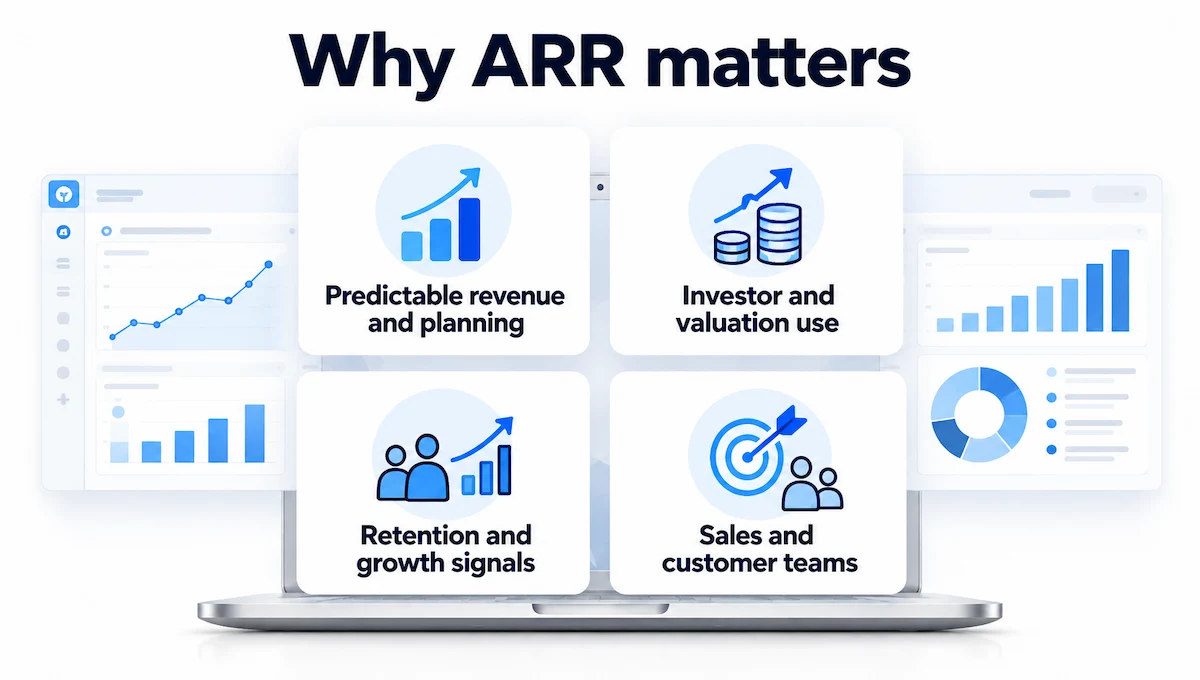
Predictable revenue and planning
A growing ARR gives a baseline you can budget against. If you know the yearly value of what customers have already committed, you can plan hiring, marketing and product spending with less guessing. Unlike one-time sales, which jump around from month to month, recurring revenue keeps coming as long as customers stay.
Investor and valuation use
Investors read ARR as a sign of how stable the business is and how far it can scale. It is the base for valuation multiples, and it often decides which funding stage a company fits. A strong ARR with healthy retention makes a company easier to fund or sell.
Retention and growth signals
ARR also shows how well you keep and grow customers. A rising number points to good retention and upsells, while a flat or falling number warns of churn, weak pricing or product problems. Teams use it to set sales targets and to check progress during the year.
Some investors look at ARR per employee as a productivity check. A 2023 OpenView report, cited by Stripe, put the bar at about $200,000 per employee for companies at scale, while a 2025 report has been quoted at more than $350,000 for upper-quartile late-stage firms. Check the report year before you compare yourself with either figure.
Why ARR matters to sales and customer teams
Sales teams use ARR to set targets and measure results. New ARR shows what reps closed, expansion ARR shows account growth, and churned ARR shows how much the customer team has to defend. Quotas, bonuses and forecasts are often built on these numbers, so the definition has to be clear enough that nobody argues about it at the end of the quarter.
What is a good ARR? Growth and valuation benchmarks for 2026
There is no single good number. It depends on your size, your growth and who you compare yourself with, and the sources below do not always agree, so treat each figure as a range.
How to calculate ARR growth rate
ARR growth rate = (current ARR – previous ARR) / previous ARR x 100
In the worked example, ($780,000 – $600,000) / $600,000 x 100 = 30%. Increasing growth year after year is usually read as a sign that the product fits the market.
ARR growth benchmarks by stage
Growth slows as a company gets bigger, so the same percentage means different things at different sizes. One 2026 benchmark page, using 2025 data, lists these median growth rates for private SaaS companies:
| ARR range | Median annual growth |
|---|---|
| Below $1M | About 100% |
| $1M to $5M | About 45% |
| $5M to $20M | About 27% |
| $20M to $50M | About 15% |
| $50M to $100M | About 10% |
| Above $100M | About 6% |
For bootstrapped companies with $3M to $20M in ARR, the 2026 SaaS Capital survey reports a median growth rate of 15% and a median NRR of 103%. Bootstrapped firms usually grow slower than venture-backed ones.
ARR multiples and valuation
An ARR multiple is the company value divided by ARR. It is the common shortcut for pricing a SaaS business. The multiple depends on growth, retention, margin and size.
Public software multiples fell sharply from about 7x ARR at the start of 2025. The SaaS Capital Index put the public median at 3.8x ARR on July 31, 2026, and L40 reported about 4.6x in late August 2026. One valuation guide still gave 6x to 7x for early 2026, so sources clearly differ. Private companies often trade around 4x to 5x ARR, and fast growers with strong retention can reach 7x to 10x.
Most of these figures come from brokers, advisors and software vendors, not from audited data. Use them to see the range, not to price a deal.
Brokers also list what pushes a multiple up. One list points to NRR above 110%, gross margin above 75%, annual churn below 5%, growth above 30% and a business that does not depend on its founder.
| Source and growth range | Typical ARR multiple |
|---|---|
| Fairview, 15% to 30% growth | 3.5x to 5.5x |
| Fairview, 50% to 80% growth | 7x to 10x |
| Breakwater ($1M to $5M ARR), 10% to 30% growth | 2.5x to 4x |
| Breakwater ($1M to $5M ARR), 30% to 60% growth | 4x to 6x |
The two sources disagree at similar growth levels, which is another reason to treat multiples as a range. One benchmark page also puts median private growth at about 25% to 26% and the top quartile at about 50%.
A quick shortcut quoted by Salesforce credits David Cummings with this rule: 10 x ARR x growth rate x NRR, with growth and NRR written as decimals. For the example company, 10 x $780,000 x 0.30 x 1.00 = $2,340,000, which is about 3x ARR. It is a crude estimate, so use it for orientation and not for pricing a deal.
Typical ARR by funding stage
As a rough guide, a seed company may have under $1M in ARR, a Series A company often sits between $1M and $5M, and a Series C company is commonly in the $20M to $75M range. These are patterns, not rules. One advisory page lists median multiples of 8x to 12x forward ARR at Series A and 5x to 9x at Series C.
ARR milestones: what $1M, $10M and $100M ARR mean
Founders talk about annual recurring revenue in round numbers. These milestones are common reference points, not rules, and the exact path differs for every company.
- $1M ARR: the product has paying customers and a sales process that repeats. Many companies reach their first institutional round between $1M and $5M in ARR.
- $10M ARR: teams become more specialized, processes start to matter and growth often slows from triple digits to double digits.
- $100M ARR: a large business where growth is usually modest, and the market looks at efficiency as closely as speed.
Time matters as much as the number. A company that reaches $1M in ARR in two years tells a different story than one that needs six, so read the milestone together with the growth benchmarks above.
How investors read ARR next to other metrics
ARR alone can look strong while the business leaks customers. Investors read it together with a few other numbers, and each one answers a different question.
- Net revenue retention (NRR): shows whether existing customers pay more or less over time. Above 100% means the base grows even without new sales.
- Gross revenue retention (GRR): counts only losses, with no credit for upsells. In the worked example it is ($600,000 – $24,000 – $36,000) / $600,000 = 90%.
- Gross margin: shows how much of each recurring dollar is left after the cost of delivering the service.
- CAC payback: shows how many months it takes to earn back the cost of winning a customer.
- Rule of 40: adds growth rate and profit margin, and a result above 40% is read as a healthy balance.
Put simply, ARR tells you how big the recurring base is, and these metrics tell you whether it is healthy and cheap to grow.
Churn rate and customer lifetime value
Two formulas help you read ARR in more detail. Revenue churn rate is churned ARR divided by starting ARR, so in the example $36,000 / $600,000 = 6%. Average revenue per account (ARPA) is ARR divided by the number of customers, so $600,000 / 250 = $2,400.
Customer lifetime value can then be estimated as ARPA x (1 / churn rate). With the example numbers, $2,400 x (1 / 0.06) = $40,000 per customer, before costs. Gross margin and the cost of winning customers decide whether that is a good number. You can also count churn by customers instead of dollars: cancellations divided by total subscribers, times 100.
How to increase ARR
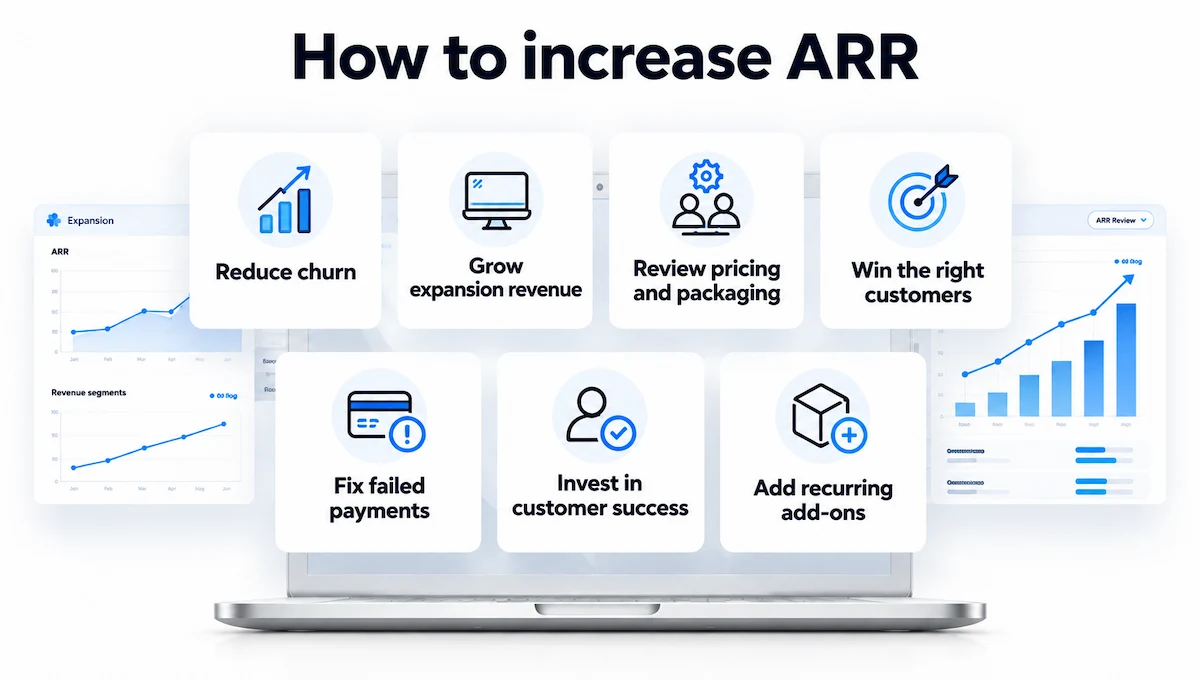
ARR only goes up when you add customers, grow what they pay or keep more of them. Seven levers cover almost everything.
Reduce churn
Losing a customer takes away their full yearly value, so fixing churn often adds more ARR than finding new leads. Look at why people cancel, improve onboarding and reach out to accounts that stop using the product.
Grow expansion revenue
Customers who already trust you are the easiest to sell to. Add tiers, extra seats or features that match how they use the product, and offer upgrades at the moment they hit a limit. Each one adds expansion ARR.
Review pricing and packaging
Pricing is rarely perfect on day one. Test what customers are willing to pay, add a higher tier for power users and look at annual plans, which lock in revenue and reduce churn.
Win the right customers
Not every sale is a good sale. Customers who fit your product well stay longer and expand more, so target the segments with the best retention instead of chasing volume.
Fix failed payments
Some churn is not a choice. Cards expire and payments fail. Retry failed charges, send reminders and let customers update their payment method easily. Billing tools handle most of this automatically.
Invest in customer success
Customers who see results stay. Good onboarding, training and regular check-ins make the product part of their routine, which lowers cancellations and raises upgrades. Track a few health signals, such as logins or feature use, and contact accounts that go quiet.
Add recurring add-ons
Extra seats, premium support, additional modules or usage packs can be sold as recurring items on top of the base plan. They raise average revenue per account without a new sales cycle. Keep the packaging simple so buyers can see what each add-on does.
Common ARR mistakes
Most errors in annual recurring revenue push the number up. Check this list before you share it with anyone.
- Counting one-time fees. Setup, onboarding and services are not recurring.
- Adding last year’s revenue. ARR looks forward, so it should not include revenue already earned.
- Counting signed deals that are not live. That number is CARR, not ARR.
- Mixing run rate and ARR. A busy month multiplied by 12 is not recurring revenue.
- Ignoring cancellations and downgrades. Subtract churned and contraction ARR, or the total overstates the base.
- Treating a multi-year deal as a yearly amount. Divide the contract by its length.
- Calling a usage spike recurring. One strong month of usage does not repeat by itself.
Limits of ARR
ARR is useful, but it does not tell the whole story. Know where it can mislead before you rely on it.
- It ignores costs. ARR can grow while the company loses money, so read it with margin and cash flow.
- It is not a standard accounting number. Every company defines it a little differently, which makes comparisons hard.
- It can hide churn. Strong new sales can cover up customers who leave. Check NRR and GRR.
- It is a snapshot. It reflects today’s contracts, not what will renew.
- It fits some models badly. Short contracts, project work and heavy usage pricing do not produce a stable yearly number.
When ARR does not fit, use MRR, run rate or total revenue, and say which one you are using.
How to calculate ARR in Excel or Google Sheets
A spreadsheet is enough for most small companies. Set up one row per customer with these columns:
- Customer name
- Plan and billing period (monthly or annual)
- Recurring amount per billing period
- Start date and end date
- Annual value, calculated with a formula
For a monthly plan, the ARR formula in the annual value column is the monthly amount times 12, for example =C2*12. For an annual plan, use the yearly price directly, and for a multi-year contract divide the contract value by the number of years. Then add up the annual value column with =SUM(F2:F200) to get total ARR.
Add a second sheet for the roll-forward: starting ARR, new, expansion, contraction, churn and ending ARR, as in the worked example above. If you are stuck on a formula, a chatbot can explain it, and you can compare options in our list of AI tools alternative to Claude. Always check the result against a few customers by hand.
ARR for non-SaaS and usage-based businesses
The method is not limited to software. Any company with contracts that repeat can annualize them. Memberships, maintenance agreements, managed services and subscription boxes all produce recurring revenue. Mobile app makers who charge a monthly fee can use it as well.
Usage-based pricing is harder. Revenue that moves with consumption is not guaranteed, so many teams count only the committed minimum as ARR and report the variable part separately. Some use an average of recent months, but then they should say so. AI products are a common example, since many charge by usage, and our guide on how to start an AI business with no money covers pricing choices at the early stage.
Whatever method you choose, write it down. Investors care less about the exact rule than about whether it stays the same over time.
Other meanings of ARR
The three letters stand for more than one thing. If you searched what is ARR and saw mixed results, this is why.
Accounting rate of return
In finance classes and capital budgeting, ARR means accounting rate of return. It is the average yearly accounting profit from an investment divided by the investment, shown as a percentage.
ARR = average annual accounting profit / initial investment x 100
For example, a machine costs $25,000 and produces an average profit of $7,000 a year after depreciation. The accounting rate of return is $7,000 / $25,000 x 100 = 28%. A company compares the result with its required rate of return and accepts the project if it is higher. The main weakness is that it ignores the time value of money, which is why finance teams also use NPV and IRR.
The method has clear strengths and weaknesses:
- Pros: easy to calculate, uses accounting data you already have and gives a quick percentage for comparing projects.
- Cons: ignores the time value of money, depends on depreciation choices and can mislead when projects differ in size.
Because of this, finance teams often use it as a first screen, then check the shortlisted projects with NPV and IRR.
Annualized run rate
As covered earlier, some writers use ARR for annualized run rate, which projects a recent period over a full year. If you see the term, check which meaning the author uses. Other uses, such as absolute risk reduction in medicine or airport codes, have nothing to do with business.
Tools to track ARR
Whoever owns the numbers should also own the definition. In small companies that is often the founder, and in growing ones it can be an operations lead, which is close to the work described in our guide to the online business manager role.
You can start in a spreadsheet and move to a tool when the number of customers grows. Tools for annual recurring revenue fall into four groups:
- Spreadsheets: Excel or Google Sheets, with the template above.
- Billing platforms: Stripe Billing, Chargebee, Paddle and Zuora, which store subscriptions and report MRR and ARR from live data.
- Subscription analytics: ChartMogul and Drivetrain, which connect to billing data and show churn, expansion and cohorts.
- CRM and finance systems: Salesforce has no standard ARR field, so teams build it from contract records. NetSuite can report ARR next to revenue recognition.
Final thoughts on ARR
Annual recurring revenue (ARR) turns subscriptions into one yearly number that you can plan with, compare and explain. Knowing how to calculate ARR is the easy part, and the harder part is keeping the rule stable. Count only recurring revenue, keep your rule stable, and read growth together with churn and retention. So when someone asks what is ARR in a board meeting, you can answer with a number and a definition. If you are still at the idea stage and want low-cost ways to test a recurring offer, start with our notes on online business without investment.
Frequently asked questions about ARR
What does ARR stand for?
ARR stands for annual recurring revenue. It is the yearly value of the subscriptions and contracts a company expects to keep earning from active customers.
What is the simplest way to calculate ARR?
Multiply monthly recurring revenue by 12. If your MRR is $50,000, your ARR is $600,000. This works when customers pay monthly and you only count recurring charges.
What is the difference between ARR and MRR?
MRR is recurring revenue per month and ARR is recurring revenue per year. ARR equals MRR x 12 for monthly plans. MRR suits short-term tracking, ARR suits planning and investors.
What is the difference between ARR and revenue?
Revenue is everything a company earns and is recognized under accounting rules. ARR counts only recurring subscription revenue, annualized, and leaves out one-time items.
Does ARR include one-time fees?
No. Setup fees, onboarding charges and professional services are one-off and stay outside ARR. They still count as revenue and as part of total contract value.
Is ARR the same as CARR or contracted revenue?
No. ARR covers live subscriptions. CARR also adds signed contracts that have not started yet, so it is usually higher.
Does ARR include deferred revenue?
No. Deferred revenue is cash received for service not yet delivered. ARR reflects the yearly value of the contract, so prepaying does not change it.
What is the difference between annual run rate and ARR?
Annual run rate projects a recent period over a year and can include any revenue. ARR counts only recurring contracts. Some sources use the same letters for both, so check the definition.
Is ARR calculated from gross or net revenue?
Most definitions use gross contract value, then subtract cancellations and downgrades. The point is to count recurring charges, not taxes or fees outside the contract.
What is a good ARR growth rate?
It depends on size. One 2026 benchmark lists medians of about 100% below $1M, 27% at $5M to $20M and 6% above $100M. Bootstrapped firms often grow about 15% a year.
How is ARR used in valuation?
Investors multiply ARR by a multiple that reflects growth, retention and margin. Public software medians were around 3.8x to 4.6x in mid-2026, and private companies often trade near 4x to 5x.
What is ARR in accounting?
In accounting and capital budgeting, ARR means accounting rate of return: average annual accounting profit divided by the investment, shown as a percentage. It is a different metric from annual recurring revenue.